El jardinero
Vincent van Gogh · 1889
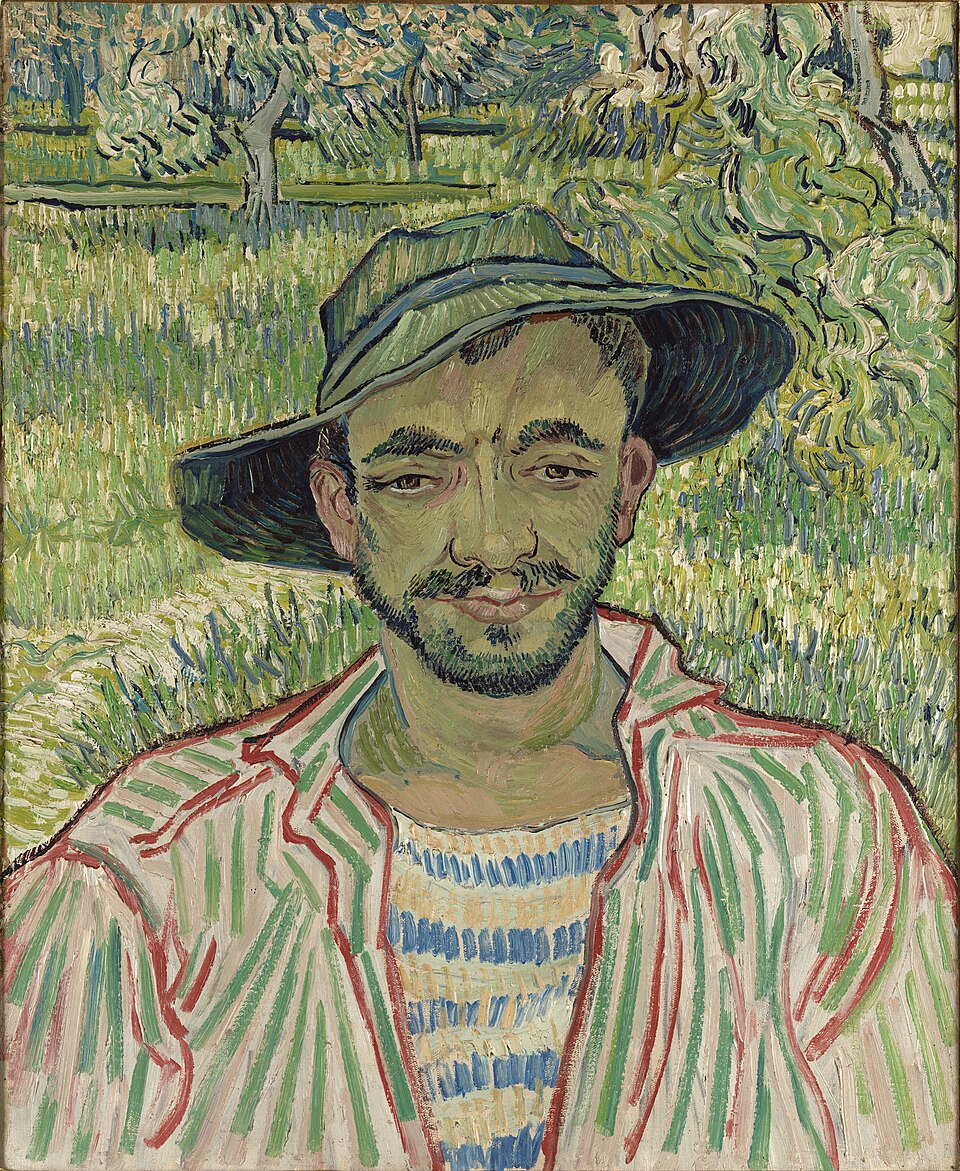
A young man with a straw hat stands among bright greens and blues, his gaze steady. Van Gogh painted him at the asylum of Saint-Rémy and never mentioned him in a single letter. Later the picture was hidden under straw to escape the war.
The story behind the painting
Van Gogh painted this canvas in September 1889 while staying at the Saint-Paul-de-Mausole hospital in Saint-Rémy, where he was a patient from April 1889 to May 1890. Unusually, he never mentioned it in any of his letters, so it has no title of his own. It was once placed in his Arles period, then in Saint-Rémy, until Jan Hulsker's studies fixed it in September 1889. Early that month, after a serious breakdown and a time of inactivity, Van Gogh returned to work and wrote to Theo that his desire to make portraits was terribly strong.
What to look for
The picture is known by many names: The Gardener, Portrait of a Young Peasant, Provençal Peasant, or Peasant's Head, as it was called in Florence in 1910. The background looks more like a garden than a cultivated field, which may explain the name The Gardener. Another hypothesis is that the sitter was the gardener of the hospital itself. The canvas, about 61 by 50 cm, gathers key themes of his painting: the portrait, the bond with nature, and the play of primary and complementary colours.
Meaning and intent
It is considered the most important Van Gogh in an Italian public collection and a masterpiece of his Provençal period. Its first Italian owner, the Florentine painter and collector Gustavo Sforni, bought it in Paris in 1910 and showed it at the first Italian Impressionist exhibition in Florence that year. The critic Ardengo Soffici disliked it, seeing a twisted will struggling with matter rather than Cézanne's lessons. Fearing more criticism, Sforni kept it at home and showed it only to friends.
Legacy
After Sforni died in 1940, his uncle, the lawyer Giovanni Verusio, inherited it. Late in the war he hid it in a wooden box under the straw of a lemon greenhouse to save it from looting. In 1966 Sandra Verusio carried it to Rome during the Florence flood. Thieves came five times but never took it. It was sold in 1977 through an intermediary acting, it later emerged, for Ernst Beyeler. When Beyeler planned to sell it abroad, the Italian State exercised its right of pre-emption in 1989. It now hangs in the National Gallery of Modern Art in Rome.
¿Sabías que…?
- Painted at Saint-Rémy in September 1889.
- Van Gogh never mentions it in his letters.
- Hidden under straw during the Second World War.
- Bought back by the Italian State in 1989.
Sobre el artista
Vincent van Gogh (1853-1890)
Más obras de Vincent van Gogh
 La noche estrellada - Vincent van Gogh (1889)
 Terraza de café por la noche - Vincent van Gogh (1888)
 Los girasoles - Vincent van Gogh (1888)
 Almendro en flor - Vincent van Gogh (1890)
 Campo de trigo con cuervos - Vincent van Gogh (1890)
 El dormitorio en Arlés - Vincent van Gogh (1888)
 Los comedores de patatas - Vincent van Gogh (1885)
 Lirios - Vincent van Gogh (1889)
Obras de artistas relacionados
 Las grandes bañistas - Paul Cézanne (1900s)
 The Boy in the Red Vest - Paul Cézanne
 ¿De dónde venimos? ¿Qué somos? ¿Adónde vamos? - Paul Gauguin (1897-1898)
 El Cristo amarillo - Paul Gauguin (1889)
 La elevación de la cruz - Peter Paul Rubens (1609)
 Rapto de las hijas de Leucipo - Peter Paul Rubens (1618)
 Paseo a orillas del mar - Joaquín Sorolla (1909)
 Triste herencia - Joaquín Sorolla (1898)
 Baile en el Moulin de la Galette - Pierre-Auguste Renoir (1876)
 El almuerzo de los remeros - Pierre-Auguste Renoir (1881)
 En el Moulin Rouge - Henri de Toulouse-Lautrec (1892)
 La toilette - Henri de Toulouse-Lautrec (1896)