Two Diggers among Trees
Vincent van Gogh · 1889
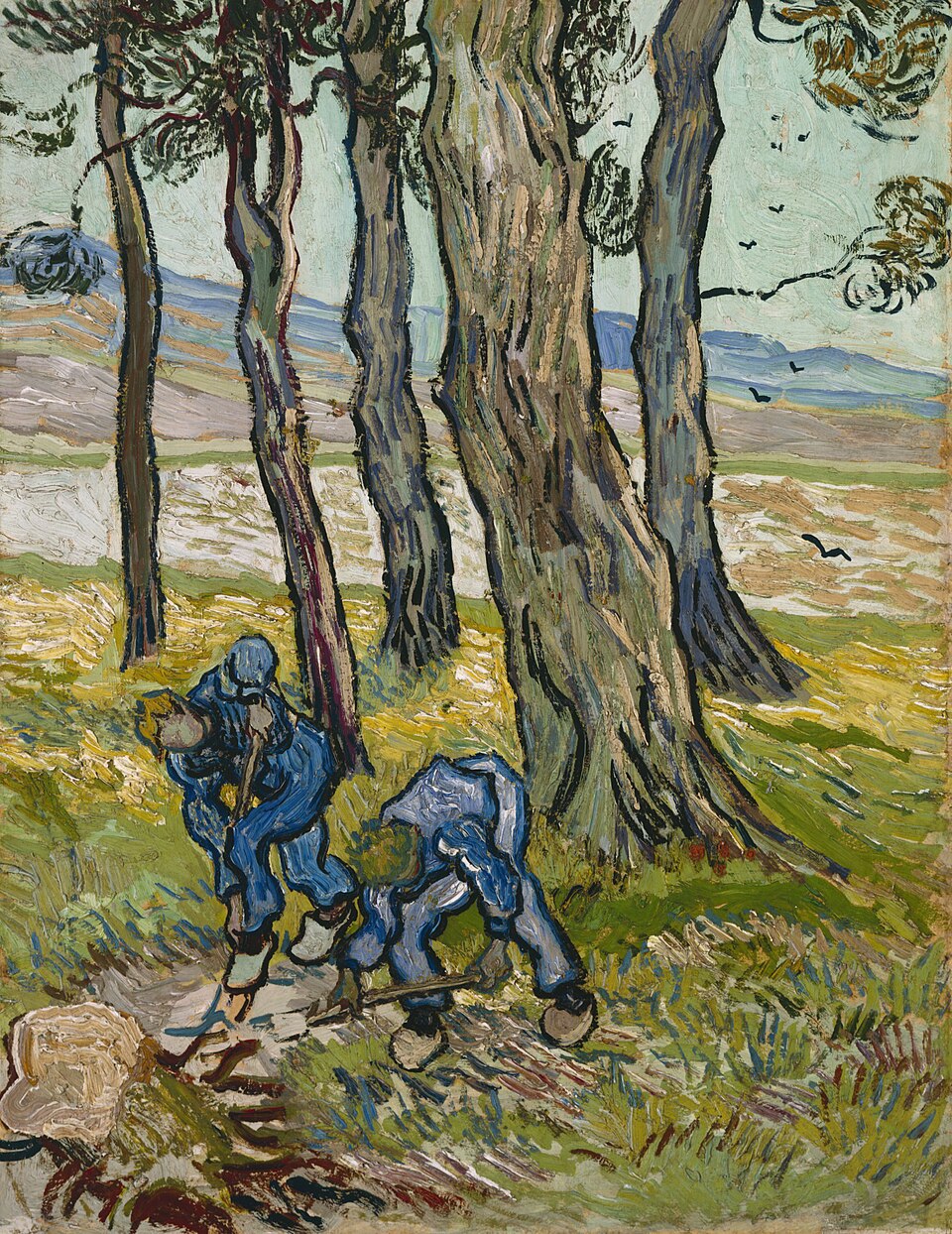
Two men dig out a tree stump among trees in Saint-Rémy, painted by Van Gogh in late 1889. Its quiet subject hides one of the most debated provenance stories of any painting in an American museum.
The story behind the painting
Van Gogh painted The Diggers, also called Two Diggers or Two Diggers among Trees, in late 1889 in Saint-Rémy-de-Provence, less than a year before his death. The longer title separates it from his other 1889 painting, The Diggers after Jean-François Millet. After Vincent died the canvas belonged to his sister-in-law, Johanna van Gogh-Bonger. It then passed through Galerie Bernheim-Jeune in Paris in 1907 and the Frankfurter Kunstverein in 1909, and in 1912 the Frankfurt collector Hugo Nathan and his wife Martha bought it.
What to look for
The scene is simple: two men digging up a tree stump among trees at Saint-Rémy. The canvas is about 65 by 50 cm. The source describes it as showing Van Gogh's relationship with nature and his admiration for Jean-François Millet, who painted similar scenes of people working the land. It is considered a work of high quality, though not among his most famous. Watch how the labour of the two figures and the trees around them share the same space.
Meaning and intent
Martha Nathan inherited the painting when Hugo died in 1922. She moved it to Basel in Switzerland in 1930, almost three years before the Nazis came to power, and left Germany for Paris in 1937. In 1938 she sold it to a group of dealers, Justin Thannhauser, Alex Ball and Georges Wildenstein, who sold it in 1941 to the Detroit collector Robert H. Tannahill. He left it, with more than 450 other works, to the Detroit Institute of Arts, which received it at his death in 1970.
Legacy
In 2004, fifteen of Martha Nathan's heirs said she had been forced to sell under Nazi persecution. The museum's researcher Laurie Stein found that the painting had been moved to Switzerland early and sold at a price normal for the time, and historians such as Jonathan Petropoulos and Sidney Bolkosky called the claim weak. A court ruled for the museum in 2007, and a later case was dismissed on time limits. The museum's use of that defence was criticised, and in 2016 Congress passed the HEAR Act to end such tactics.
¿Sabías que…?
- Painted in late 1889 at Saint-Rémy-de-Provence.
- Shows two men digging up a tree stump, in the spirit of Millet.
- Given to the Detroit Institute of Arts by Robert H. Tannahill.
- At the centre of a restitution dispute that ended in court in 2007.
Sobre el artista
Vincent van Gogh (1853-1890)
Más obras de Vincent van Gogh
 La noche estrellada - Vincent van Gogh (1889)
.jpg) Terraza de café por la noche - Vincent van Gogh (1888)
Terraza de café por la noche - Vincent van Gogh (1888) Los girasoles - Vincent van Gogh (1888)
 Almendro en flor - Vincent van Gogh (1890)
 Campo de trigo con cuervos - Vincent van Gogh (1890)
 El dormitorio en Arlés - Vincent van Gogh (1888)
 Los comedores de patatas - Vincent van Gogh (1885)
 Lirios - Vincent van Gogh (1889)
Obras de artistas relacionados
 Las grandes bañistas - Paul Cézanne (1900s)
 The Boy in the Red Vest - Paul Cézanne
 ¿De dónde venimos? ¿Qué somos? ¿Adónde vamos? - Paul Gauguin (1897-1898)
%201889.jpg) El Cristo amarillo - Paul Gauguin (1889)
El Cristo amarillo - Paul Gauguin (1889).jpg) La elevación de la cruz - Peter Paul Rubens (1609)
La elevación de la cruz - Peter Paul Rubens (1609) Rapto de las hijas de Leucipo - Peter Paul Rubens (1618)
 Paseo a orillas del mar - Joaquín Sorolla (1909)
 Triste herencia - Joaquín Sorolla (1898)
 Baile en el Moulin de la Galette - Pierre-Auguste Renoir (1876)
 El almuerzo de los remeros - Pierre-Auguste Renoir (1881)
 En el Moulin Rouge - Henri de Toulouse-Lautrec (1892)
%20Rousse%20(La%20Toilette)%20-%201889%20-%20Henri%20de%20Toulouse-Lautrec%20-%20Mus%C3%A9e%20d'Orsay%2C%20Paris.jpg) La toilette - Henri de Toulouse-Lautrec (1896)
La toilette - Henri de Toulouse-Lautrec (1896)