El aventador
Jean-François Millet · 1848
.jpg)
A peasant in clogs lifts his winnowing basket on a ragged knee, and the grain rises in a column of golden dust. Shown at the Salon of 1848, this was the painting with which Millet turned toward the daily life of country people.
The story behind the painting
Millet painted The Winnower in 1847 to 1848 and presented it in the Grand Salon of the Salon of 1848, alongside a history painting, The Captivity of the Jews in Babylon. That second work was the kind meant to attract buyers. The Winnower marked something new: Millet's entry into painting the daily life of peasants. With it he turned away from literary and artistic references toward pictures drawn directly from rural life, a path he would follow from 1849 when he settled in Barbizon. This first version, about 100.5 by 71 cm, is now in the National Gallery in London. Millet later made at least two other versions, now in the Louvre and the Musee d'Orsay.
What to look for
The winnower wears his working clothes and clogs. Using a winnowing basket, he tosses the grain into the air to separate it from the straw, and the dust rises around him. Theophile Gautier, reviewing the Salon, described the surface as rough, fierce and bristling, a thick mortar of paint, yet of a fine and warm tone when one steps back three paces. He admired how the man raises his basket on his ragged knee, lifting the grain into a column of golden dust, and arches his back in the most masterly way. Stand back a little, as Gautier advised, and let the heavy paint turn to light.
Meaning and intent
Like Millet's gleaners, shepherdesses and ploughmen, the winnower represents a type more than an individual person. Millet wanted above all to create what he called "syntheses". The appearance of such peasant subjects in his work may have been encouraged by the socialist climate around the Revolution of 1848, even though Millet took no part in it and refused to be called a socialist. Gautier added that the painting had everything needed to exasperate the beardless bourgeois, a remark that helps explain why Republicans took an interest in the picture. The figure is humble, but the painting gives his labour the weight of something essential.
Legacy
At the Salon of 1848 The Winnower stood out among some 5,000 works on show, and it was bought by Alexandre Ledru-Rollin, a minister of the Provisional Government. Its importance grew further because it inspired Gustave Courbet's The Stone Breakers of 1849, another painting of anonymous labour that became a landmark of realism. Wikipedia notes that The Stone Breakers was destroyed in the bombing of Dresden in 1945. Through the London picture, and the two later versions in Paris, Millet set out the subject that would define his career: the quiet dignity of people who work the land.
¿Sabías que…?
- Painted 1847 to 1848 and shown at the Salon of 1848.
- Marked Millet's turn to scenes of peasant life.
- Bought by Alexandre Ledru-Rollin of the Provisional Government.
- Inspired Courbet's The Stone Breakers.
varón · escena de género · National Gallery de Londres
Más obras de Jean-François Millet
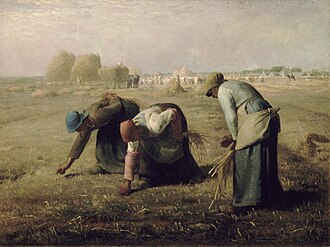 Las espigadoras - Jean-François Millet (1857)
.jpg) El Ángelus - Jean-François Millet (1858)
El Ángelus - Jean-François Millet (1858)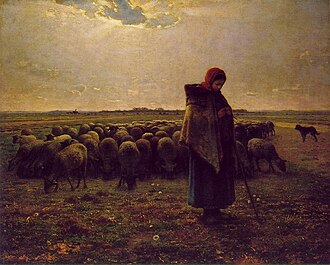 Una pastora con su rebaño - Jean-François Millet (1863)
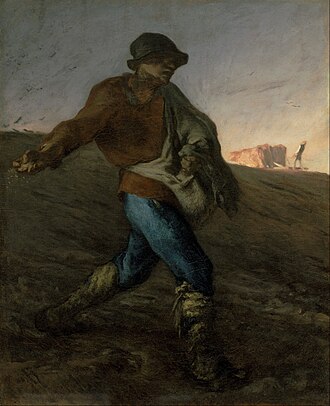 El sembrador - Jean-François Millet (1850)
.jpg) El hombre con la azada - Jean-François Millet (1860s)
El hombre con la azada - Jean-François Millet (1860s)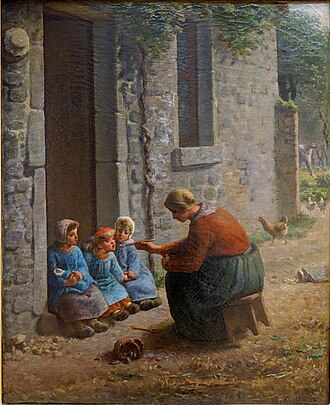 The Beaked - Jean-François Millet (1860)
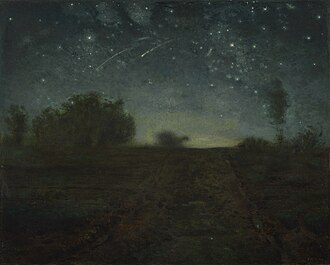 Noche estrellada - Jean-François Millet (1850s)
Obras de artistas relacionados
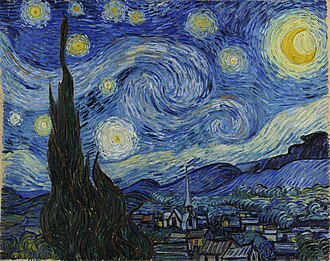 La noche estrellada - Vincent van Gogh (1889)
.jpg) Terraza de café por la noche - Vincent van Gogh (1888)
Terraza de café por la noche - Vincent van Gogh (1888)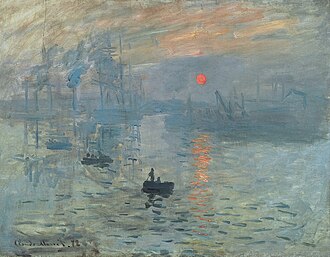 Impresión, sol naciente - Claude Monet (1872)
 Nenúfares - Claude Monet (1906)