The Seine with the Pont de Clichy
Vincent van Gogh · 1887
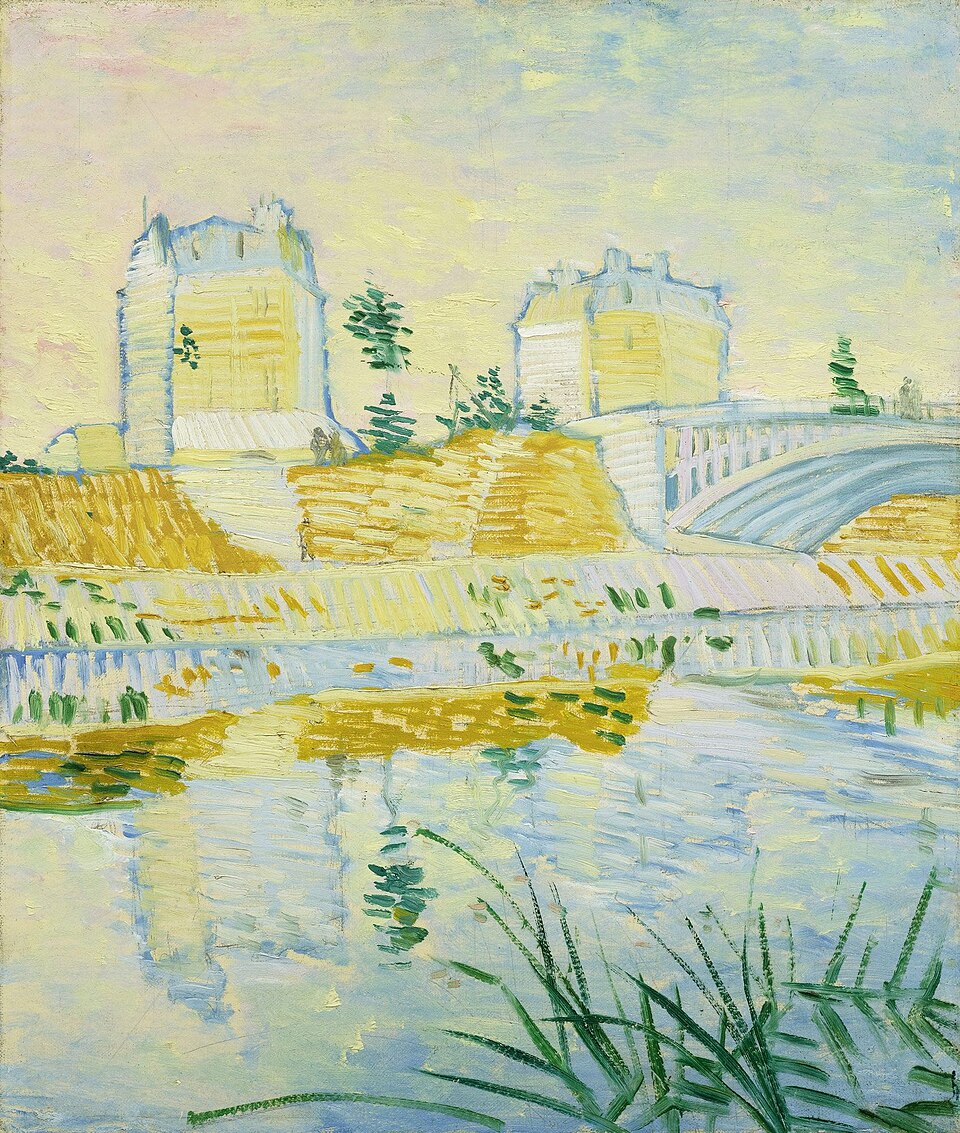
A lemon-yellow and azure sky, two houses mirrored in the moving water, and the cut-off arch of a steel bridge. Van Gogh painted this view near Asnieres in summer 1887, and a year later he still remembered it in a letter to his brother.
The story behind the painting
Van Gogh came to Paris in February 1886 and lived with his brother Theo, an art dealer. Through Theo he met Pissarro, Degas, Gauguin, Toulouse-Lautrec and Signac, and at the colour shop of Pere Tanguy he met the young painter Emile Bernard, who became a close friend. The two often went to paint around Asnieres, where Bernard's parents lived, and there, in summer 1887, this picture was made outdoors. Van Gogh wrote to his sister Wilhelmina that painting landscapes at Asnieres that summer, he saw more colour in them than before.
What to look for
Van Gogh stood close to the bank. The Seine is sketched in vertical blue strokes, the far bank is ochre, and at the right edge a cut-off arch of the bridge is painted in light blues, with two pedestrians suggested by grey dabs. Two tall houses have blue roofs and horizontal yellow strokes on their facades, and the whole far bank is reflected in the rippling water. Thin reeds in the foreground recall Japanese woodcuts he had just seen. With a perspective frame he drew pencil guide lines like a Union Jack, and some are still visible.
Meaning and intent
In March 1888 he described it to Theo as the Pont de Clichy with yellow sky and two houses reflected in the water. He called it an etude, a study, and did not sign it. The painting stands at the turning point between his Impressionist Paris phase and the expressive style he developed in Arles from early 1888. Unlike his late work, the paint is not thick: in the sky it lies in one or two layers, largely smoothed with a palette knife. He likely used a standard F 10 primed canvas, the kind usually used for sketches, with a cream ground.
Legacy
It belongs to a group of Seine bridge pictures from Paris. Banks of the Seine with the Pont de Clichy in Spring, in the Dallas Museum of Art, first shows this bridge, and Fishing in Spring, the Pont de Clichy, in the Art Institute of Chicago, moves still closer to the bank. A privately owned view of the same motif shows the scene from the other bank, under a grey sky. In Arles in 1888 he took up bridges again. The dimensions differ slightly between sources: 55 by 46.3 cm in German Wikipedia, 54.8 by 46.1 cm in Wikidata. The painting was on long-term loan to the Wallraf-Richartz-Museum in Cologne and is privately owned.
¿Sabías que…?
- Painted outdoors at Asnieres in summer 1887.
- Van Gogh called it a study and did not sign it.
- Pencil guide lines from a perspective frame are still visible.
- Privately owned; long on loan to Cologne's Wallraf-Richartz-Museum.
Sobre el artista
Vincent van Gogh (1853-1890)
Más obras de Vincent van Gogh
 La noche estrellada - Vincent van Gogh (1889)
.jpg) Terraza de café por la noche - Vincent van Gogh (1888)
Terraza de café por la noche - Vincent van Gogh (1888) Los girasoles - Vincent van Gogh (1888)
 Almendro en flor - Vincent van Gogh (1890)
 Campo de trigo con cuervos - Vincent van Gogh (1890)
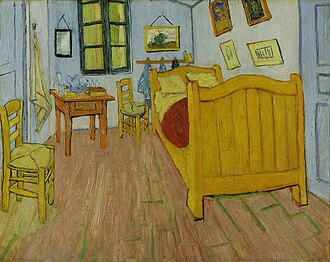 El dormitorio en Arlés - Vincent van Gogh (1888)
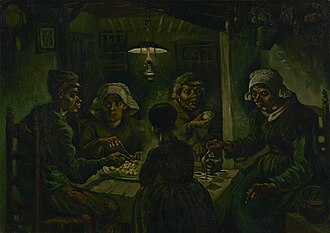 Los comedores de patatas - Vincent van Gogh (1885)
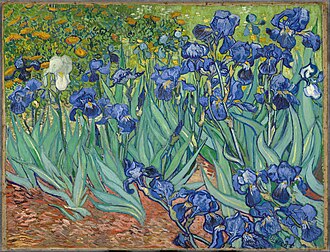 Lirios - Vincent van Gogh (1889)
Obras de artistas relacionados
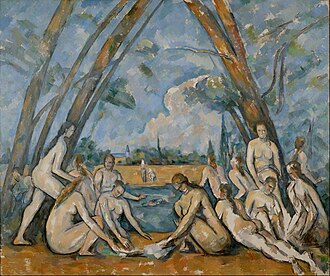 Las grandes bañistas - Paul Cézanne (1900s)
 The Boy in the Red Vest - Paul Cézanne
 ¿De dónde venimos? ¿Qué somos? ¿Adónde vamos? - Paul Gauguin (1897-1898)
%201889.jpg) El Cristo amarillo - Paul Gauguin (1889)
El Cristo amarillo - Paul Gauguin (1889).jpg) La elevación de la cruz - Peter Paul Rubens (1609)
La elevación de la cruz - Peter Paul Rubens (1609) Rapto de las hijas de Leucipo - Peter Paul Rubens (1618)
 Baile en el Moulin de la Galette - Pierre-Auguste Renoir (1876)
 El almuerzo de los remeros - Pierre-Auguste Renoir (1881)
 En el Moulin Rouge - Henri de Toulouse-Lautrec (1892)
%20Rousse%20(La%20Toilette)%20-%201889%20-%20Henri%20de%20Toulouse-Lautrec%20-%20Mus%C3%A9e%20d'Orsay%2C%20Paris.jpg) La toilette - Henri de Toulouse-Lautrec (1896)
La toilette - Henri de Toulouse-Lautrec (1896)