La inspiración de San Mateo
Caravaggio · 1602
.jpg)
An evangelist hurries to his desk, his stool tipping toward us, while an angel swirling in white cloth counts off what he must write. Caravaggio's second attempt at this altarpiece is the one that still hangs in Rome.
The story behind the painting
The Inspiration of Saint Matthew is an oil on canvas of 1602, painted for the altar of the Contarelli Chapel in San Luigi dei Francesi, the church of the French congregation in Rome. The chapel was linked to the French Cardinal Matthieu Cointerel. In February 1602, after his first two canvases had been installed on the side walls, Caravaggio was commissioned to make the altarpiece, due by Pentecost of that year. His first version, Saint Matthew and the Angel, was rejected, and it was later accidentally destroyed in the Second World War. The second, the painting we see, was finished quickly; Caravaggio received payment in September 1602.
What to look for
Everything is darkness except the two large figures. Above, the angel belongs to an airy, sublime realm, wrapped in an encircling, rippling sheet of cloth. Below, Matthew leans into his work as the angel enumerates for him what is to come. He seems to have rushed to his desk: his stool teeters out of the picture into our own space, a small, vivid detail that pulls the viewer into the moment. His expression is sober and attentive. The canvas is tall, 292 by 186 centimetres according to Wikidata, suited to its place above the altar.
Meaning and intent
This is a picture about listening. The angel does not hand Matthew a finished book; it counts out the work ahead, and the saint, half risen, bends to receive it. The meeting of heaven and earth is shown through two kinds of space: the floating, swirling angel and the solid, slightly unstable furniture of a writer's desk. The teetering stool suggests urgency, as if inspiration had arrived before Matthew had properly sat down. For visitors who know the two side canvases, the altarpiece offers a quieter moment between calling and martyrdom.
Legacy
The painting hangs between the two larger, earlier canvases of the chapel, The Martyrdom of Saint Matthew and The Calling of Saint Matthew, so the three can still be seen together where they were made to be. The source notes that this was not an easy commission and that at least two of the three paintings had to be replaced or repainted to satisfy Caravaggio's patron, Cardinal Francesco Maria del Monte. The loss of the rejected first version in the Second World War makes the surviving altarpiece all the more precious as the final word in that long process.
¿Sabías que…?
- Oil on canvas, 1602, Contarelli Chapel, San Luigi dei Francesi, Rome.
- The rejected first version was destroyed in the Second World War.
- Caravaggio was paid in September 1602.
- Size 292 x 186 cm (Wikidata).
Sobre el artista
Caravaggio (1571-1610)
arte religioso · ángel · San Mateo
Más obras de Caravaggio
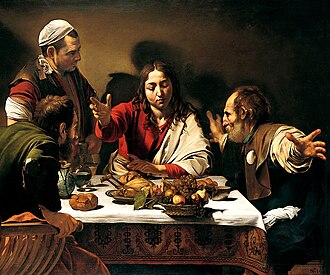 La cena de Emaús - Caravaggio (1601)
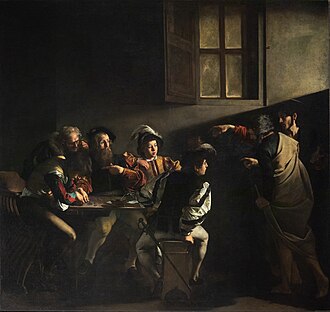 La vocación de San Mateo - Caravaggio (1609)
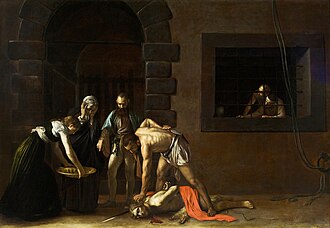 La decapitación de San Juan Bautista - Caravaggio (1608)
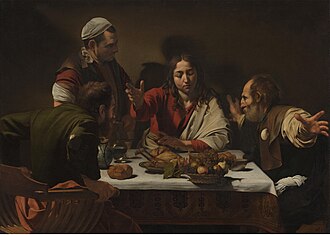 Los discípulos de Emaús - Caravaggio (1601)
 Cabeza de Medusa - Caravaggio (1597)
 Judit decapitando a Holofernes - Caravaggio (1598)
 El amor victorioso - Caravaggio (1600s)
%2C%201595%20circa%2C%20534.jpg) Baco enfermo - Caravaggio (1595)
Baco enfermo - Caravaggio (1595)
Obras de artistas relacionados
 Las meninas - Diego Velázquez (1656)
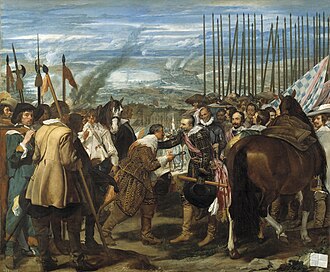 La rendición de Breda - Diego Velázquez (1635)
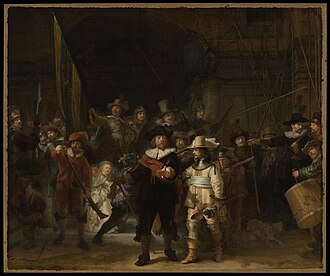 La ronda de noche - Rembrandt van Rijn (1642)
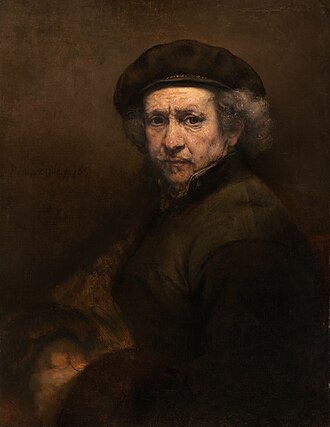 Autorretrato - Rembrandt van Rijn (1659)
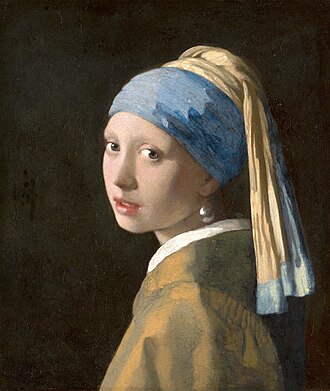 La joven de la perla - Johannes Vermeer (1665)
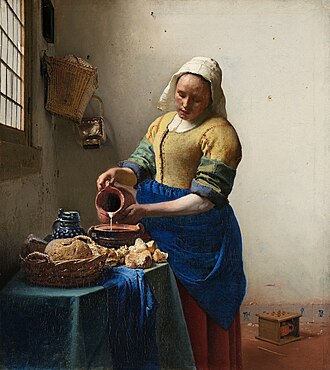 La lechera - Johannes Vermeer (c. 1658)