The garden of St. Paul's Hospital
Vincent van Gogh · 1889
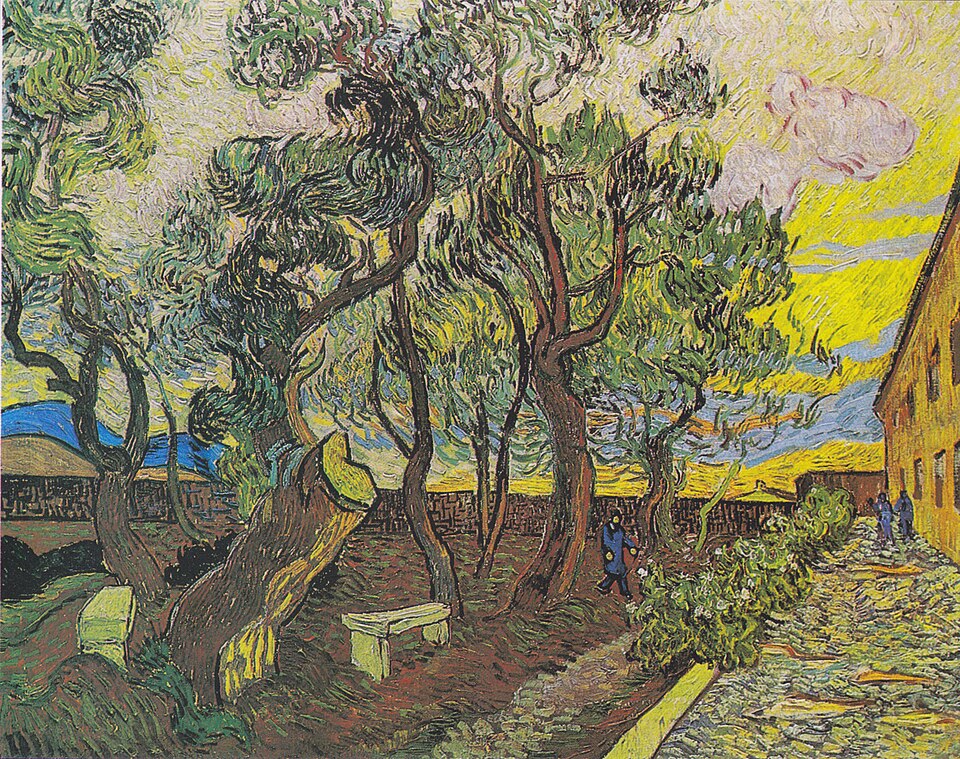
A huge pine, struck by lightning and stripped of its largest branch, still pushes one limb toward the sky. Van Gogh painted it in the walled garden of the asylum he had entered of his own will, and called the tree a proud defeated one.
The story behind the painting
In December 1888, after a quarrel with Paul Gauguin, Van Gogh lost part of his left ear in circumstances never fully explained. It was seen as the first sign of an illness then diagnosed, probably wrongly, as epilepsy. More hospital stays in Arles followed, including one forced by a petition from neighbours who feared his behaviour. Not yet confident to live alone, and perhaps not wanting to burden his newly married brother, he entered the asylum of Saint-Paul-de-Mausole in Saint-Remy-de-Provence on 8 May 1889. Painting was allowed there as a kind of therapy.
What to look for
The painting shows the walled garden of the asylum. At its centre stands the mighty pine, its wounded trunk the core of the picture, with one side branch still reaching upward. Behind it more trees fill the scene, so twisting branches dominate the canvas. Against their restless movement stand the garden ground and the asylum wall, painted in heavy red tones. Three figures appear, tiny beside the trees. The canvas measures about 73 by 93 cm.
Meaning and intent
In a letter to Emile Bernard, Van Gogh wrote that the pine had been struck by lightning and that its largest branch had to be sawn off. He described the tree himself as a sombre giant and a proud defeated one, words that make it hard not to see the painter in the tree. In July 1889 he suffered a severe attack, during which, as again at the end of the year, he tried to swallow poisonous paints. For weeks he did not dare leave the building.
Legacy
In October 1889 Van Gogh ventured outside the asylum walls for the first time again, and olive groves and pines became central themes of his art. This canvas was painted in the autumn and winter of 1889 in the garden of the asylum, and it now hangs in the Museum Folkwang in Essen. Its little people under the wounded giant remain one of the clearest images of how he kept painting through his illness.
¿Sabías que…?
- Painted in autumn and winter 1889 in the asylum garden at Saint-Remy.
- Van Gogh entered the asylum voluntarily on 8 May 1889.
- He called the lightning-struck pine a proud defeated one.
- Now in the Museum Folkwang, Essen.
Sobre el artista
Vincent van Gogh (1853-1890)
pintura del paisaje · jardín · Museo Folkwang
Más obras de Vincent van Gogh
 La noche estrellada - Vincent van Gogh (1889)
 Terraza de café por la noche - Vincent van Gogh (1888)
 Los girasoles - Vincent van Gogh (1888)
 Almendro en flor - Vincent van Gogh (1890)
 Campo de trigo con cuervos - Vincent van Gogh (1890)
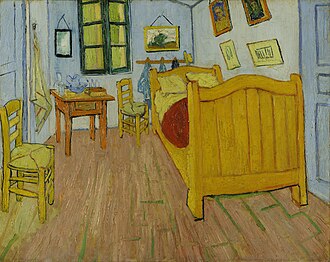 El dormitorio en Arlés - Vincent van Gogh (1888)
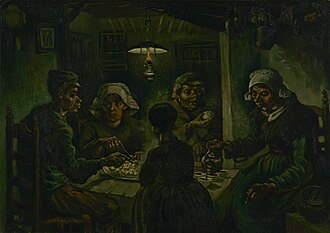 Los comedores de patatas - Vincent van Gogh (1885)
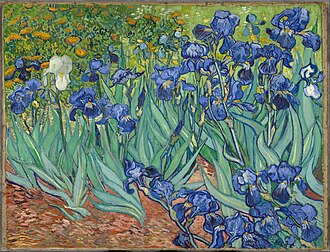 Lirios - Vincent van Gogh (1889)
Obras de artistas relacionados
 Las grandes bañistas - Paul Cézanne (1900s)
 The Boy in the Red Vest - Paul Cézanne
 ¿De dónde venimos? ¿Qué somos? ¿Adónde vamos? - Paul Gauguin (1897-1898)
 El Cristo amarillo - Paul Gauguin (1889)
 La elevación de la cruz - Peter Paul Rubens (1609)
 Rapto de las hijas de Leucipo - Peter Paul Rubens (1618)
 Paseo a orillas del mar - Joaquín Sorolla (1909)
 Triste herencia - Joaquín Sorolla (1898)
 Baile en el Moulin de la Galette - Pierre-Auguste Renoir (1876)
 El almuerzo de los remeros - Pierre-Auguste Renoir (1881)
 En el Moulin Rouge - Henri de Toulouse-Lautrec (1892)
 La toilette - Henri de Toulouse-Lautrec (1896)