La coronación de espinas
Caravaggio · 1602
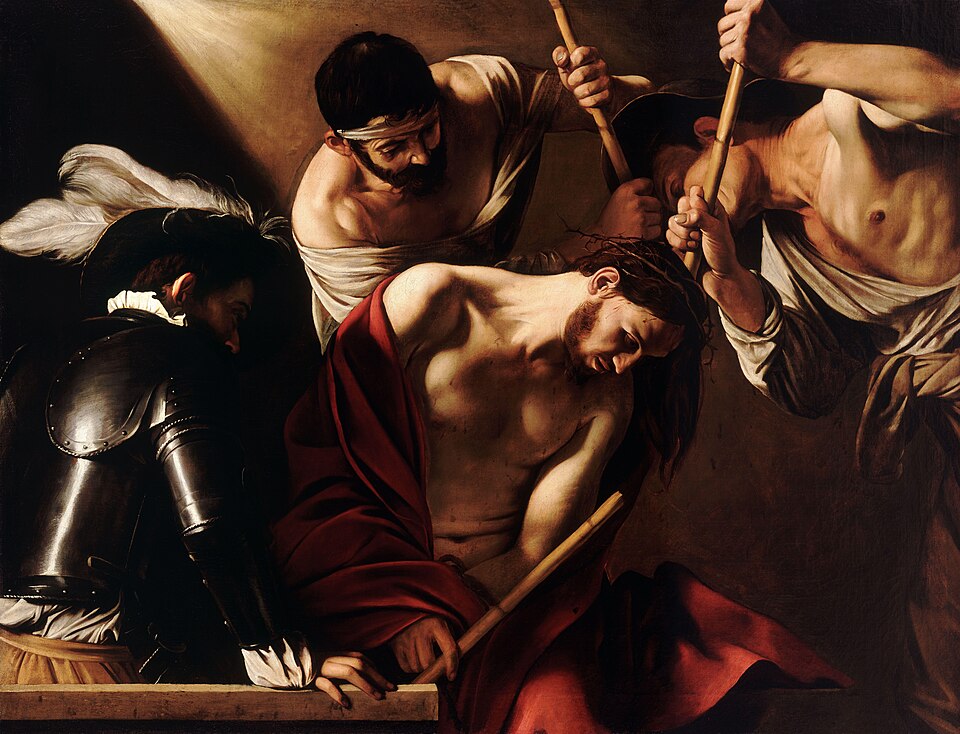
Two torturers hammer thorns into Christ's head while an official leans on a rail and watches, bored. Caravaggio painted pain as plain, observed reality, and made it unbearable to look away.
The story behind the painting
According to the biographer Giovanni Bellori, Caravaggio made this painting for his patron Vincenzo Giustiniani, and it can be traced convincingly to the Giustiniani collection. That link would place it before 1606, when Caravaggio fled Rome. Peter Robb instead dates it to 1607, when the artist was in Naples. Wikipedia gives probably 1602 to 1604 or possibly around 1607, while Wikidata records 1602. Giustiniani was both an intellectual and a collector, which helps explain why he valued this picture so highly.
What to look for
A crown of thorns is being forced onto the head of Jesus before his crucifixion, to mock his claim to authority. Watch the two torturers driving the thorns home, and the slouching official leaning on the rail. Christ's twisted body was influenced by the ancient Belvedere Torso. The scene is built from contrasting and intersecting horizontals and diagonals. The canvas, about 127 by 165.5 cm, was designed as a supraporte, to hang above a doorway.
Meaning and intent
Late in life Giustiniani wrote a paper ranking artists in twelve grades. In the highest he placed only Caravaggio and Annibale Carracci, as the painters who best combined realism and style. This painting shows what he meant: the cruelty of the torturers and the boredom of the official are acutely observed reality, while Christ suffers real pain with patient endurance, all inside a classical composition. Pain and sadism are at the centre of the work.
Legacy
The Imperial ambassador Baron Ludwig von Lebzelter bought the painting in Rome in 1809, but it did not reach Vienna until 1816. It now hangs in the Kunsthistorisches Museum in Vienna, where its quiet, unflinching cruelty still asks the viewer to stay and look. The painting still embodies what Giustiniani admired most: a scene of acutely observed cruelty set within the order of a classical composition, made by one of the two painters he placed in his highest grade.
¿Sabías que…?
- Made for the patron Vincenzo Giustiniani, according to Bellori.
- Dated around 1602 to 1604, or possibly 1607.
- Designed to hang above a doorway.
- In the Kunsthistorisches Museum, Vienna, since 1816.
Sobre el artista
Caravaggio (1571-1610)
arte religioso · varón · Jesús de Nazaret · barroco · Museo de Historia del Arte de Viena
Más obras de Caravaggio
 La cena de Emaús - Caravaggio (1601)
 La vocación de San Mateo - Caravaggio (1609)
 La decapitación de San Juan Bautista - Caravaggio (1608)
 Los discípulos de Emaús - Caravaggio (1601)
 Cabeza de Medusa - Caravaggio (1597)
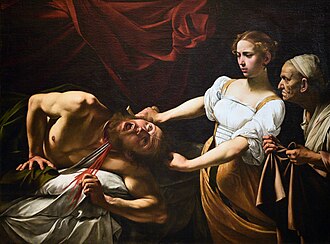 Judit decapitando a Holofernes - Caravaggio (1598)
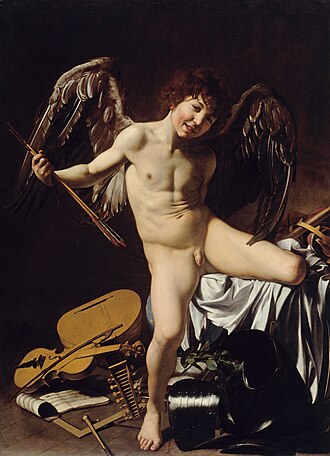 El amor victorioso - Caravaggio (1600s)
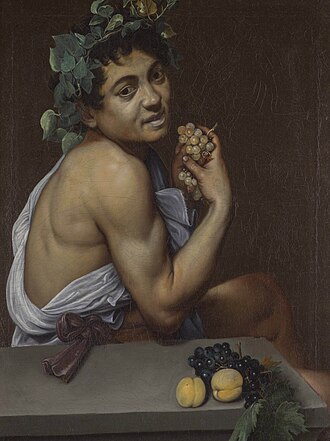 Baco enfermo - Caravaggio (1595)
Obras de artistas relacionados
 Las meninas - Diego Velázquez (1656)
 La rendición de Breda - Diego Velázquez (1635)
 Saint Francis in Meditation - Francisco de Zurbarán (1639)
 Inmaculada Concepción - Francisco de Zurbarán (1661)
 Triple retrato de Carlos I - Anthony van Dyck (1635)
 Charles I (1600-1649) with M. de St Antoine - Anthony van Dyck (1636)
 La elevación de la cruz - Peter Paul Rubens (1609)
 Rapto de las hijas de Leucipo - Peter Paul Rubens (1618)
 La ronda de noche - Rembrandt van Rijn (1642)
 Autorretrato - Rembrandt van Rijn (1659)
 El alegre bebedor - Frans Hals (1620s)
 Caballero sonriente - Frans Hals (1624)