Taste in High Life
William Hogarth · 1740s
.jpg)
An old lady in a hooped gown of giant roses and a lord in high heels swoon over a tiny porcelain cup, while a monkey in a robe reads an auction bill. Hogarth was paid to laugh at fashion, and he did.
The story behind the painting
Hogarth painted Taste in High Life around 1742; Wikidata dates it more loosely to the 1740s. It was commissioned by Mary Edwards of Kensington, a loyal patron of his. She was considered eccentric: she had inherited a fortune at twenty-four and had discarded her common-law husband, Lord Anne Hamilton, when he proved profligate. She wanted a picture mocking what she saw as the ridiculous fashions and indulgences of the upper class and female adornment. It is reported that she did it as revenge, having been ridiculed by such people.
What to look for
An elderly woman wears a sacque covered in absurdly overblown roses, swollen by a huge hoop. Beside her an opulent man, thought to be Beau Colyear, 2nd Earl of Portmore, wears a diamond-patterned coat, stockings pulled over his breeches, high heels, a muff and a tricorn hat. The two admire a minute porcelain cup and saucer. Another woman chucks the chin of a turbaned black page holding a porcelain figure. A monkey in a cuffed robe studies an auction list. On the wall, cupids burn old petticoats and wigs, and a statue is mocked by a vast hoop labelled the mode 1742.
Meaning and intent
The painting satirises the dress of the day and the superficial tastes of the aristocracy, and it is a forerunner of Marriage A-la-Mode. The black page is placed with irony: a servant who mocks masters who themselves bow before every passing fashion. The page is thought to be modelled on the young Ignatius Sancho, later an actor and writer. The burning petticoats show how quickly fashion passes. On a fire-screen, a lady is stuck in a sedan chair filled by her own hoops.
Legacy
Hogarth was not particularly fond of the work, as he often felt less enthusiastic about paintings made to order. Yet its images lived on: the lady trapped by her hoops reappears in the background of his Beer Street of 1752. The painting was engraved by Samuel Phillips in 1798 for John Boydell's posthumous edition of Hogarth's works, with a final state published in 1808. According to Wikidata the painting is held by the Metropolitan Museum of Art in New York.
¿Sabías que…?
- Painted around 1742 for Mary Edwards of Kensington.
- A forerunner of Hogarth's Marriage A-la-Mode.
- The lady trapped by her hoops reappears in Beer Street (1752).
- Engraved by Samuel Phillips in 1798.
Sobre el artista
William Hogarth (1697-1764)
Más obras de William Hogarth
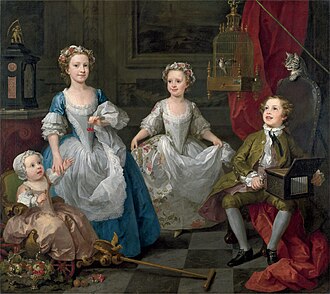 Retrato de los niños Graham - William Hogarth (1742)
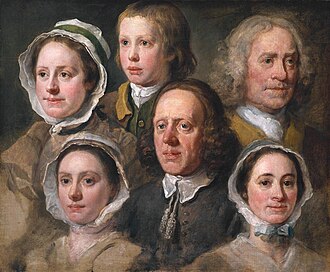 Los servidores del pintor - William Hogarth (1750s)
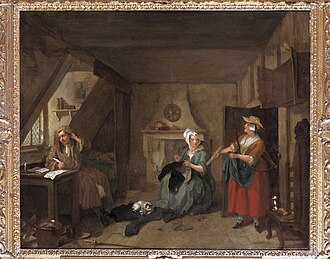 El poeta angustiado - William Hogarth (1730s)
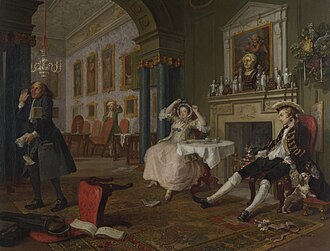 Casamiento a la moda II - William Hogarth (1743)
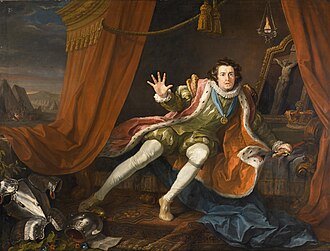 David Garrick as Richard III - William Hogarth (1745)
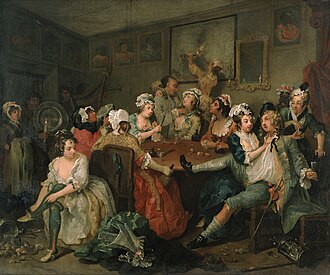 La orgía - William Hogarth (1735)
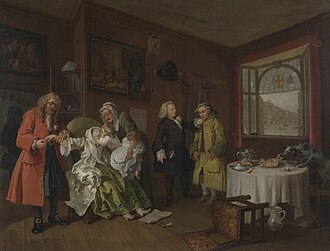 Marriage A-la-Mode: 6. The Lady's Death - William Hogarth (1743)
La última apuesta de la dama - William Hogarth (1759)