Santa Catalina de Alejandría
Caravaggio · 1598
.jpg)
A young woman kneels beside a broken wheel, a sword resting in her hands, and looks out at us with calm assurance. She is a saint of wisdom and courage, and Caravaggio gave her the face of a real woman of Rome.
The story behind the painting
This canvas belonged to Cardinal Francesco Maria del Monte, Caravaggio's early patron, and was recorded in his collection in 1627. Saint Catherine and Mary Magdalene were said to be among the Cardinal's favourite saints. According to the scholar Alessandro Zuccari, the picture was painted at the Cardinal's suggestion while Caravaggio lived in his household at the Palazzo Madama in Rome. The sources disagree a little on the date: Wikipedia places it around 1593, while Wikidata gives 1598. Either way, it belongs to the years when the young painter was finding his voice under del Monte's roof. Today it hangs in the Thyssen-Bornemisza Museum in Madrid, a large canvas of about 173 by 133 centimetres.
What to look for
Look first at the model. Caravaggio chose Fillide Melandroni, a well known Roman courtesan, to pose as the saint, a choice that the sources call controversial. She is not an idealised, distant figure but a recognisable person, and that closeness is part of the picture's force. Around her are the signs of Catherine's story: the wheel on which she was meant to die, and the weapon of her final martyrdom. Notice how the objects are treated with the same weight and solidity as the woman herself. Fillide would pose for Caravaggio again, in Martha and Mary Magdalene, in Judith Beheading Holofernes, and in a portrait that was burned in Berlin during the Second World War.
Meaning and intent
Catherine of Alexandria was a beloved figure in Catholic imagery, praised for beauty, fearlessness, virginity and intelligence. Tradition says that at eighteen she confronted a Roman emperor, debated his philosophers and converted many of them. Condemned to die on a spiked wheel, she saw the wheel shatter at her touch, and she was then beheaded. That is why the broken wheel matters here: it is a sign of a faith that the instruments of power could not break. She became patron of libraries, teachers and scholars, and of all whose work depended on wheels. Caravaggio lets the legend sit quietly in the objects, while the living face holds our attention.
Legacy
The painting stands at the start of a long working relationship between Caravaggio and his model, whose face returns in some of his most famous pictures. It also shows the taste of Cardinal del Monte, whose household gave the painter both shelter and subjects. The saint herself had a remarkable later history: in 1969 the Church removed her from the calendar of saints, persuaded by historians who doubted she had existed, and by 2002 she had been reinstated, even though most historians had not changed their view. Through all of this, Caravaggio's image kept her very present: a real young woman, steady and unafraid, beside the wheel that could not hold her.
¿Sabías que…?
- Recorded in the collection of Cardinal Francesco Maria del Monte in 1627.
- The model was Fillide Melandroni, who also posed for Judith Beheading Holofernes.
- Date given as c. 1593 by Wikipedia and 1598 by Wikidata.
- Held at the Thyssen-Bornemisza Museum, Madrid; 173 × 133 cm.
Sobre el artista
Caravaggio (1571-1610)
Más obras de Caravaggio
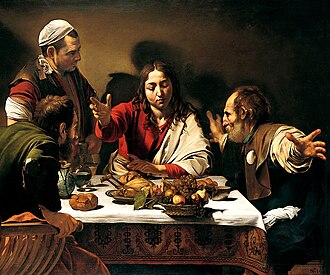 La cena de Emaús - Caravaggio (1601)
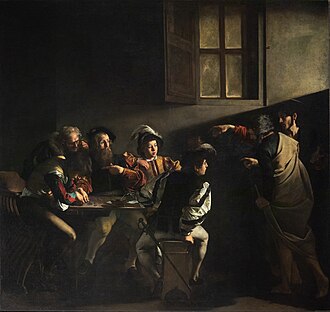 La vocación de San Mateo - Caravaggio (1609)
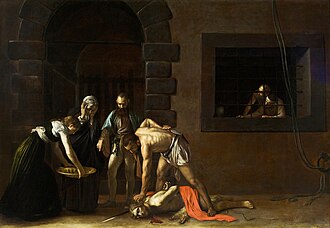 La decapitación de San Juan Bautista - Caravaggio (1608)
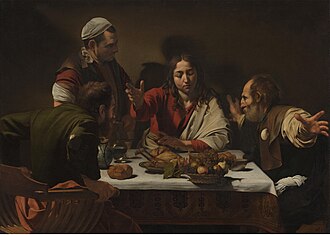 Los discípulos de Emaús - Caravaggio (1601)
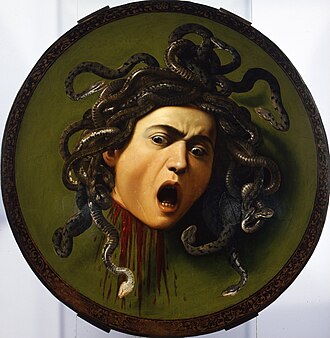 Cabeza de Medusa - Caravaggio (1597)
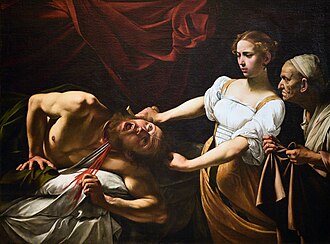 Judit decapitando a Holofernes - Caravaggio (1598)
 El amor victorioso - Caravaggio (1600s)
%2C%201595%20circa%2C%20534.jpg) Baco enfermo - Caravaggio (1595)
Baco enfermo - Caravaggio (1595)
Obras de artistas relacionados
 Las meninas - Diego Velázquez (1656)
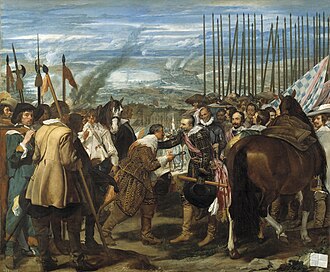 La rendición de Breda - Diego Velázquez (1635)
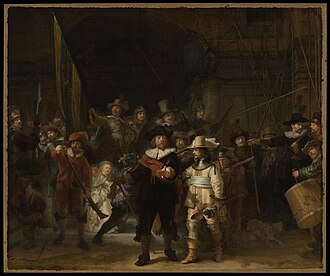 La ronda de noche - Rembrandt van Rijn (1642)
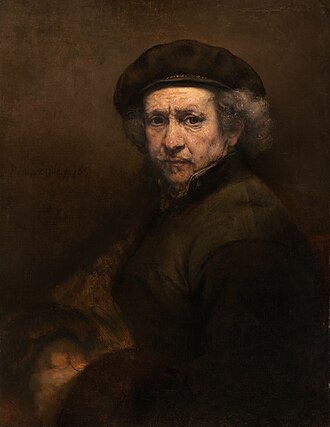 Autorretrato - Rembrandt van Rijn (1659)
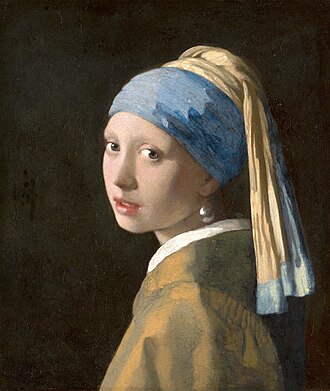 La joven de la perla - Johannes Vermeer (1665)
 La lechera - Johannes Vermeer (c. 1658)