Retrato de Madame Trabuc
Vincent van Gogh · 1889
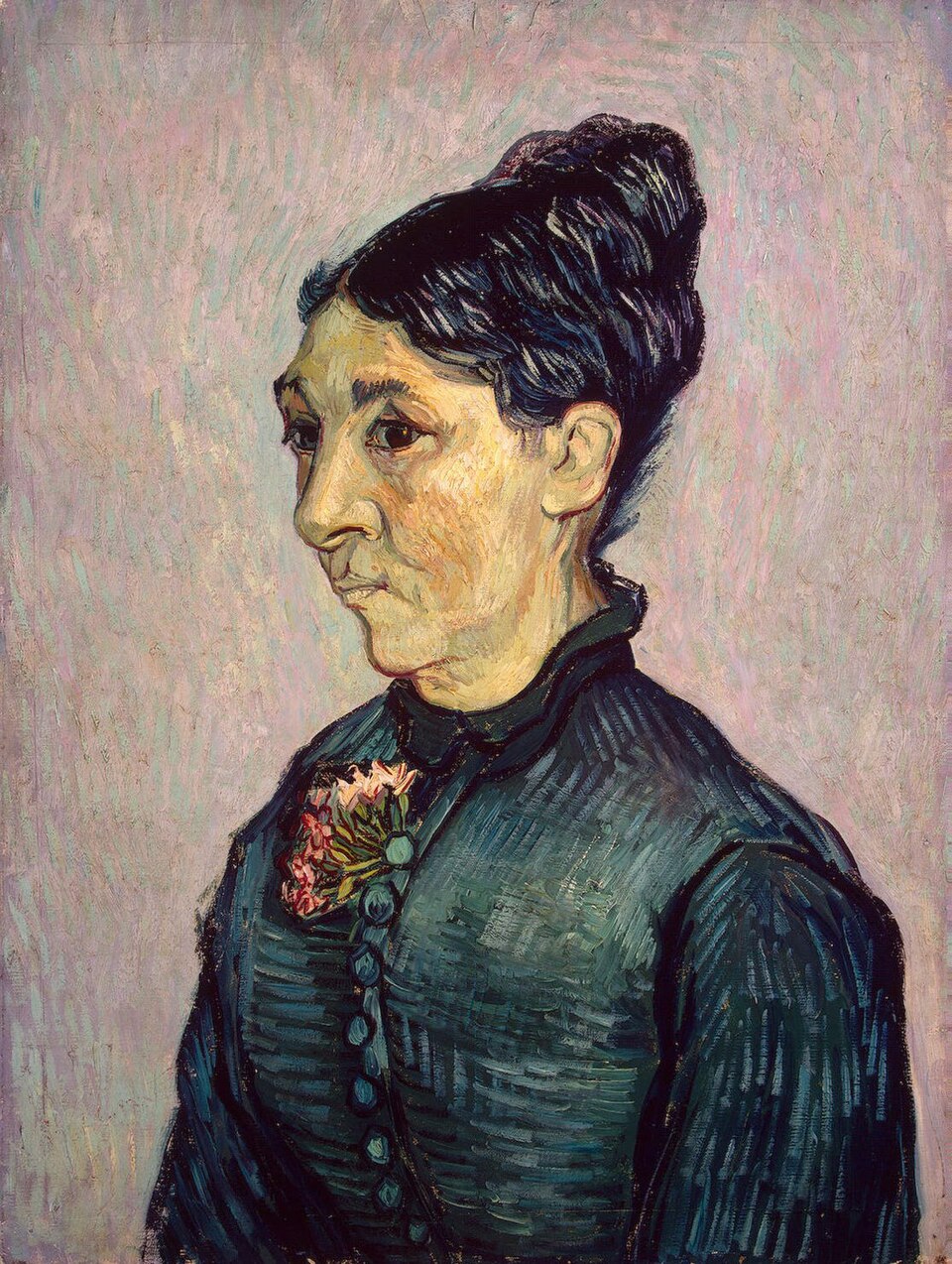
At the asylum of Saint-Rémy, Van Gogh painted the wife of the chief attendant. He found her gentle and unhappy, and painted her in black and pink.
The story behind the painting
Around 6 September 1889, Van Gogh wrote to his brother Theo that he urgently needed to work at his painting and feared another attack of madness. He said he had painted Trabuc, the attendant at the asylum, and was about to paint his wife. He found her gentle and unhappy. The Trabuc couple lived in a small house a few steps from the Saint-Paul asylum at Saint-Rémy-de-Provence. On 19 September he wrote again that the portrait of Madame Trabuc was finished.
What to look for
In that letter Van Gogh described the picture as done in tones of black and pink, and to his sister Willemina he wrote of a portrait of a woman dressed in black with an olive complexion. Look for that contrast between the dark dress and the skin. He also said he had made a copy, less successful than the original. Jeanne Trabuc, born Lafuis, was fifty-five when she posed. She was a woman of the people.
Meaning and intent
According to Pickvance, Madame Trabuc resembles the peasant figures in English prints of the 1870s that Van Gogh loved to collect, especially those from the weekly The Graphic. The portrait shows how, in a period of fear about his own health, Van Gogh turned to the people closest to him at the asylum and looked at them with sympathy. He thought Theo would like this painting, and his description of her as gentle and unhappy is the heart of the work.
Legacy
The portrait belonged to Johanna van Gogh, then was sold to the Thannhauser gallery in Berlin, where Otto Krebs acquired it. Like the rest of that collection, it was taken by the Red Army to the Hermitage in 1947 as reparation for war damage. It was shown to the Hermitage public for the first time in 1995, in an exhibition of French nineteenth and twentieth century painting from private collections in Germany. It remains in the Hermitage Museum in Saint Petersburg.
¿Sabías que…?
- Painted in September 1889 at Saint-Rémy-de-Provence.
- The sitter, Jeanne Trabuc, was 55.
- Van Gogh described it as black and pink tones.
- First shown publicly at the Hermitage in 1995.
Sobre el artista
Vincent van Gogh (1853-1890)
mujer · retrato · Museo del Hermitage · Otto Krebs collection
Más obras de Vincent van Gogh
 La noche estrellada - Vincent van Gogh (1889)
 Terraza de café por la noche - Vincent van Gogh (1888)
 Los girasoles - Vincent van Gogh (1888)
 Almendro en flor - Vincent van Gogh (1890)
 Campo de trigo con cuervos - Vincent van Gogh (1890)
 El dormitorio en Arlés - Vincent van Gogh (1888)
 Los comedores de patatas - Vincent van Gogh (1885)
 Lirios - Vincent van Gogh (1889)
Obras de artistas relacionados
 Las grandes bañistas - Paul Cézanne (1900s)
 The Boy in the Red Vest - Paul Cézanne
 ¿De dónde venimos? ¿Qué somos? ¿Adónde vamos? - Paul Gauguin (1897-1898)
 El Cristo amarillo - Paul Gauguin (1889)
 La elevación de la cruz - Peter Paul Rubens (1609)
 Rapto de las hijas de Leucipo - Peter Paul Rubens (1618)
 Paseo a orillas del mar - Joaquín Sorolla (1909)
 Triste herencia - Joaquín Sorolla (1898)
 Baile en el Moulin de la Galette - Pierre-Auguste Renoir (1876)
 El almuerzo de los remeros - Pierre-Auguste Renoir (1881)
 En el Moulin Rouge - Henri de Toulouse-Lautrec (1892)
 La toilette - Henri de Toulouse-Lautrec (1896)