Poppy field
Vincent van Gogh · 1890
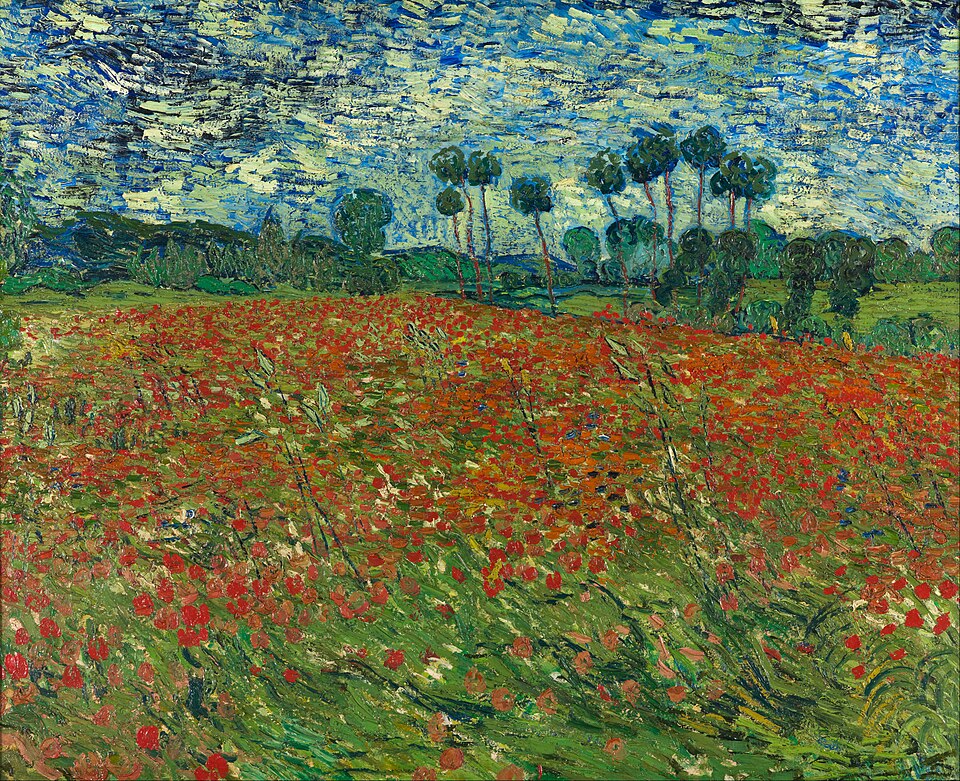
A field of red poppies climbs almost to the top of the canvas, dark trees and a restless blue sky squeezed above it. Van Gogh painted it in Auvers about a month before his death.
The story behind the painting
In May 1890 Van Gogh moved from the south of France to Auvers-sur-Oise near Paris, to be closer to the doctor Paul Gachet and to his brother and supporter Theo. He is believed to have finished Poppy Field in June 1890, about a month before he took his own life. In those last months he painted more than 70 pictures, among them Portrait of Dr Gachet, The Church at Auvers and Wheatfield with Crows.
What to look for
The colours lie in horizontal bands: a red and green field of poppies in front, ragged masses of darker trees along the horizon, and restless skies in varying blues above. Compared with Monet's Poppy Field of 1881, the horizon is much higher, so the poppies fill the space. It has been called a composition that verges on the abstract, and it differs markedly from his 1888 painting of the same subject in the Van Gogh Museum.
Meaning and intent
Bright red blooms set against alfalfa green make what Van Gogh called a motif in red and green. He wrote that some colours make each other shine, forming a couple that complete each other like man and woman. In his last weeks he found consolation in painting fields, writing that his canvases of wheatfields under turbulent skies tried to express sadness and extreme loneliness, yet also showed what he found healthy and fortifying in the countryside.
Legacy
In 1911 Gustav Pauli bought the painting for the Kunsthalle Bremen, which provoked the Vinnen Protest by German artists hostile to French modernism. Acquired by the Nazis, it was returned to Dutch ownership in 1948. It is on long-term loan from the Cultural Heritage Agency of the Netherlands to the Kunstmuseum Den Haag, which expects to restore it to its original private owners, closing a long, troubled journey across two countries.
¿Sabías que…?
- Painted in Auvers-sur-Oise, probably June 1890.
- About a month before Van Gogh's death.
- Bought for the Kunsthalle Bremen in 1911.
- On loan to the Kunstmuseum Den Haag.
Sobre el artista
Vincent van Gogh (1853-1890)
pintura del paisaje · campo · Papaver rhoeas
Más obras de Vincent van Gogh
 La noche estrellada - Vincent van Gogh (1889)
 Terraza de café por la noche - Vincent van Gogh (1888)
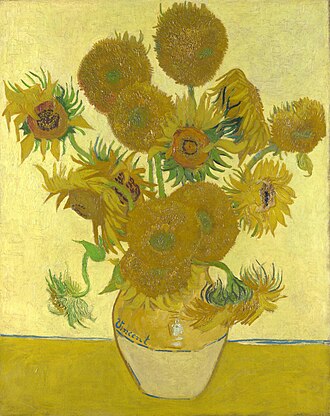 Los girasoles - Vincent van Gogh (1888)
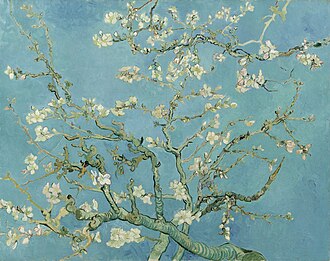 Almendro en flor - Vincent van Gogh (1890)
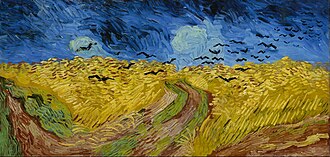 Campo de trigo con cuervos - Vincent van Gogh (1890)
 El dormitorio en Arlés - Vincent van Gogh (1888)
 Los comedores de patatas - Vincent van Gogh (1885)
 Lirios - Vincent van Gogh (1889)
Obras de artistas relacionados
 Las grandes bañistas - Paul Cézanne (1900s)
 The Boy in the Red Vest - Paul Cézanne
 ¿De dónde venimos? ¿Qué somos? ¿Adónde vamos? - Paul Gauguin (1897-1898)
 El Cristo amarillo - Paul Gauguin (1889)
 La elevación de la cruz - Peter Paul Rubens (1609)
 Rapto de las hijas de Leucipo - Peter Paul Rubens (1618)
 Paseo a orillas del mar - Joaquín Sorolla (1909)
 Triste herencia - Joaquín Sorolla (1898)
 Baile en el Moulin de la Galette - Pierre-Auguste Renoir (1876)
 El almuerzo de los remeros - Pierre-Auguste Renoir (1881)
 En el Moulin Rouge - Henri de Toulouse-Lautrec (1892)
 La toilette - Henri de Toulouse-Lautrec (1896)