Concierto campestre
Tiziano · 1510s
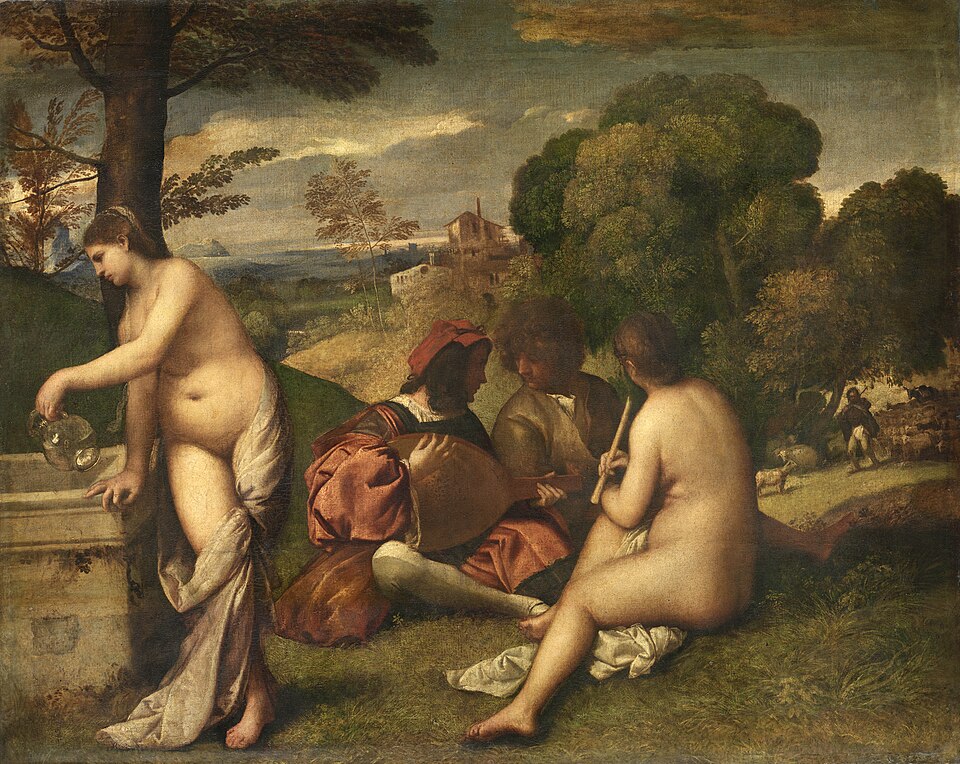
Two young men make music on the grass while two women, nearly unclothed, share the meadow with them. Do the men even see the women? Scholars have argued about it for centuries.
The story behind the painting
The Pastoral Concert, or Le Concert champêtre, is an oil painting of about 1509-1510 now in the Louvre in Paris. It is attributed to Titian, though it was earlier given to his fellow Venetian Giorgione; Wikidata dates it to the 1510s. The exact date and the patron are unknown. Isabella d'Este has been suggested, but the evidence is uncertain. These were turbulent years for Venice, with the War of the League of Cambrai in 1509, and the art historian Jonathan Unglaub sees the picture as an idyllic refuge from the ravages of history. The name Concert champêtre was first used in 1754.
What to look for
Three young people sit on a lawn playing music, while a standing woman pours water from a glass vessel into a marble basin. The women are naked apart from drapery fallen to their legs; the two men wear contemporary Venetian dress, one holding a lute. Beyond them stretches a vast pastoral landscape with a shepherd, broad slopes running down toward water, and buildings in a Venetian town and villa style. The rich colour and warm glow are typical of the Venetian school, whose way of building forms through colour was called colorito. No drawings clearly connected to the painting survive.
Meaning and intent
Interpretations are many. Philipp Fehl proposed in 1957 that the women are nymphs, drawn out of the woods by the music and invisible to the men. Others read it as an allegory of poetry: the woman with the glass vessel as the muse of tragic poetry, the other of pastoral poetry, the lute player as lofty lyric poetry. Some see the four elements in harmony, a reference to Virgil's Eclogues, or a discourse on love inspired by Pietro Bembo. It has also been read as a statement in the paragone debate, arguing that Venetian colour could rival Florentine drawing.
Legacy
The painting is considered the origin of a genre of pastoral pictures, in which young people gather in a picturesque landscape, often with allegorical or mythological meaning. When it entered the Louvre in 1792 it was titled a Fête champêtre, the name of a genre arguably based on this very work; in the later French version of that genre, women became the main figures. The question of who painted it, Titian or Giorgione, has itself become part of its fame. Few pictures have given rise to so many readings, and each visitor is invited to add one more.
¿Sabías que…?
- Oil painting of about 1509-1510, Louvre, Paris
- Attributed to Titian; formerly to Giorgione
- Entered the Louvre in 1792
- Wikidata size: 105 x 136.5 cm
Sobre el artista
Tiziano (1488-1576)
mujer · Alto Renacimiento · Departamento de Pinturas del Museo del Louvre · pintura mitológica · desnudo · escuela veneciana · casa · músico · planifolio · laúd · oveja · flauta dulce · ovejero
Más obras de Tiziano
.jpg) Venus de Urbino - Titian (1538)
Venus de Urbino - Titian (1538)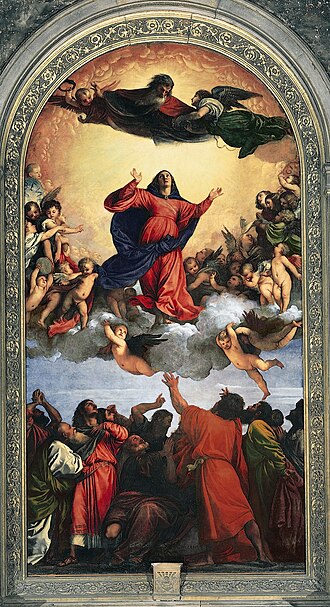 La Asunción de la Virgen - Titian (1510s)
FXD.jpg) Amor sacro y amor profano - Titian (1510s)
Amor sacro y amor profano - Titian (1510s)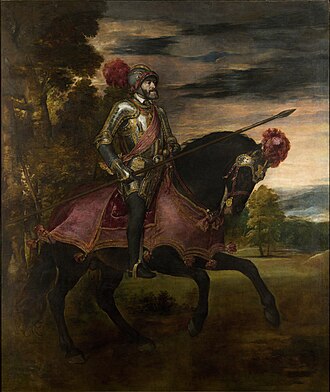 Carlos V a caballo en Mühlberg - Titian (1548)
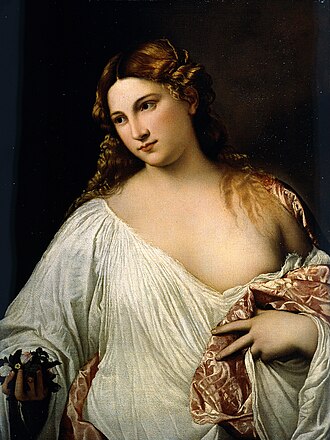 Flora - Titian (1517)
 Alegoría de la Prudencia - Titian (1550)
 Baco y Ariadna - Titian (1520s)
%20nave%20left%20-%20Altar%20of%20Madona%20di%20Ca'Pesaro.jpg) Pala Pesaro - Titian
Pala Pesaro - Titian