Venus del Pardo
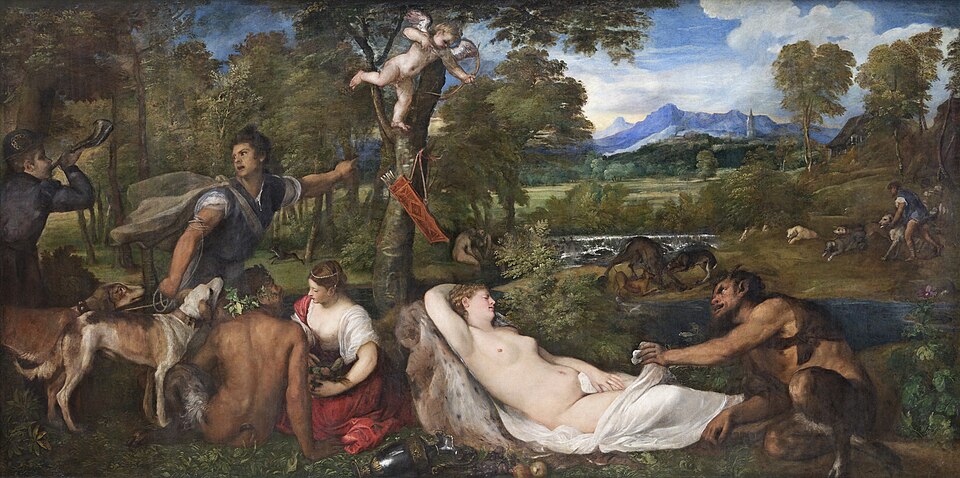
A nymph sleeps in a vast landscape while a satyr lifts her drapery, hunters chase a stag and Cupid aims from a tree. Titian's largest mythological painting has never settled its own name: Venus, or Antiope?
The story behind the painting
Titian completed this painting in 1551, and it was the first major mythological work he produced for Philip II of Spain. Studies of its style show that he reworked a Bacchanalian scene begun much earlier, finishing the landscape and adding figures; Sydney Freedberg saw it as essentially an invention of the later 1530s, reworked later. It was long kept in the Royal Palace of El Pardo near Madrid, hence its common name, the Pardo Venus. Titian called it simply the landscape, and his son Orazio the nude woman with the landscape and the satyr.
What to look for
The canvas is huge, about 196 by 385 cm, and split in two by the tree at centre. At right, Jupiter in the form of a satyr creeps up on the sleeping nymph Antiope and lifts her drapery. Above her, hounds have brought down a stag; beside her, a goat-legged satyr talks with a lady in contemporary dress, a hunter stands with large dogs, and another blows a horn at far left. Cupid perches in a tree with an arrow aimed at Jupiter. Far off, a farmhouse, a church steeple and mountains recall the country between Venice and Titian's home in Pieve di Cadore.
Meaning and intent
An El Pardo inventory called it Jupiter and Antiope, from Ovid's Metamorphoses, while letters during the sale of Charles I's collection call the nude Venus. Scholars disagree about meaning. One reading saw active, voluptuous and contemplative modes of life in its groups, which Harold Wethey rejected; another compares the woman to the hunted stag, an old image of the soul longing for God. Others see a decorative piling-up of groups without one complex meaning. Kenneth Clark found it a laboured attempt to recapture his early style, its pose borrowed from Giorgione's Dresden Venus.
Legacy
In 1574 Titian still had not been paid for it. When most of El Pardo burnt in 1603, King Philip III's first question was reportedly whether the Venus was lost; told it survived, he said he was satisfied, for the rest could be redone. In 1623 it was given to the future Charles I of England during his visit to Madrid seeking a Spanish bride. After his execution it was sold in 1649 to Colonel John Hutchinson, who soon resold it. It later entered the French royal collection and is now in the Louvre.
¿Sabías que…?
- Completed in 1551 for Philip II of Spain; begun much earlier.
- About 196 x 385 cm, Titian's largest mythological painting.
- Survived the 1603 fire at El Pardo palace.
- Belonged to Charles I of England, now in the Louvre.
Sobre el artista
Tiziano (1488-1576)
mujer · Departamento de Pinturas del Museo del Louvre · pintura mitológica · desnudo · manierismo · escuela veneciana · desnudo · decúbito · mama · ombligo · sátiro
Más obras de Tiziano
.jpg) Venus de Urbino - Titian (1538)
Venus de Urbino - Titian (1538)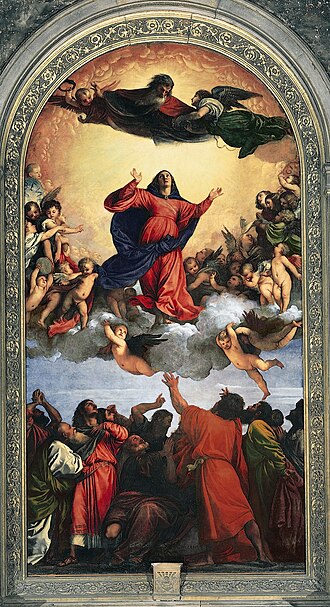 La Asunción de la Virgen - Titian (1510s)
FXD.jpg) Amor sacro y amor profano - Titian (1510s)
Amor sacro y amor profano - Titian (1510s)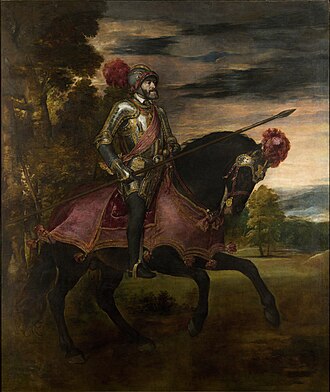 Carlos V a caballo en Mühlberg - Titian (1548)
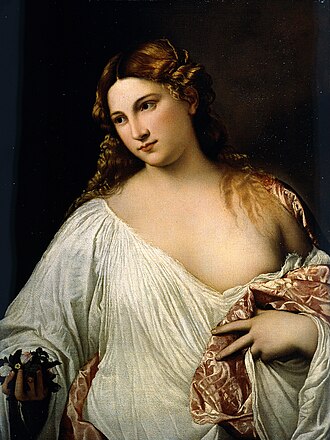 Flora - Titian (1517)
 Alegoría de la Prudencia - Titian (1550)
 Baco y Ariadna - Titian (1520s)
%20nave%20left%20-%20Altar%20of%20Madona%20di%20Ca'Pesaro.jpg) Pala Pesaro - Titian
Pala Pesaro - Titian