Ecce homo
Tiziano · 1543
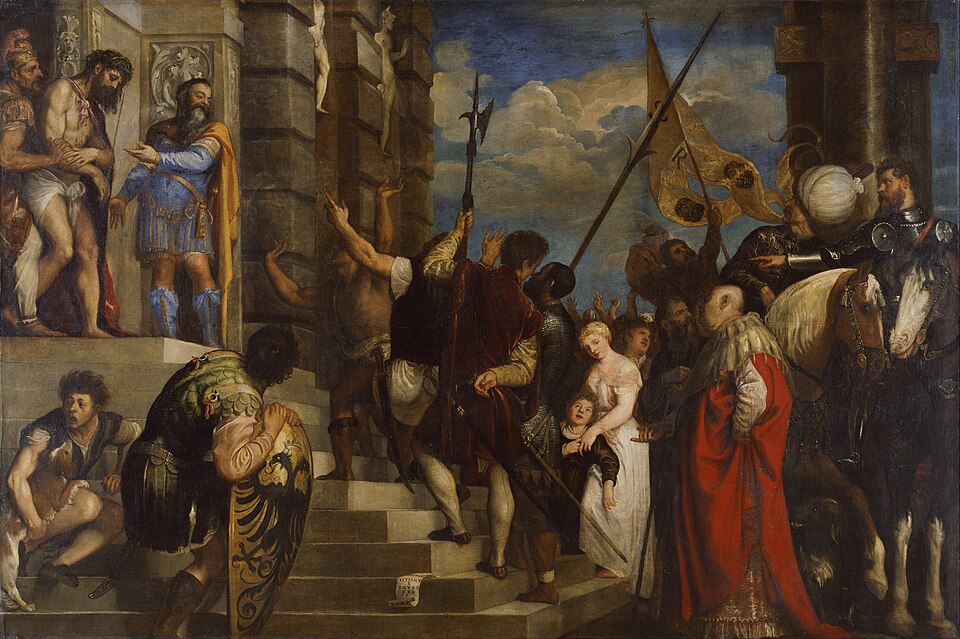
At the top of a staircase a tired, half-naked Christ is shown to a shouting crowd. In the middle of the throng stands a girl in white satin, whom legend calls Titian's own daughter.
The story behind the painting
Titian signed and dated this large canvas in 1543. He painted it for Giovanni d'Anna, a rich Dutch or Flemish merchant settled in Venice, whom Vasari calls Titian's compare, a close friend. It was still in the merchant's family in 1580; a story says King Henry III of France tried and failed to buy it in 1574. In the early 17th century Sir Henry Wotton bought it, and in 1621 it passed to the Duke of Buckingham, who refused an offer for it from the Earl of Arundel. It is not to be confused with smaller compositions by Titian on related themes.
What to look for
The canvas is huge, about 242 by 361 cm. At the top of the palace stairs Jesus stands bare to the waist, exhausted and powerless. Pontius Pilate, in a blue Roman costume, presents him to the people. Below, a crowd fills the steps: soldiers, a young blonde girl in white drawing a boy toward her, a fat Pharisee in front, horsemen on the right and a turbaned figure from the East, each with a strongly marked face. They press half way up the steps, point at Jesus and fling up their arms.
Meaning and intent
The picture stages the moment when Pilate questions the crowd and the answer comes back: crucify him. Titian builds a public scene full of individual types rather than a single devotional image. Walter Gronau says Pilate's face, with its ghastly mix of haughtiness and cynicism, is taken from Titian's friend Pietro Aretino. Charles Ricketts thought the fat patrician in an ermine-lined robe recalls the Emperor Vitellius. Near the centre, the girl in soft white satin, whom legend identifies as Titian's daughter Lavinia, stands out as a calm figure in the storm of gestures.
Legacy
The painting left England under the Commonwealth and was auctioned in Antwerp in 1648. Archduke Leopold Wilhelm then acquired it for his brother, Emperor Ferdinand III, in Prague. After being recorded several times in Prague it was moved to Vienna in 1723, and today it hangs in the Kunsthistorisches Museum. Its long path through Venetian, English and imperial collections shows how much it was wanted by collectors over the centuries.
¿Sabías que…?
- Signed and dated 1543.
- Painted for the Venetian merchant Giovanni d'Anna.
- Pilate's face is said to be Pietro Aretino's.
- In the Kunsthistorisches Museum, Vienna, since its move there in 1723.
Sobre el artista
Tiziano (1488-1576)
arte religioso · Jesús de Nazaret · escuela veneciana · Museo de Historia del Arte de Viena · caballo · equitación · Galería Belvedere · escudo · mujer joven
Más obras de Tiziano
 Venus de Urbino - Titian (1538)
 La Asunción de la Virgen - Titian (1510s)
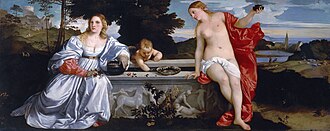 Amor sacro y amor profano - Titian (1510s)
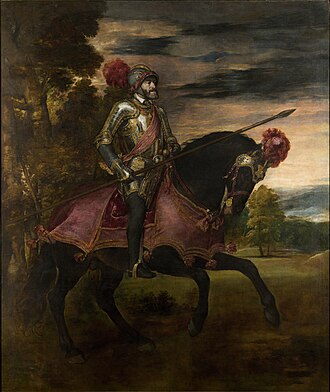 Carlos V a caballo en Mühlberg - Titian (1548)
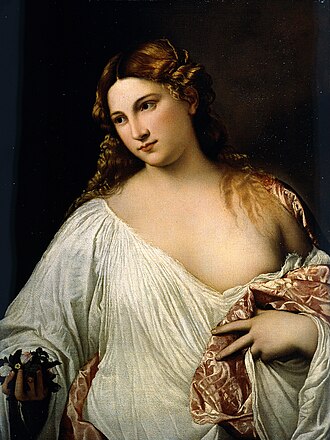 Flora - Titian (1517)
 Alegoría de la Prudencia - Titian (1550)
 Diana y Acteón - Titian (1550s)
 Baco y Ariadna - Titian (1520s)
Obras de artistas relacionados
 La Última Cena - Jacopo Tintoretto (1563)
 San Marcos liberando al esclavo - Jacopo Tintoretto (1540s)
 Las bodas de Caná - Paolo Veronese (1560s)
 Cena en casa de Leví - Paolo Veronese (1573)