El dux Antonio Grimani arrodillado ante la Fe
Tiziano · 1570s
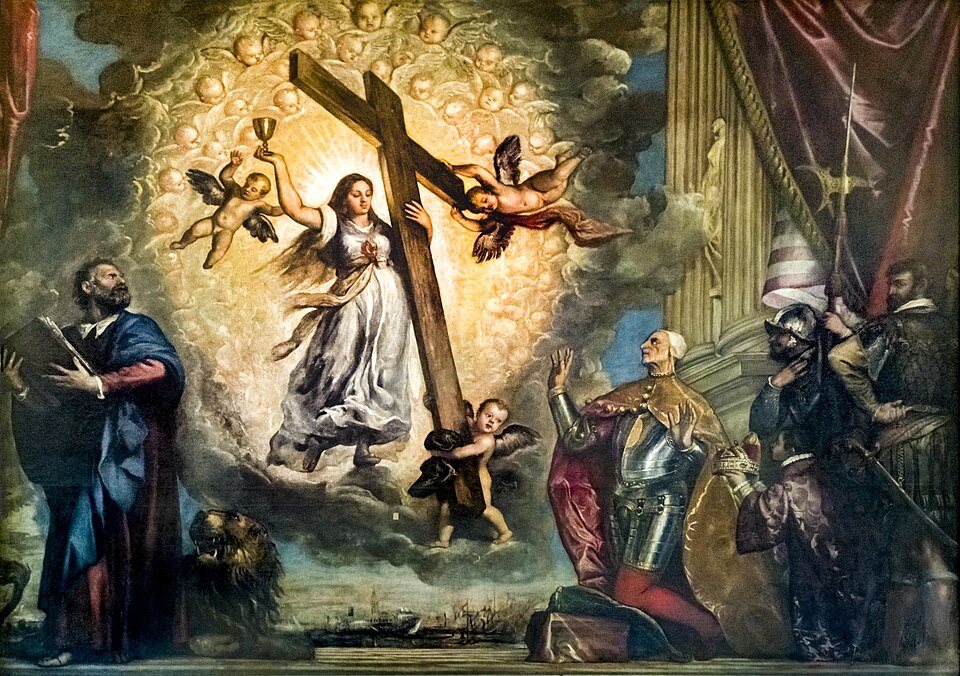
A doge in armour kneels with open arms before a young woman holding a cross and a chalice. The painting was ordered 32 years after his death, took about twenty years, and was finished only after Titian himself had died.
The story behind the painting
Antonio Grimani was doge of Venice only briefly, from 1521 to 1523. Born into a merchant family without fortune, he rose to the top through business. As doge he allied with France in the Italian War of 1521 to 1526 and was defeated at Bicocca in 1522, dying the next year in a difficult time for his city. By tradition every Venetian ruler commissioned a votive painting for his reign, but Grimani's short rule prevented it. In 1555, thirty-two years after his death, the Council of Ten gave the commission to Titian. The work dragged on for some twenty years and was finished after Titian's death by a pupil, perhaps Marco Vecellio or Cesare Vecellio, both of Titian's family.
What to look for
In the centre, in a burst of heavenly light, a young woman in a blue tunic personifies Faith. She holds the chalice of the Last Supper in her right hand and a large wooden cross in her left, surrounded by three putti in a triangular composition, with angel heads and wings above. The doge kneels in armour, arms spread wide, a pose often given to Saint Francis receiving the stigmata. At left stands Saint Mark, patron of Venice, with a book and his lion at his feet. At right, beside the doge, a page holds the ducal crown, with two soldiers. Below, at the centre, lies a view of Venice.
Meaning and intent
The armour casts Grimani as a miles christianus, a soldier of Christ who defends the Faith. His open arms, borrowed from images of Saint Francis, stress humility and piety in a man who had held the highest office of the Republic. Saint Mark and his lion bind the scene to Venice itself, and the city's skyline at the bottom ties the doge's devotion to his homeland. In a sense the canvas gave Grimani, decades after his death, the votive image that his short and troubled reign had denied him, joining him to the line of doges honoured in the palace.
Legacy
The painting hangs in the Doge's Palace in Venice, seat of the government of the old Republic, in the Hall of the Four Doors, named for its access to the administrative offices, the Council of Ten, the Senate and the Anticollegio. There it keeps company with works by Tintoretto, Tiepolo and others, and sculptures by Alessandro Vittoria. Of Titian's several votive paintings in the palace, it is the only one not destroyed in the fires of 1574 and 1577. It is unsigned and undated. The Spanish article gives its size as 373 by 496 cm, Wikidata as 365 by 500 cm, and Wikidata dates it to the 1570s.
¿Sabías que…?
- Commissioned in 1555 by the Council of Ten, 32 years after Grimani's death.
- Finished after Titian's death by a pupil, perhaps a relative.
- Titian's only votive painting in the Doge's Palace to survive the fires of 1574 and 1577.
- Hangs in the Hall of the Four Doors.
Sobre el artista
Tiziano (1488-1576)
arte religioso · escuela veneciana · Palacio Ducal de Venecia
Más obras de Tiziano
 Venus de Urbino - Titian (1538)
 La Asunción de la Virgen - Titian (1510s)
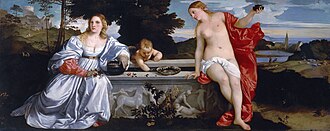 Amor sacro y amor profano - Titian (1510s)
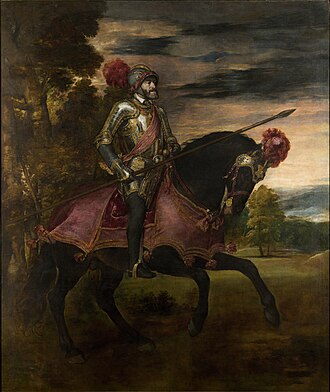 Carlos V a caballo en Mühlberg - Titian (1548)
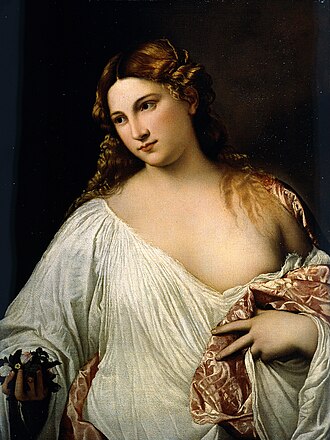 Flora - Titian (1517)
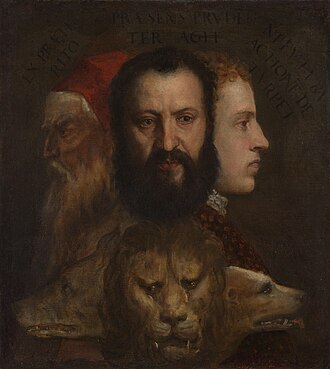 Alegoría de la Prudencia - Titian (1550)
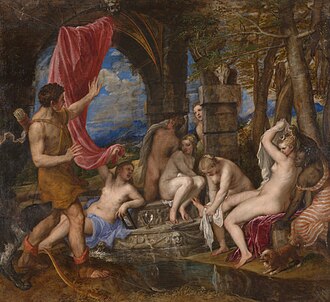 Diana y Acteón - Titian (1550s)
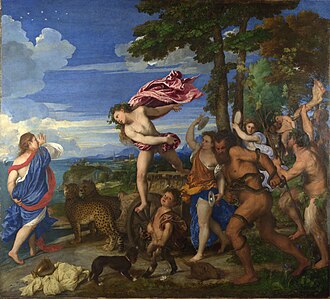 Baco y Ariadna - Titian (1520s)
Obras de artistas relacionados
 La Última Cena - Jacopo Tintoretto (1563)
 San Marcos liberando al esclavo - Jacopo Tintoretto (1540s)
 Las bodas de Caná - Paolo Veronese (1560s)
 Cena en casa de Leví - Paolo Veronese (1573)