Dormición de la Virgen
Giotto · 1312
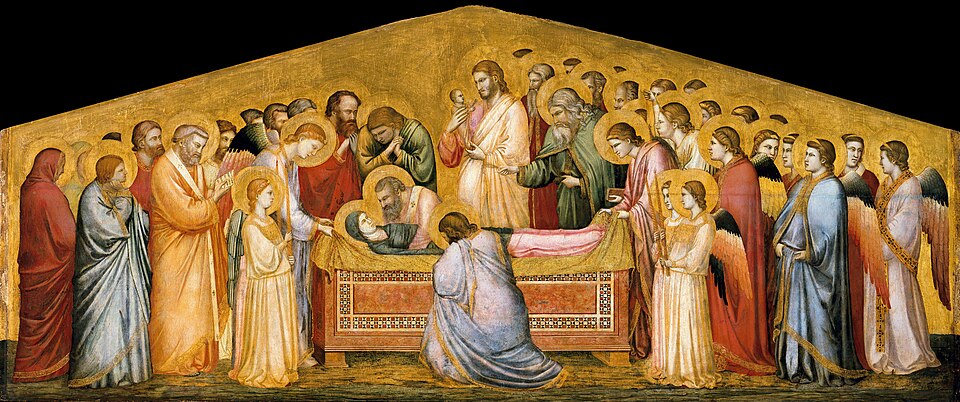
Apostles, angels and mourning women gather around Mary's body, while Christ stands among them holding a tiny child: her soul. Giotto arranged this farewell in layers of depth that were new in his time.
The story behind the painting
This altarpiece by Giotto di Bondone, known in German as Die Grablegung Mariae and also called the Dormition or Death of the Virgin, is painted in tempera on poplar wood with a gold ground. The source gives its size as 75.8 by 179.7 centimetres and dates it around 1310, because of its closeness in style to Giotto's Ognissanti Madonna in the Uffizi; Wikidata gives 1312. A label on the back bears the number 1761 from the auction of Cardinal Fesch's collection. In 1914 the Kaiser Friedrich Museumsverein acquired it, and it is now in the Gemäldegalerie of the Staatliche Museen in Berlin.
What to look for
Mary's body lies on a bier at the centre, surrounded by apostles, angels, women and patriarchs against the gold. Peter, in a golden cloak, reads from the psalms on the left; Andrew, in green, sprinkles her with holy water from the right. In the middle stands Christ, holding a small child in his arms, a sign for Mary's soul. Notice the depth: rather than lining figures up flat, Giotto layers them on several planes, so that distant figures with haloes disappear behind those in front. Angels by the sarcophagus hold specially twisted candles, and one on the right swings incense. Women at the far left mourn as her companions.
Meaning and intent
Giotto combines several episodes into one image: Mary's falling asleep in death, the funeral rites, the burial and the reception of her soul. The story comes from apocryphal writings, especially a text attributed to Pseudo-Melito, later reshaped by Gregory of Tours and by Jacobus de Voragine in the Golden Legend. Rather than a narrative, the source describes the scene as a staging of a medieval funeral, a ritual of shared remembrance. The apostles above her head make gestures of lament, Peter recites the psalms and Andrew blesses the body. Every pose, gesture and gaze leads the eye to the central point, where Christ receives his mother's soul.
Legacy
The panel's long format with a low gabled top, called a dossal, belongs to a type that appeared in thirteenth-century Tuscany and was later replaced by polyptychs. Time has not been gentle with it. The panel was cut down on all sides and thinned to about half a centimetre. In the nineteenth century the paint was heavily cleaned, which probably caused the whitish look of many faces, and the gold background was entirely renewed. Overpaint was partly removed in 1972, and new retouching followed four years later. Even so, its innovative use of depth, shared with the Ognissanti Madonna, makes it an important witness to Giotto's art.
¿Sabías que…?
- Tempera on poplar with gold ground; source gives 75.8 x 179.7 cm
- Dated around 1310 by the source; Wikidata gives 1312
- Acquired in 1914 by the Kaiser Friedrich Museumsverein
- Gold background entirely renewed; faces affected by heavy cleaning
Sobre el artista
Giotto (1267-1337)
arte religioso · mujer · Virgen María · Gemäldegalerie de Berlín
Más obras de Giotto
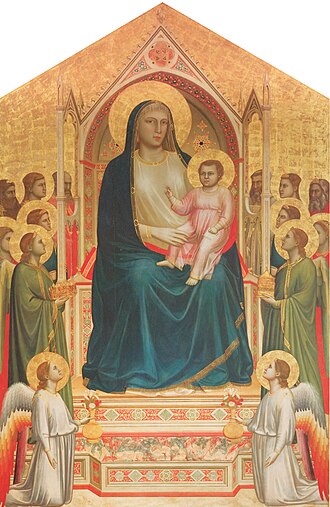 Maestà di Ognissanti - Giotto (1300s)
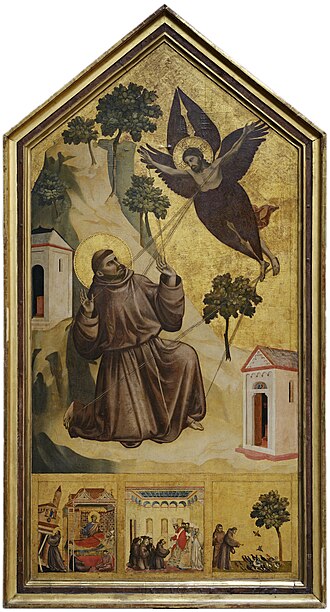 St. Francis of Assisi Receiving the Stigmata - Giotto (1290s)
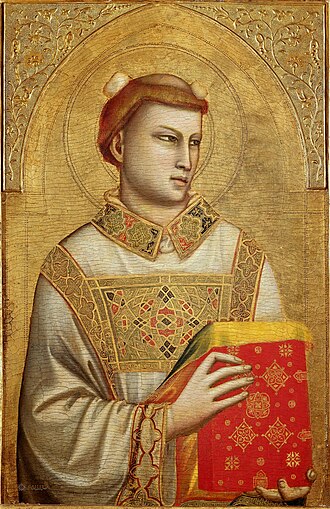 Saint Stephen - Giotto (1320)
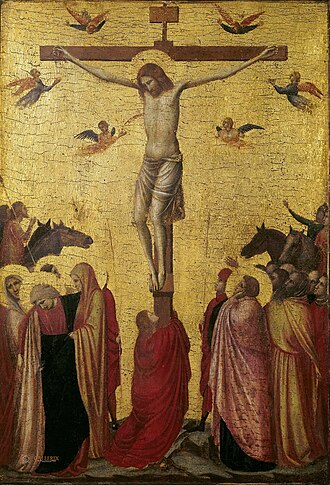 Crucifixion of Strasbourg - Giotto (1315)
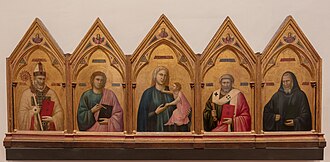 Badia Polyptych - Giotto (1300s)
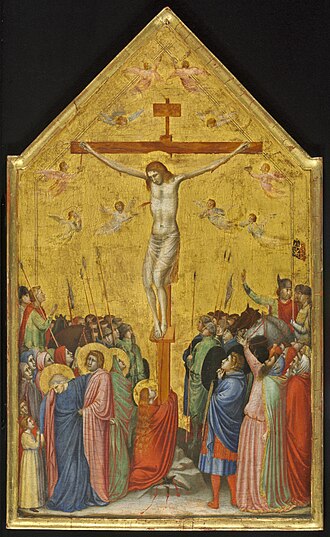 Crucifixión - Giotto (1310s)
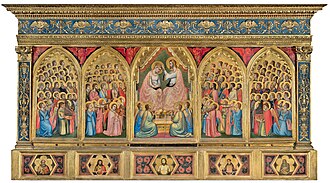 Políptico Baroncelli - Giotto (1328)
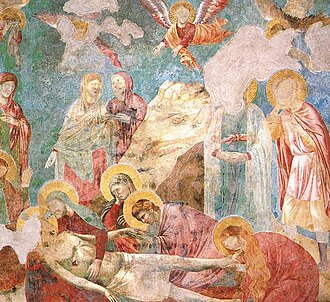 Scenes from the New Testament: Lamentation - Giotto (1291)