Cipreses
Vincent van Gogh · 1889
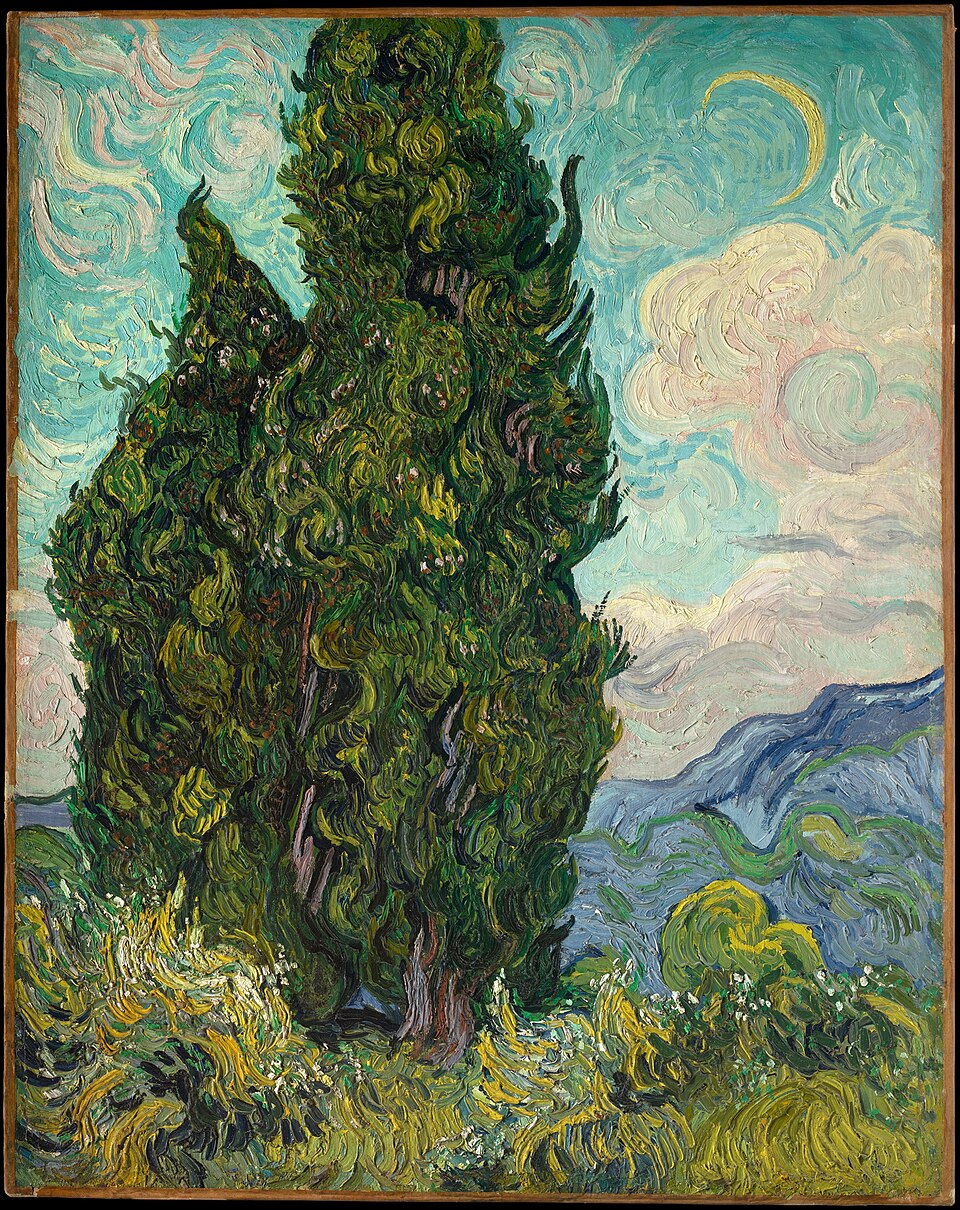
Two cypress trees rise like dark flames into a churning sky. Van Gogh painted them while living in an asylum, and he thought they were as beautiful as an Egyptian obelisk.
The story behind the painting
In May 1889 Vincent van Gogh entered the Saint-Paul asylum at Saint-Rémy in Provence as a patient. Even there he was allowed to keep painting, and he turned to the landscape around him. Among the subjects that gripped him were the region's cypresses and pines. He described the cypress as beautiful in its lines and proportions, like an Egyptian obelisk, and the fascination grew into a group of paintings. Cypresses, painted in oil on canvas around June 1889, was made soon after his arrival. It shows a pair of cypress trees in the French countryside. For a man confined by illness, the act of going out to study these towering trees was a way of keeping his art, and himself, alive.
What to look for
Let the trees lead you. The two cypresses dominate the canvas, a dark vertical mass climbing nearly the whole height of the picture, which is taller than it is wide, about 93 by 74 centimetres. Their shape echoes the obelisk Van Gogh had in mind: narrow, upright, almost architectural. Around them the countryside and sky are full of movement; Wikidata's catalogue of the work's subjects even lists turbulence, along with the Moon and garrigue, the scrubby vegetation of Provence. Look for the crescent moon in the sky and the low growth at the trees' feet. Then step close and watch how the paint itself seems to twist and swirl, so that the trees feel less like still objects than like living, rising forms.
Meaning and intent
Cypresses have long been associated in Mediterranean culture with cemeteries and mourning, and it is tempting to read these dark trees in light of Van Gogh's suffering at the asylum. Yet his own words point elsewhere. What he praised was their form: their lines and proportions, the clean upward thrust of an obelisk. For him the cypress seems to have been a supreme challenge of design and colour, a dark note that could hold its own against bright southern light. Seen this way, the painting is less a lament than an act of attention, an artist under great strain finding in two trees a shape strong and stable enough to build a picture around.
Legacy
Van Gogh did not keep this painting hidden. It was shown at the 1890 Salon des Indépendants in Paris, one of the few public exhibitions of his work during his lifetime, which ended that same year. Cypresses belongs to the series of tree paintings from Saint-Rémy that has become one of the most recognisable strands of his late art, sharing its swirling energy with other works from that year. Today it hangs in the Metropolitan Museum of Art in New York, where visitors can stand before the trees he once compared to an obelisk and feel the same upward pull that captivated him in the summer of 1889.
¿Sabías que…?
- Van Gogh painted it around June 1889, soon after arriving at the Saint-Paul asylum in Saint-Rémy.
- He described cypresses as beautiful in lines and proportions, like an Egyptian obelisk.
- The painting was exhibited at the 1890 Salon des Indépendants in Paris.
- It now hangs in the Metropolitan Museum of Art, New York.
Sobre el artista
Vincent van Gogh (1853-1890)
pintura del paisaje · Museo Metropolitano de Arte · Cupressus
Más obras de Vincent van Gogh
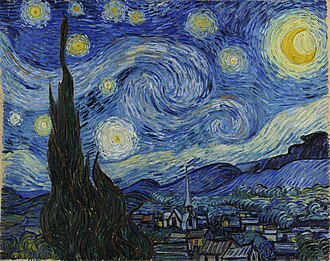 La noche estrellada - Vincent van Gogh (1889)
.jpg) Terraza de café por la noche - Vincent van Gogh (1888)
Terraza de café por la noche - Vincent van Gogh (1888)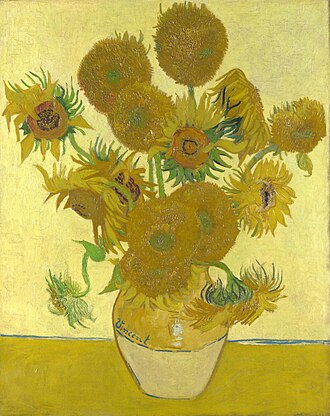 Los girasoles - Vincent van Gogh (1888)
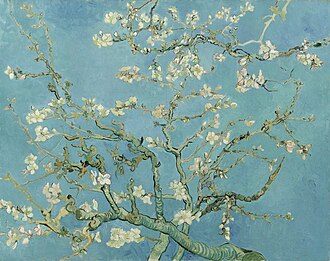 Almendro en flor - Vincent van Gogh (1890)
 Campo de trigo con cuervos - Vincent van Gogh (1890)
 El dormitorio en Arlés - Vincent van Gogh (1888)
 Los comedores de patatas - Vincent van Gogh (1885)
 Lirios - Vincent van Gogh (1889)
Obras de artistas relacionados
 ¿De dónde venimos? ¿Qué somos? ¿Adónde vamos? - Paul Gauguin (1897-1898)
%201889.jpg) El Cristo amarillo - Paul Gauguin (1889)
El Cristo amarillo - Paul Gauguin (1889) Almuerzo sobre la hierba - Édouard Manet (1863)
 Olympia - Édouard Manet (1863)