Campos en Cordeville, en Auvers-sur-Oise
Vincent van Gogh · 1890
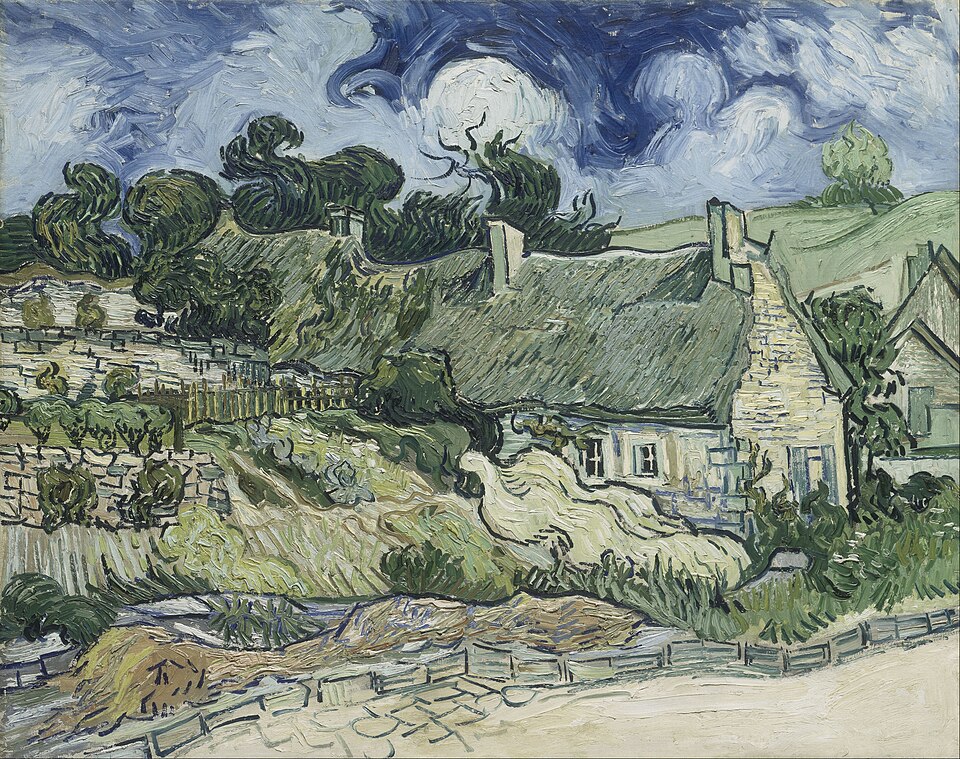
Thatched cottages heave under a dark blue sky of tangled clouds, trees and grass bending in a strong wind. Van Gogh painted them at Auvers-sur-Oise in June 1890, one month before his death.
The story behind the painting
In May 1890 Vincent van Gogh left the asylum at Saint-Rémy and went to Paris to stay with his brother Theo, where he met his sister-in-law and their baby. He then settled at Auvers-sur-Oise, about thirty kilometres north of Paris, to be looked after by Doctor Gachet. His last weeks there were a period of frantic creation. Cordeville is a hamlet a little apart from the village of Auvers. He painted these cottages in June 1890, one month before his death on 29 July 1890. The French article also gives the title Chaumes de Montcel.
What to look for
The canvas measures 73 by 92 cm. The cottages are painted in a twisting way, as if Van Gogh wanted to swell their volumes, in thick impasto that brings out cool tones: greys, verdigris and greens. Above them a dark blue sky with dishevelled clouds recalls The Starry Night. The thatched house almost disappears into the greens, and the warm tones are gone. Trees and grass seem driven by a powerful wind. Stand close and follow the paint: every roof, bush and cloud seems to be moving.
Meaning and intent
Wikipedia reads the picture as the tormented soul of the painter producing a fantastic and stormy view. It is a description, not a statement from Van Gogh himself, and the source offers no letter about this painting. What the canvas itself shows is a quiet rural subject, a group of old cottages, turned into something restless and alive, with the solid volumes of the houses swelling and the sky churning above them. Frank Herbert later gave it a voice of its own in fiction, as a picture about the wild thread in humans that cannot be suppressed.
Legacy
In 1954 Paul Gachet, son of the doctor who cared for Van Gogh in Auvers, gave the painting to the Louvre. It was shown at the Jeu de Paume before moving to the Musée d'Orsay in 1986, where it is inventory RF 1954 14. In Chapterhouse: Dune, the last book of Frank Herbert's Dune cycle, it is the favourite painting of the Reverend Mother Odrade, who sees in it the impossibility of removing the wild streak in human beings.
¿Sabías que…?
- Painted at Auvers-sur-Oise in June 1890, a month before Van Gogh's death.
- Given to the Louvre in 1954 by Paul Gachet, the doctor's son.
- At the Musée d'Orsay since 1986.
- Cited in Frank Herbert's Chapterhouse: Dune.
Sobre el artista
Vincent van Gogh (1853-1890)
pintura del paisaje · Museo de Orsay · árbol · paisaje · cielo · casa · Auvers-sur-Oise
Más obras de Vincent van Gogh
 La noche estrellada - Vincent van Gogh (1889)
.jpg) Terraza de café por la noche - Vincent van Gogh (1888)
Terraza de café por la noche - Vincent van Gogh (1888) Los girasoles - Vincent van Gogh (1888)
 Almendro en flor - Vincent van Gogh (1890)
 Campo de trigo con cuervos - Vincent van Gogh (1890)
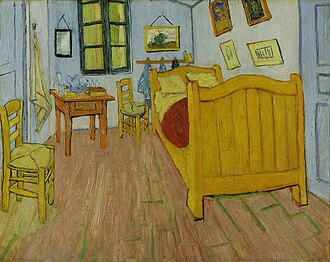 El dormitorio en Arlés - Vincent van Gogh (1888)
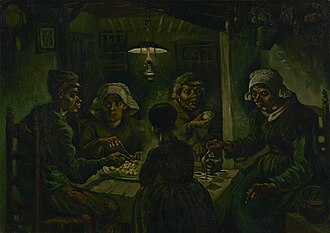 Los comedores de patatas - Vincent van Gogh (1885)
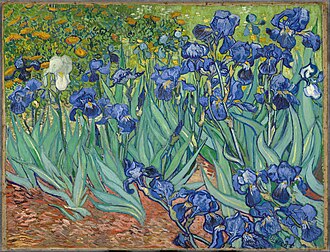 Lirios - Vincent van Gogh (1889)
Obras de artistas relacionados
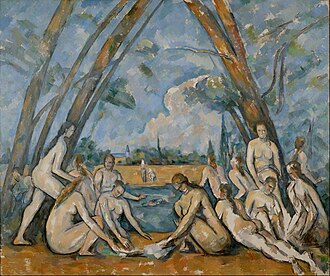 Las grandes bañistas - Paul Cézanne (1900s)
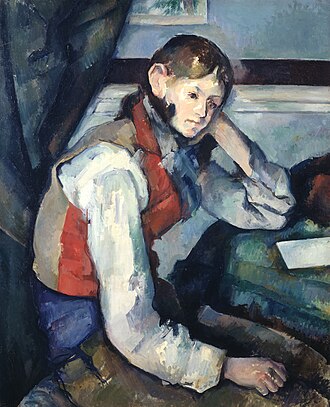 The Boy in the Red Vest - Paul Cézanne
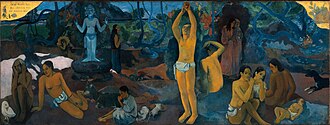 ¿De dónde venimos? ¿Qué somos? ¿Adónde vamos? - Paul Gauguin (1897-1898)
%201889.jpg) El Cristo amarillo - Paul Gauguin (1889)
El Cristo amarillo - Paul Gauguin (1889).jpg) La elevación de la cruz - Peter Paul Rubens (1609)
La elevación de la cruz - Peter Paul Rubens (1609)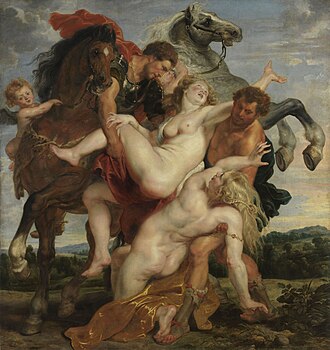 Rapto de las hijas de Leucipo - Peter Paul Rubens (1618)
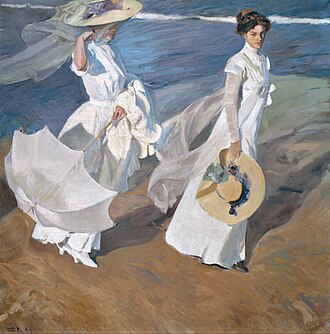 Paseo a orillas del mar - Joaquín Sorolla (1909)
 Triste herencia - Joaquín Sorolla (1898)
 Baile en el Moulin de la Galette - Pierre-Auguste Renoir (1876)
 El almuerzo de los remeros - Pierre-Auguste Renoir (1881)
 En el Moulin Rouge - Henri de Toulouse-Lautrec (1892)
%20Rousse%20(La%20Toilette)%20-%201889%20-%20Henri%20de%20Toulouse-Lautrec%20-%20Mus%C3%A9e%20d'Orsay%2C%20Paris.jpg) La toilette - Henri de Toulouse-Lautrec (1896)
La toilette - Henri de Toulouse-Lautrec (1896)