Caridad
Lucas Cranach el Viejo · 1540
.jpg)
A young mother nurses a baby beneath an apple tree while two more children cling to her. Cranach turned the old virtue of Charity into a figure of warm, almost tangible motherly love.
The story behind the painting
Lucas Cranach the Elder was court painter to the Electors of Saxony for most of his career and a close friend of Martin Luther, whose Reformation he embraced with enthusiasm. He painted German princes, Reformation leaders and religious subjects, first in the Catholic tradition and later looking for new ways to express Lutheran concerns. From 1529 onward, images of Charity on her own became part of his work. This oil on panel is one of them; Wikidata dates it 1540, and Friedländer and Rosenberg place the Antwerp picture after 1537.
What to look for
The panel is small, about 50 by 34 cm. A young mother, identified as Charity, the personification of benevolence, sits on a stone block beneath an apple tree. Her naked body is covered only by a transparent gauze as she breastfeeds a child. A second child embraces her, and a young boy sits on the ground in front of her, touching her leg. Behind the bush at her back a mountainous landscape opens up. Her slim figure belongs to the distinctive later style of Cranach's nudes, which turned away from Italian influence toward a revival of Late Gothic forms.
Meaning and intent
Before Cranach, Charity usually appeared as one virtue among a series of virtues and vices. He isolated her and made her monumental. He was also an innovator in showing his Charity more or less nude: the transparent veil is little more than a symbolic fig leaf, and at the same time adds to the visual pleasure. Surrounding her with three children, the Protestant painter filled the picture with motherly love. Wikipedia notes that Cranach cared more about the physical presence of the figure than about symbolism, and that his nudes, built on the same female type, are easy to recognise.
Legacy
Friedländer and Jakob Rosenberg recorded six different variations of this composition, a sign of how often the workshop returned to it. The Antwerp version is held by the Royal Museum of Fine Arts Antwerp and is listed in the Flemish Art Collection. Cranach's slim, veiled women appear again and again in his mythological and biblical scenes, and this Charity shows how a traditional virtue could become, in his hands, an intimate picture of a mother and her children in a landscape.
¿Sabías que…?
- Oil on panel, about 50 x 34 cm, dated 1540 by Wikidata, after 1537 by Friedländer and Rosenberg.
- Cranach painted Charity on her own from 1529 onward.
- Six variations of the composition are known.
- Held by the Royal Museum of Fine Arts Antwerp.
Sobre el artista
Lucas Cranach el Viejo (1472-1553)
alegoría · Colección de arte flamenco · Museo Real de Bellas Artes de Amberes
Más obras de Lucas Cranach el Viejo
.jpg) La fuente de eterna juventud - Lucas Cranach the Elder (1546)
La fuente de eterna juventud - Lucas Cranach the Elder (1546)%20-%20Venus%20and%20Cupid%20(National%20Gallery%2C%20London).jpg) Venus y Cupido ladrón de miel - Lucas Cranach the Elder (1520s)
Venus y Cupido ladrón de miel - Lucas Cranach the Elder (1520s)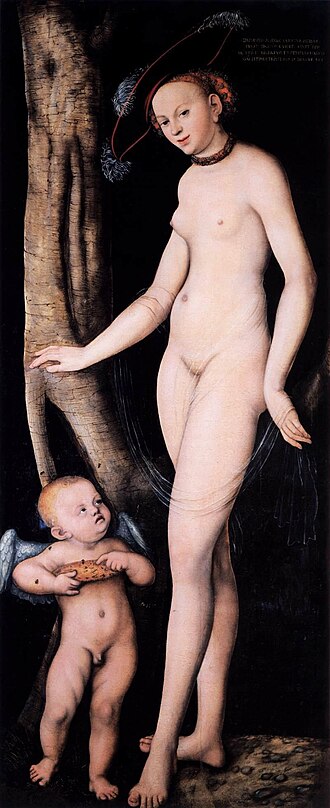 Venus y Cupido con un panal de miel - Lucas Cranach the Elder (1531)
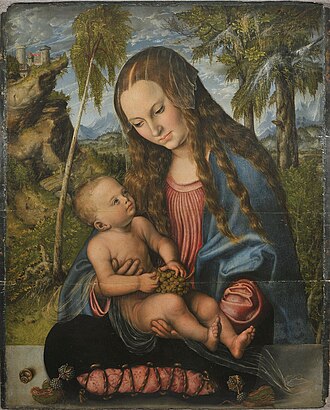 Madonna under the Fir Tree - Lucas Cranach the Elder
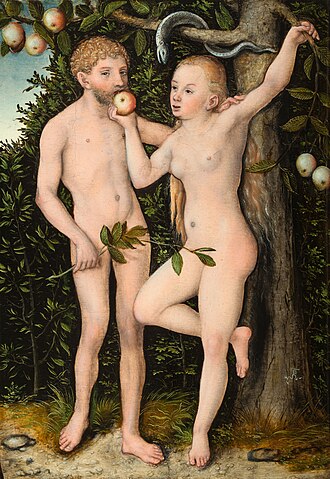 Adam and Eve - Lucas Cranach the Elder (1538)
.jpg) Law and Grace - Lucas Cranach the Elder (1529)
Law and Grace - Lucas Cranach the Elder (1529).jpg) Príncipe Juan de Anhalt - Lucas Cranach the Elder (1520)
Príncipe Juan de Anhalt - Lucas Cranach the Elder (1520).jpg) La pareja desigual - Lucas Cranach the Elder (1548)
La pareja desigual - Lucas Cranach the Elder (1548)
Obras de artistas relacionados
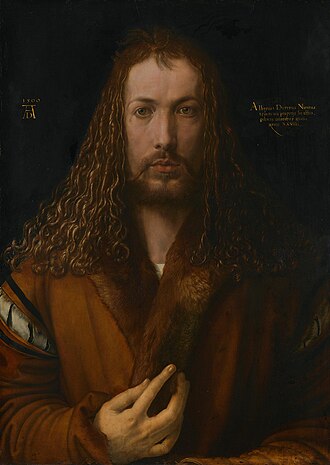 Autorretrato de Durero - Albrecht Dürer (1500)
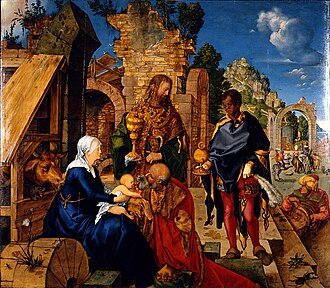 Adoración de los Magos - Albrecht Dürer (1504)