Madonna de San Nicolás dei Frari
Tiziano · 1520s
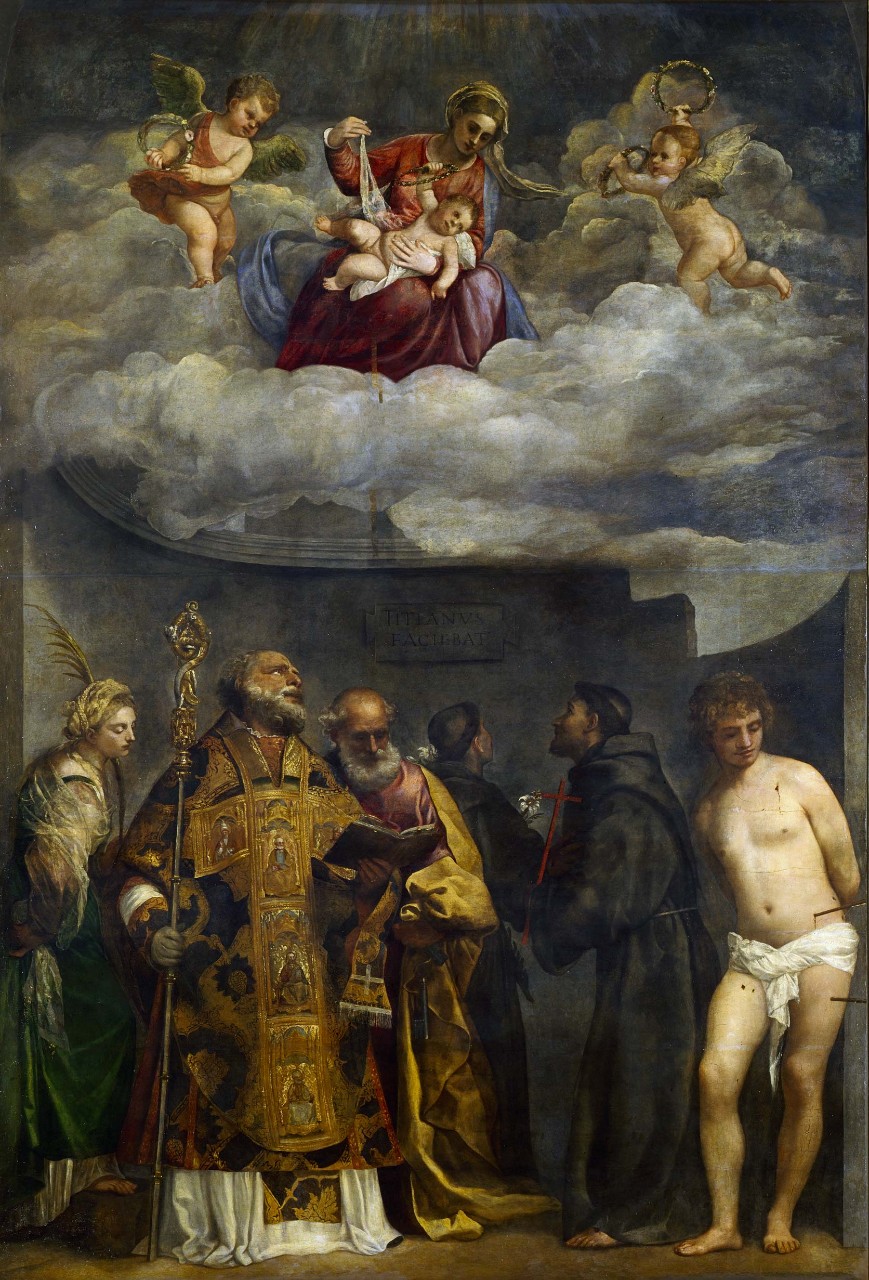
A bishop in a heavy gold-embroidered robe gazes up to heaven while a young saint reads over his shoulder. Goethe said this Titian put everything he had seen before into the shade, and beneath it lies a first, hidden version.
The story behind the painting
Titian painted this altarpiece in oil on panel for the Venetian church of San Nicolò della Lattuga, also called San Nicolò dei Frari. A document published in 1770 dates the commission to 1514, and when the picture was moved to canvas in 1960, an earlier composition was found underneath, the version Titian began in 1514 to 1515 and left unfinished while he took on grander jobs such as the Assumption and the Pesaro altarpiece. Giorgio Vasari claimed the commission first went to Titian's pupil Paris Bordone, but it has been shown that Bordone could not work independently until 1520.
What to look for
The final version, about 388 by 270 cm, drops the closed symmetrical pyramid of the first design for more varied, pronounced gestures in the group of saints below, after Titian's experience with the Assumption. Goethe described what struck him: an immense mass robe stiff with gold-embossed figures wrapping a bishop who holds a pastoral staff and a book and gazes toward heaven, while behind him a beautiful young woman with a palm branch looks over his shoulder into the open book. These are Saint Nicholas, patron of the church, and Saint Catherine of Alexandria.
Meaning and intent
The marble frame carried a dedication to the Virgin Mary, mother of the Redeemer, dated 1522. Saint Nicholas, especially venerated in Venice and often seen there as protector of sailors, here stands apart from the others; his great height makes him a firm pillar of the Church. The date of the second version has long been debated. Many scholars now agree on 1522 to 1526, while Mayer, Pallucchini and Valcanover preferred around 1535, and Hood and Hope proposed 1532 to 1538 because of the signature Titianus, an argument weakened because Titian used that form as early as 1520.
Legacy
In the eighteenth century the friars complained that the panel was deteriorating day by day. In 1770 it was sold to the British consul John Udny, then Pope Clement XIV was persuaded to buy it. Goethe saw it at the Quirinal Palace in 1786 with the painter Tischbein. Pius VII moved it to the Vatican, where it became part of the picture gallery in 1817. It was cut in two for transport, and its arched top was removed so it could pair with Raphael's Transfiguration. A transfer to canvas in 1960 and a restoration for a 2013 Titian exhibition followed.
¿Sabías que…?
- Commissioned in 1514; the final composition dates from the 1520s to 1535 according to different scholars.
- An earlier unfinished version was found beneath it in 1960.
- Goethe admired it at the Quirinal in 1786.
- Now in the Pinacoteca Vaticana.
Sobre el artista
Tiziano (1488-1576)
arte religioso · Virgen María · Alto Renacimiento · Niño Jesús · escuela veneciana · Pedro · Pinacoteca Vaticana · Catalina de Alejandría · Francisco de Asís
Más obras de Tiziano
.jpg) Venus de Urbino - Titian (1538)
Venus de Urbino - Titian (1538) La Asunción de la Virgen - Titian (1510s)
FXD.jpg) Amor sacro y amor profano - Titian (1510s)
Amor sacro y amor profano - Titian (1510s) Carlos V a caballo en Mühlberg - Titian (1548)
 Flora - Titian (1517)
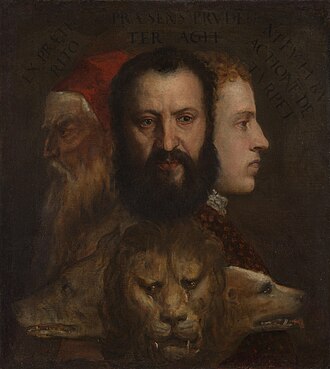 Alegoría de la Prudencia - Titian (1550)
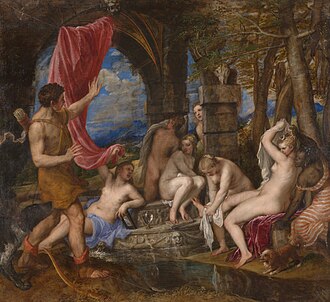 Diana y Acteón - Titian (1550s)
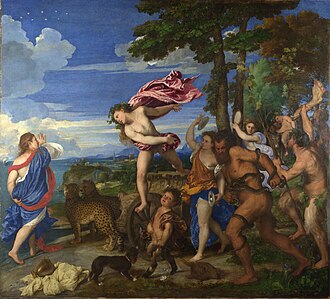 Baco y Ariadna - Titian (1520s)
Obras de artistas relacionados
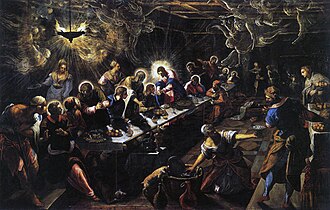 La Última Cena - Jacopo Tintoretto (1563)
 San Marcos liberando al esclavo - Jacopo Tintoretto (1540s)