Andrea Mantegna
1431-1506
Andrea Mantegna, a carpenter's son who fell in love with ancient Rome, painted figures as firm as statues and perspectives so daring that they still seem to break through walls and ceilings.
Origins
Andrea Mantegna was born around 1431 in Isola di Carturo, near Padua, in the Venetian Republic, the second son of a carpenter named Biagio. At eleven he was apprenticed to the Paduan painter Francesco Squarcione, a former tailor with a passion for ancient art who collected statues, reliefs and vases and let his pupils study them. Mantegna was said to be his favourite pupil; Squarcione taught him Latin and had him study fragments of Roman sculpture. At seventeen Mantegna left the workshop, later claiming that his master had profited from his work without paying him fairly. Padua then drew artists such as Donatello, Paolo Uccello and Filippo Lippi.
Life and turning points
In 1448 he began working on the Ovetari Chapel frescoes in the Eremitani church in Padua and ended up finishing most of them alone. In 1453 he married Nicolosia, daughter of Jacopo Bellini. Between 1457 and 1459 he painted the San Zeno altarpiece in Verona. In 1460 Ludovico III Gonzaga made him court artist in Mantua, at a salary so large it marked the high regard for his art. From 1488 to 1490 he painted a chapel for Pope Innocent VIII in the Vatican. Back in Mantua he worked for Francesco II Gonzaga and Isabella d'Este. He died in Mantua on 13 September 1506.
Style and technique
Like other artists of his time, Mantegna experimented with perspective, for example lowering the horizon to give his scenes greater monumentality. His flinty, metallic landscapes and somewhat stony figures reveal a fundamentally sculptural approach. He openly considered ancient art superior to nature, so he drew with precise outlines and gave his figures slim, muscular, bony forms; his draperies are tight and closely folded. In the Camera degli Sposi in Mantua, finished around 1474, the painted oculus in the ceiling had a profound effect on Correggio. His perspective was not always mathematically correct, but it achieved an astonishing effect for the time. He also ran the leading print workshop in Venice before 1500.
Stories and anecdotes
Squarcione mocked the Ovetari frescoes, saying the figures looked like men made of stone and should have been painted the colour of marble. Vasari notes the irony, since it was Squarcione's love of Roman art that had shaped his pupil. Most of the Ovetari cycle, including the dramatic St. James Led to His Execution, was lost in the 1944 bombing of Padua. His Vatican frescoes were destroyed in 1780. Isabella d'Este disliked his 1493 portrait of her, complaining it had no features like her own. In old age, troubled by debts, he had to part with a beloved antique bust of Faustina, and he died very soon after.
Legacy
Mantegna was the first painter of real eminence to be based in Mantua. His nine Triumphs of Caesar, finished around 1492 and considered his finest works, were sold in 1628 with much of the Mantuan art collection to King Charles I of England. The Lamentation over the Dead Christ, probably painted for his own funerary chapel, remains one of his most famous images. His San Zeno altarpiece was probably the first good example of Renaissance art in Verona. In 1516 his sons raised a monument to him in Sant'Andrea in Mantua. His stony grandeur and bold illusion opened new possibilities for the painters who followed.
¿Sabías que…?
- The sketch for his St. Stephen fresco is the earliest known surviving preliminary drawing that can be compared with its fresco.
- He never signed or dated his engraved plates, except for one disputed instance of 1472.
- He built a house near San Sebastiano in Mantua that can still be seen today.
- His painting for Isabella d'Este's studiolo on the god Comus was finished by Lorenzo Costa.
Primer Renacimiento · Renacimiento
Artistas relacionados
Sandro Botticelli · Piero della Francesca · Leonardo da Vinci · Fra Angelico
Obras de Andrea Mantegna
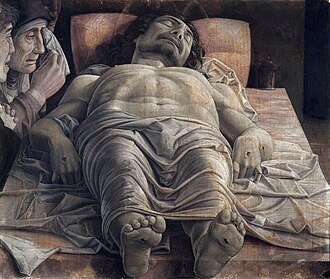 Lamentación sobre Cristo muerto - Andrea Mantegna (1483)
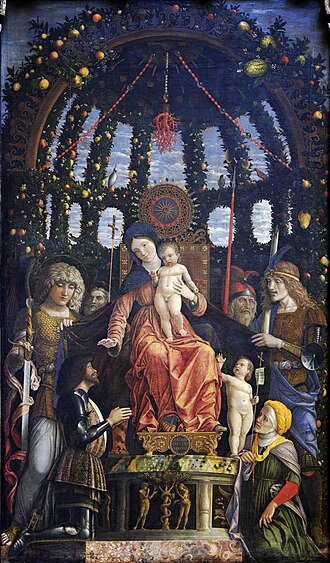 Madonna de la Victoria - Andrea Mantegna
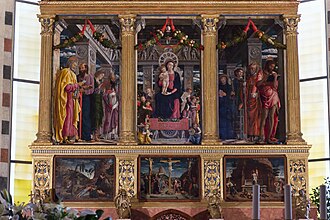 Retablo de San Zenón - Andrea Mantegna (1457)
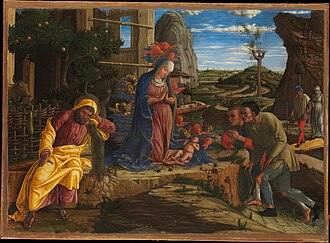 Adoración de los Pastores - Andrea Mantegna (1450)
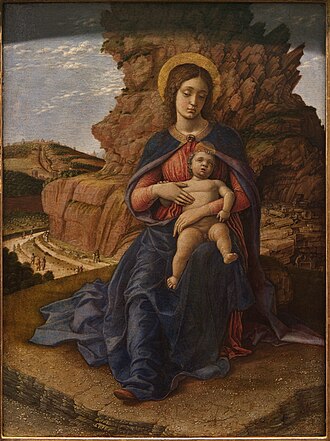 Madonna de la Cantera - Andrea Mantegna (1489)
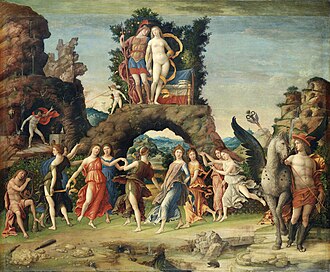 Parnaso - Andrea Mantegna
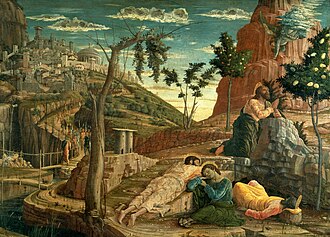 Oración en el huerto - Andrea Mantegna (1459)
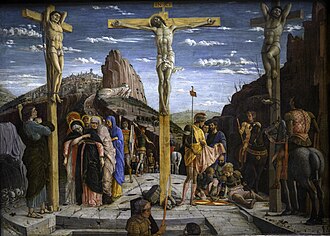 Crucifixión - Andrea Mantegna (1450s)
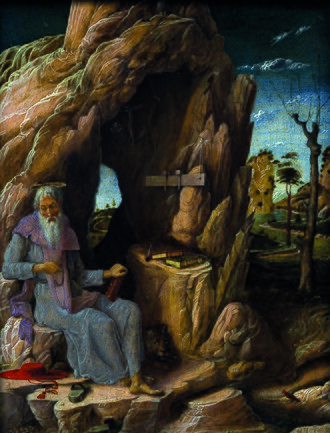 San Jerónimo Penitente en el Desierto - Andrea Mantegna
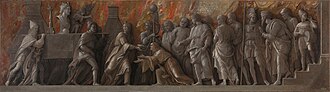 Introducción del culto de Cibeles en Roma - Andrea Mantegna (1500s)
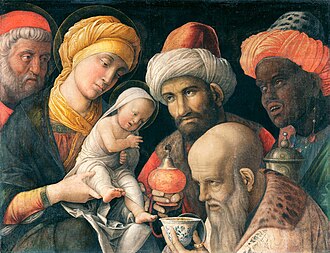 Adoración de los Magos - Andrea Mantegna (1500)
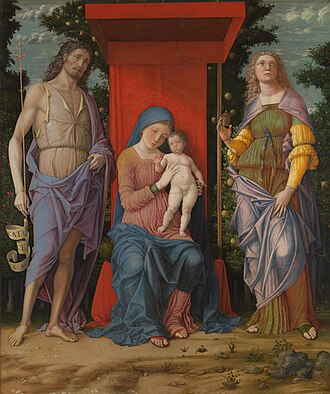 La Virgen y el Niño con santa María Magdalena y san Juan Bautista - Andrea Mantegna
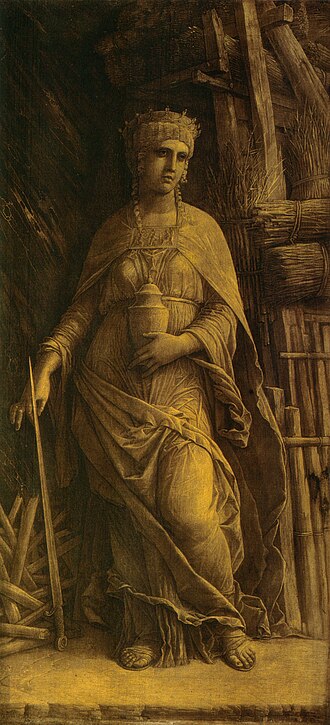 Dido - Andrea Mantegna (1495)
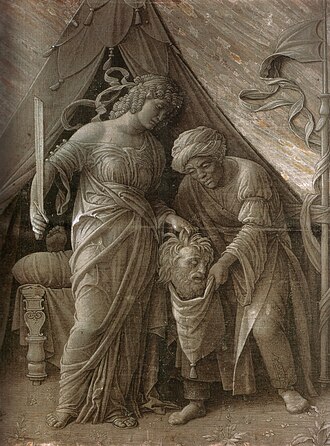 Judith with the Head of Holofernes - Andrea Mantegna