The Vow of Louis XIII
Jean-Auguste-Dominique Ingres · 1824
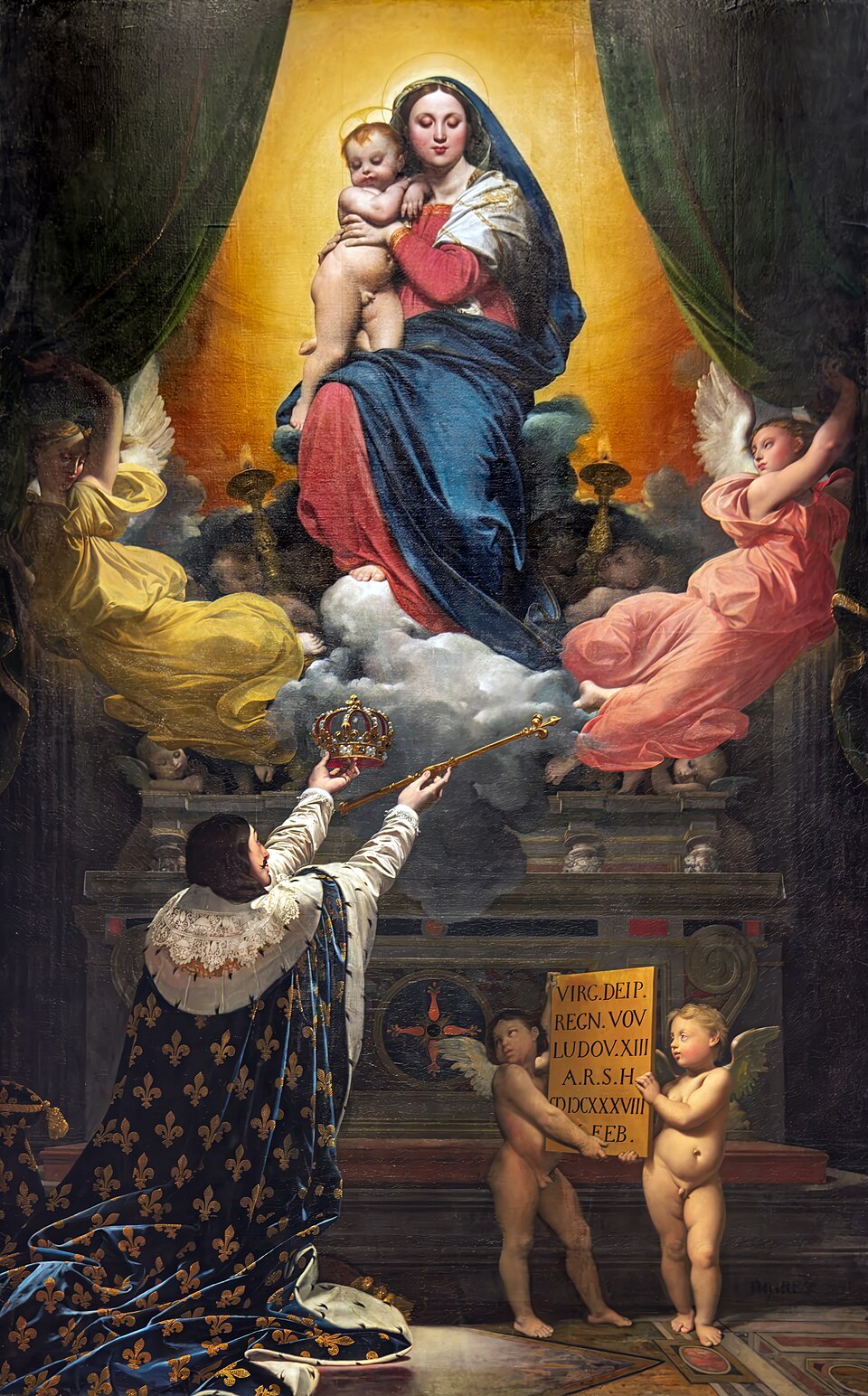
A French king makes a vow to the Virgin, who appears above with the Christ Child. Ingres spent four years on this huge canvas in Florence, and in 1824 it made him, almost overnight, the champion of classicism in France.
The story behind the painting
In August 1820 France's Ministry of the Interior commissioned the painting for the cathedral of Notre-Dame in Montauban. The subject was set: Louis XIII's vow in 1638 to consecrate his kingdom to the Virgin in her Assumption. Ingres was then living in Florence. He had found success as a portrait painter, but his ambition was to make his name in history painting, the more prestigious genre. He worked with his usual diligence and spent four years bringing the large canvas, about 421 by 262 cm, to completion. In October 1824 he travelled to Paris with it for the Salon.
What to look for
Numerous life drawings and painted studies survive, and a small oil sketch of the composition is in the Musée Ingres in Montauban. Comparing the two shows a key change. In the sketch the Virgin stands with her hands together and does not hold the Christ Child. For the final painting Ingres borrowed the seated Virgin and Child from Raphael's Madonna di Foligno and reversed the pose. Look at the Virgin and Child and you are looking, in mirror image, at Raphael, filtered through Ingres.
Meaning and intent
The painting was conceived in a Raphaelesque style, relatively free of the archaisms Ingres had been reproached for in the past. It marked his grand return to the Paris art world after years in Rome and Florence, and his abandonment of a more daring style. At the Salon of 1824 it was a critical success, and it set Ingres up as the main representative of classicism, against the romanticism represented at the same Salon by Delacroix's The Massacre at Chios. A royal vow, a classical Madonna and an ordered composition: the subject and the style both spoke for tradition.
Legacy
Ingres found himself celebrated throughout France. In January 1825 Charles X awarded him the Cross of the Legion of Honour, and in June 1825 he was elected to the Institut de France. The painting went to its intended home and remains in Montauban Cathedral. Ingres did not forget its central figures. In 1855 he repeated the Virgin and Child in a watercolour he made for his wife, Virgin and Child Appearing to Saints Anthony of Padua and Leopold, now at the Fogg Art Museum in Cambridge. Wikidata gives the size as 421 by 262 cm.
Did you know?
- Commissioned by the French Ministry of the Interior in August 1820.
- Took Ingres four years, mostly in Florence.
- A success at the Salon of 1824, opposite Delacroix's Massacre at Chios.
- Still in Montauban Cathedral.
About the artist
Jean-Auguste-Dominique Ingres (1780-1867)
history painting · Neoclassicism · Madonna and Child
More by Jean-Auguste-Dominique Ingres
 Grande Odalisque - Jean-Auguste-Dominique Ingres (1814)
 The Source - Jean-Auguste-Dominique Ingres (1856)
 The Turkish Bath - Jean-Auguste-Dominique Ingres (1862)
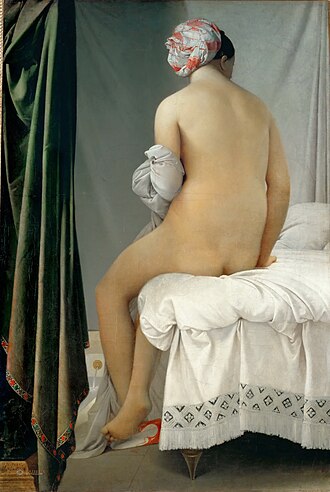 The Valpinçon Bather - Jean-Auguste-Dominique Ingres (1808)
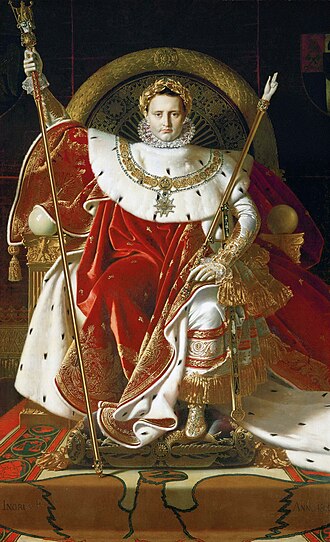 Napoleon I on his Imperial Throne - Jean-Auguste-Dominique Ingres (1806)
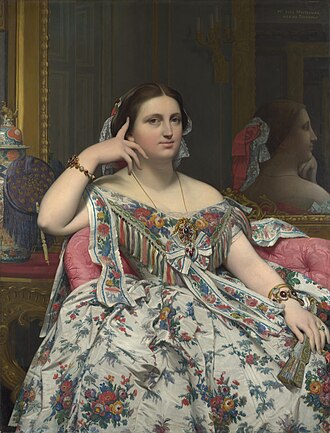 Madame Moitessier - Jean-Auguste-Dominique Ingres (1856)
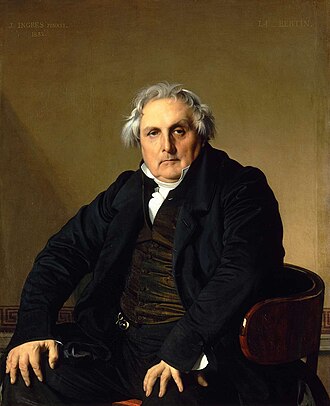 Portrait of Monsieur Bertin - Jean-Auguste-Dominique Ingres (1832)
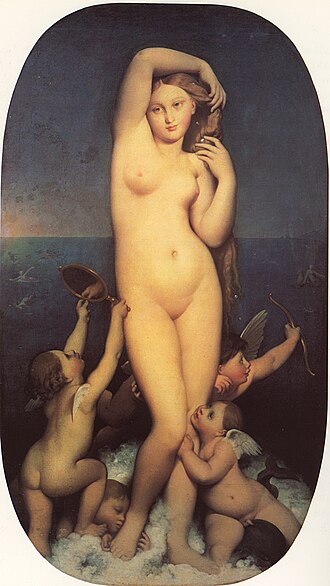 Vénus Anadyomène - Jean-Auguste-Dominique Ingres (1808)
Paintings by related artists
 The Death of Socrates - Jacques-Louis David (1787)
 The Oath of the Horatii - Jacques-Louis David (1784)
 The Third of May 1808 - Francisco Goya (1814)
 La Maja nue - Francisco Goya (1800)