The Thames
Berthe Morisot · 1875
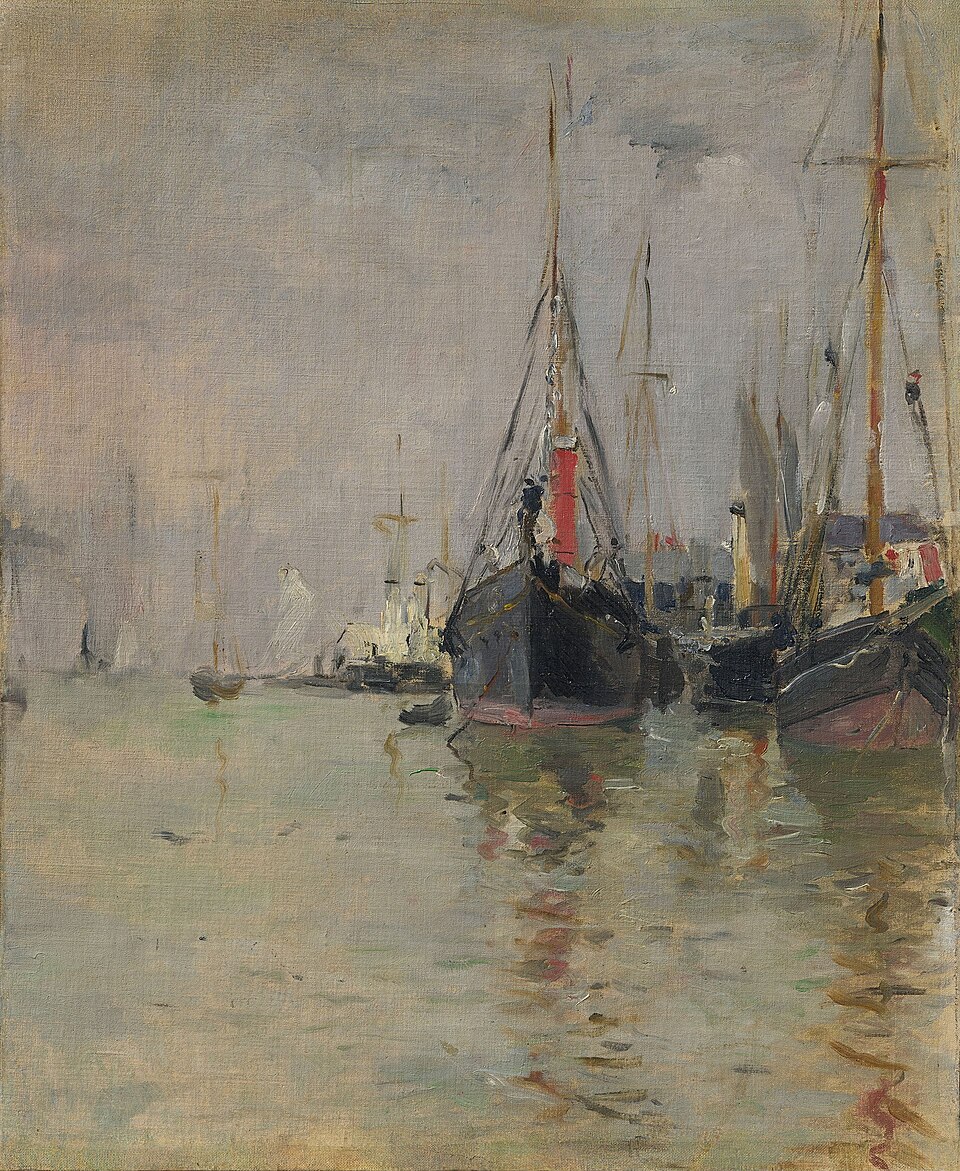
Grey clouds, glinting water and a ship with a bright red funnel: in London in 1875, Berthe Morisot tried her hand at the open-air city view after looking at Turner. This is the only landscape that came of it.
The story behind the painting
Berthe Morisot painted The Thames, in French La Tamise, in London in 1875, in oil on canvas, 46 by 38 cm. She did not sign it. During that stay she visited the National Gallery, where she studied eighteenth-century painting and also the works of William Turner. Like many Impressionists, she was interested in how Turner captured light, air and atmosphere. His pictures encouraged her to attempt studies of the city in the open air, and this is the only landscape painting that resulted from those attempts.
What to look for
The picture shows ships on the River Thames in London. The grey, cloudy sky and the water with its reflections take up much of the space. One ship stands out: besides its sailing mast and rigging, it has a red funnel, which catches the eye and points to modern steam power. Let your gaze move between the soft greys of sky and river and that single strong note of red, which holds the whole composition together.
Meaning and intent
Another influence was probably Claude Monet's Impression, Sunrise, which Morisot had seen in the spring before her trip, in a shared exhibition. Monet's picture also has a red contrast, though there it comes from the rising sun. In Morisot's version the red belongs not to nature but to a machine, a steam funnel among the old sails. The painting thus joins the Impressionist search for atmosphere with a quiet sign of the modern industrial city.
Legacy
The first known owner was the artist's niece, Paule Gobillard. She left it to her sister Jeannie, Madame Paul Valéry, and it then passed by inheritance into a private collection. Hasso Plattner acquired it on the art market in April 2002. It was shown in London in 1950, in Paris at the Musée Marmottan in 1993 in an exhibition of women Impressionists, and since 2020 at the Museum Barberini in Potsdam. In 2021 it was one of three works by Morisot on permanent display in German museums.
Did you know?
- Painted in London in 1875, unsigned.
- Inspired by Turner's paintings in the National Gallery.
- Morisot's only landscape from that London stay.
- Shown at the Museum Barberini, Potsdam, since 2020.
About the artist
Berthe Morisot (1841-1895)
Impressionism: The Hasso Plattner Collection
More by Berthe Morisot
 The Cradle - Berthe Morisot (1872)
 Summer's Day - Berthe Morisot (1879)
 The Psyche mirror - Berthe Morisot (1876)
 The Port at Lorient - Berthe Morisot (1869)
 The Mother and Sister of the Artist - Berthe Morisot
 Eugène Manet on Isle of Wight - Berthe Morisot (1875)
 Young girl in a park - Berthe Morisot (1893)
 In the Dining Room - Berthe Morisot (1886)
Paintings by related artists
 Impression, Sunrise - Claude Monet (1872)
 Water Lilies - Claude Monet (1906)
 Luncheon on the Grass - Édouard Manet (1863)
 Olympia - Édouard Manet (1863)
 Dance at Le Moulin de la Galette - Pierre-Auguste Renoir (1876)
 Luncheon of the Boating Party - Pierre-Auguste Renoir (1881)
 L'Absinthe - Edgar Degas (1875)
 The Bellelli Family - Edgar Degas (1858)
 The Canal du Loing at Moret - Alfred Sisley (1892)
 The Watering Pond at Marly with Hoarfrost - Alfred Sisley (1876)
 Paris Street; Rainy Day - Gustave Caillebotte (1877)
 Les raboteurs de parquet - Gustave Caillebotte (1875)