The Thames below Westminster
Claude Monet · 1871
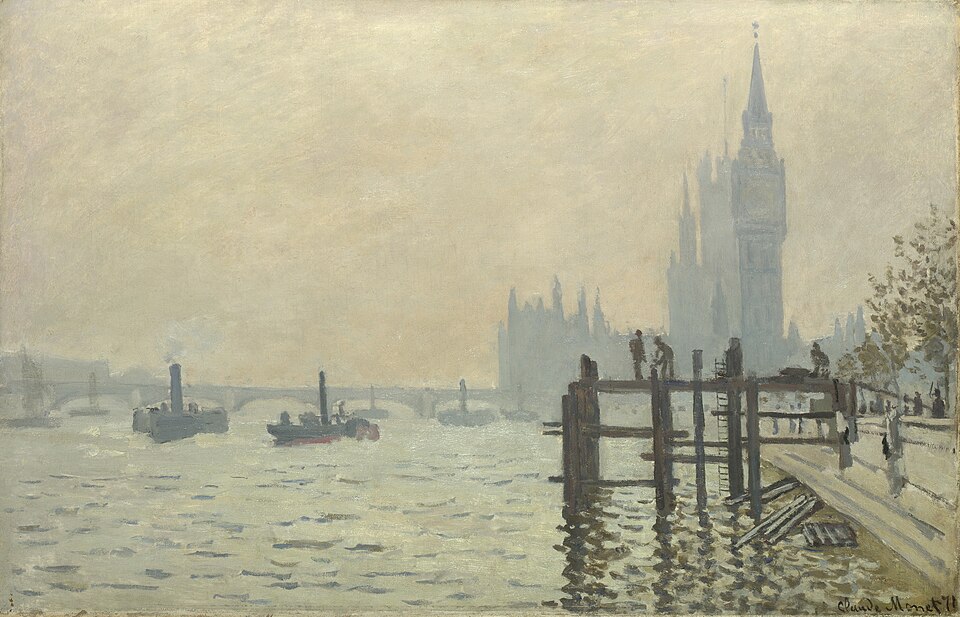
A pale haze over the river, a new Parliament half lost in mist, steamboats and a building site in the foreground. Monet painted it in 1871 as a refugee from war in London, and thirty years later he came back to the same view.
The story behind the painting
After the French defeat at Sedan in 1870, Monet left for London, alone at first. There he met Daubigny again, who introduced him to the dealer Durand-Ruel. Thanks to the dealer's purchases, Monet could bring over Camille, newly his wife, and their son Jean. He also met Pissarro, and both were captivated by the city and its many subjects. They visited museums where the paintings of the Turner bequest were now on show, and the English painter's style gave them a kind of inspiration. With Durand-Ruel interested in his work, Monet quickly took up again the painting that the war on the continent had interrupted. He very probably also knew Whistler's paintings and etchings of the British capital.
What to look for
The Houses of Parliament had burned almost completely in 1834, and rebuilding took decades; by 1871 it was nearly finished, with the Victoria Tower standing and the Big Ben tower being completed. The old bridge had already been replaced, and the embankments were being rebuilt, including the Victoria Embankment, which served both as a flood wall and as a road covering the underground railway. Look at the steamboats and the works in progress: Monet is painting modernity. Look too at the sharp foreground against the blurrier planes behind it, and at the subtle touches of salmon colour that add a warm tone, hinting at the hidden sun and giving life to the sky and the river.
Meaning and intent
The buildings are not the only subject. The diffuse light created by the mist is something Monet wanted to bring forward just as much. The French Wikipedia article describes his means here as economical. The work may seem to draw on Whistler or Turner, yet it differs from both through Monet's very personal use of colour. So this small canvas, about 47 by 72.5 cm, is at once a picture of a modern city under construction and a study of light dissolving in fog, painted by an exile who was rebuilding his own working life after the war.
Legacy
Monet returned to the same site during several stays between 1899 and 1901, painting it under different conditions of light. The result became one of his most famous series, the Houses of Parliament. Seen from there, the 1871 picture is a first meeting with a motif he would revisit three decades later. The canvas is dated 1871 in both sources and today belongs to the National Gallery in London, the city where it was painted. Its French title names the Thames and the Parliament, while in English it is known as The Thames below Westminster.
Did you know?
- Painted in London in 1871, during Monet's first stay there.
- Shows the rebuilt Parliament, steamboats and embankment works.
- Monet painted the same site again between 1899 and 1901.
- Now in the National Gallery, London.
About the artist
Claude Monet (1840-1926)
More by Claude Monet
 Impression, Sunrise - Claude Monet (1872)
 Water Lilies - Claude Monet (1906)
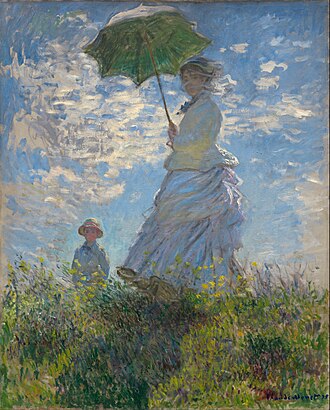 Woman with a Parasol - Claude Monet (1875)
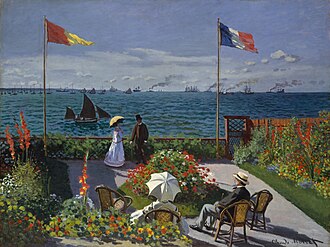 Garden at Sainte-Adresse - Claude Monet (1867)
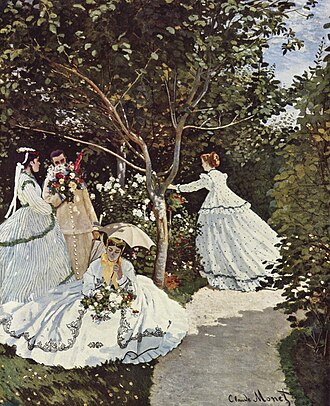 Women in the Garden - Claude Monet (1866)
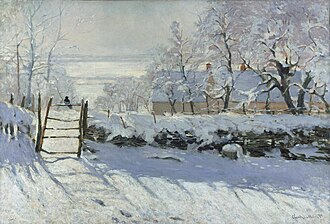 The Magpie - Claude Monet (1868)
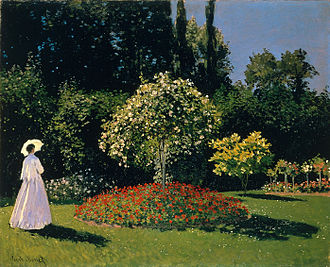 Woman in the Garden - Claude Monet (1867)
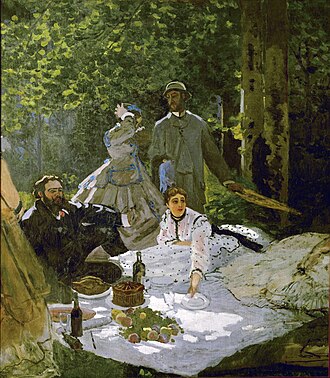 Luncheon on the Grass - Claude Monet (1866)
Paintings by related artists
 The Fighting Temeraire - J. M. W. Turner (1839)
 Rain, Steam and Speed - The Great Western Railway - J. M. W. Turner (1844)
 L'Origine du monde - Gustave Courbet (1866)
 A Burial at Ornans - Gustave Courbet (2020)
 Luncheon on the Grass - Édouard Manet (1863)
 Olympia - Édouard Manet (1863)
 Dance at Le Moulin de la Galette - Pierre-Auguste Renoir (1876)
 Luncheon of the Boating Party - Pierre-Auguste Renoir (1881)
 The Cradle - Berthe Morisot (1872)
 Summer's Day - Berthe Morisot (1879)
 L'Absinthe - Edgar Degas (1875)
 The Bellelli Family - Edgar Degas (1858)