The death of young Bara
Jacques-Louis David · 1794
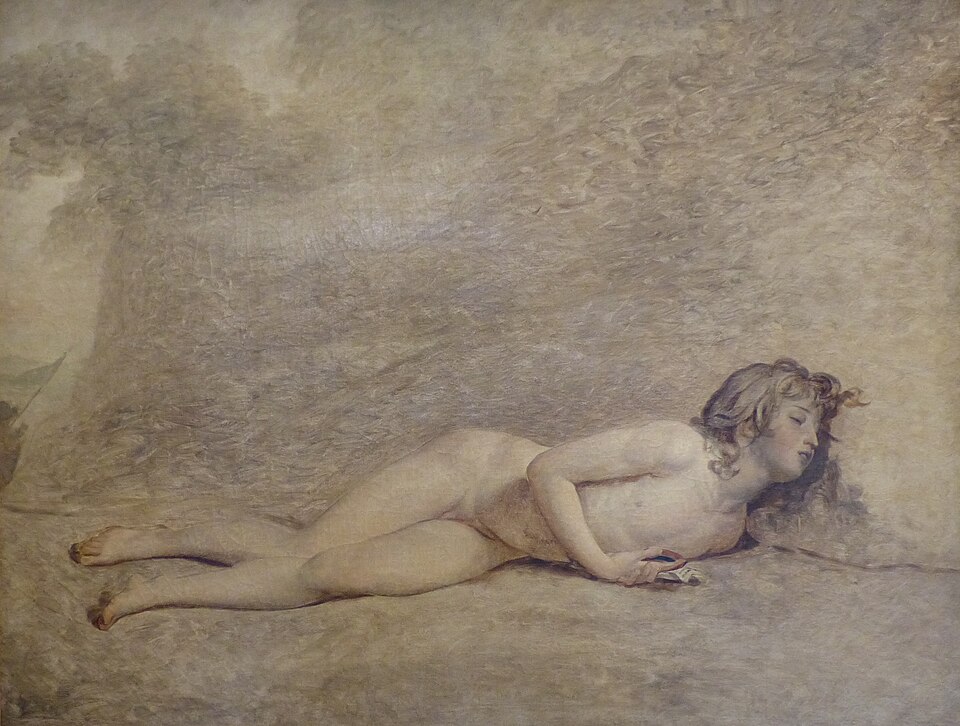
A pale boy lies alone on bare ground, clutching a letter and a tricolour cockade. David painted the death of twelve-year-old Joseph Bara in 1794 as a revolutionary martyr, and left the canvas unfinished.
The story behind the painting
Joseph Bara was a young drummer in the army of the French First Republic, too young to enlist but, according to General J.B. Desmarres, whom he assisted, burning to serve. Desmarres reported that the boy died rather than hand over a pair of horses to the enemy, killed by the Vendéens, French Royalists. In the hard winter of 1793 to 1794, as Robespierre struggled to hold power, he turned the story into a beacon: Bara, he said, had answered cries of long live the king with long live the Republic. Robespierre asked David to paint the boy as absolute virtue, and wanted the image reproduced in schools to inspire children to join the Republic's forces.
What to look for
Only one figure fills the canvas: a naked, androgynous body lying horizontally, dividing background from foreground. The hands grasp a letter and a red, white and blue cockade. A small silhouette at the far left is the only hint of the story of the stolen horses. Grey and brown tones form a cold, unsettled backdrop, and a broad area of scumbling above the body sets off the smooth pale skin, which shows no wound or blood. The only sign of pain is the tortured face. A thin brown layer of oil paint and thinner, a technique called frotté used in early stages, suggests the work was never completed.
Meaning and intent
David leaned on Bara's innocence and youth, softening his masculinity; the art historian Dorothy Johnson speaks of beauty without disruption. The pose recalls antique sculpture such as the Hermaphrodite and Girodet's Sleep of Endymion. Historians read the nakedness in different ways: some think the attackers stripped him, a few even see a darker hidden narrative, and others see only an allegory of devotion to the nation. David himself told the National Convention that he meant to contrast Bara with idle, corrupted young loyalists. The letter, probably to his mother, speaks of love for family, and the cockade of love for the homeland.
Legacy
The painting belongs to David's group of images of the Revolution's heroes and martyrs, beside The Death of Marat and The Last Moments of Michel Lepeletier. Experts still disagree on whether it is truly finished, but the frotté underlayer points to a canvas stopped in an early stage. It is dated 1794 and measures about 119 by 156 cm. Today it hangs in the musée Calvet in Avignon. What survives is less a record of what happened to Joseph Bara than a record of how a revolution wanted him remembered, painted by an artist who shared its feelings of pride, sorrow and pain.
Did you know?
- Painted in 1794 at Robespierre's request.
- Joseph Bara was twelve when he was killed by Royalist Vendéens.
- Left unfinished, with an early frotté underlayer still visible.
- Held at the musée Calvet in Avignon.
About the artist
Jacques-Louis David (1748-1825)
portrait · boy · waist-length hair · Neoclassicism · nudity · history painting · brown hair · lying · agony
More by Jacques-Louis David
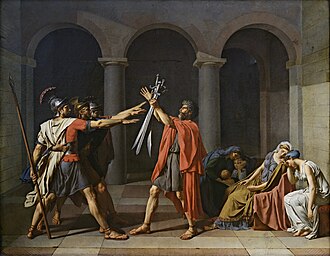 The Oath of the Horatii - Jacques-Louis David (1784)
.jpg) The Intervention of the Sabine Women - Jacques-Louis David (1799)
The Intervention of the Sabine Women - Jacques-Louis David (1799)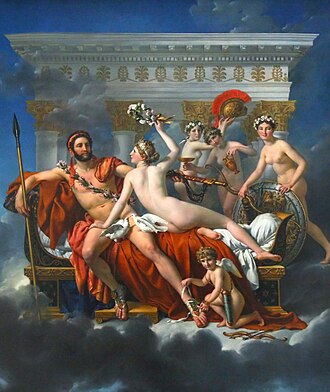 Mars Being Disarmed by Venus - Jacques-Louis David (1824)
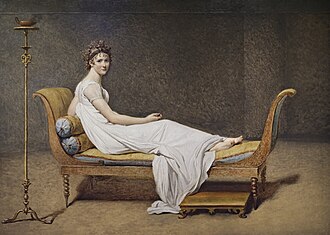 Portrait of Madame Récamier - Jacques-Louis David (1800)
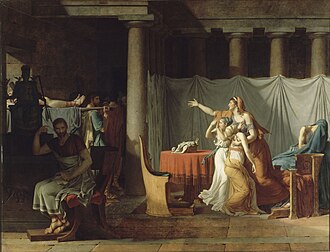 The Lictors Bring to Brutus the Bodies of His Sons - Jacques-Louis David (1789)
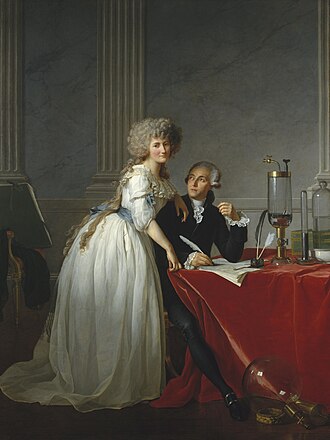 Portrait of Antoine-Laurent Lavoisier and his wife - Jacques-Louis David (1788)
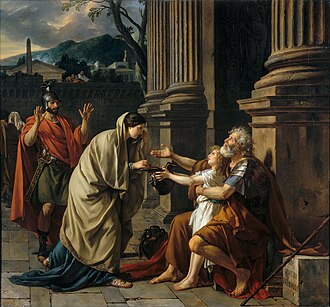 Belisarius Begging for Alms - Jacques-Louis David (1781)
Cupid and Psyche - Jacques-Louis David (1817)
Paintings by related artists
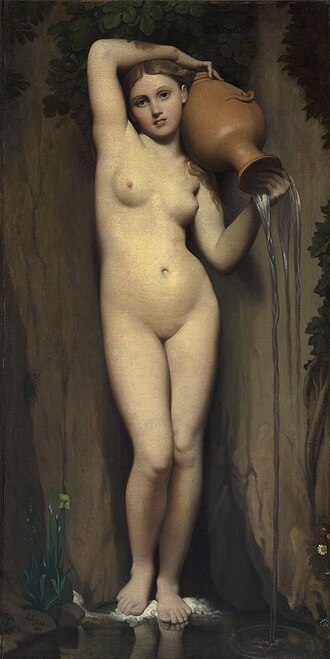 The Source - Jean-Auguste-Dominique Ingres (1856)
 Napoleon I on his Imperial Throne - Jean-Auguste-Dominique Ingres (1806)
 The Third of May 1808 - Francisco Goya (1814)
.jpg) La Maja nue - Francisco Goya (1800)
La Maja nue - Francisco Goya (1800)