The Beggars
Pieter Bruegel the Elder · 1568
.jpg)
Five men on crutches shuffle across a sunlit courtyard, each wearing a hat that mocks a rank of society: crown, helmet, cap, mitre, beret. It is one of Bruegel's smallest surviving paintings, and its riddle has never been fully solved.
The story behind the painting
Pieter Bruegel the Elder painted The Beggars, also called The Cripples, in 1568, near the end of his career, a time when he showed a keener interest in the natural world. The panel is tiny, only 18.5 by 21.5 cm, among his smallest known surviving works. The Netherlands at the time was in turmoil under Spanish rule, on the way to the Dutch Revolt. Some have tried to link the picture to a real event: the fox or badger tails on the beggars' clothes might refer to the Gueux, a rebel party formed against Philip II of Spain and Granvelle. But the same tails already appear in Bruegel's Fight Between Carnival and Lent of 1559, so the link is uncertain.
What to look for
Five physically impaired men move on crutches across a courtyard enclosed by red-brick walls. Their headgear looks like carnival costume: a cardboard crown for the king, a paper shako for the soldier, a beret for the burgher, a cap for the peasant and a mitre for the bishop. Foxtails hang from their clothes. In the background a woman in an apron walks away carrying a bowl, seemingly indifferent. Through the opening in the wall, small as it is, a landscape glows in a delicate light that seems to shimmer like dew on the leaves. On the back of the panel are two old inscriptions, one in Flemish, now fragmentary, and one in Latin.
Meaning and intent
The work clearly has a satirical meaning, though it has so far eluded a sure interpretation. Perhaps the physical impairments stand for moral decay, which can strike anyone regardless of class. In the 16th century foxtails were linked with deceit, hypocrisy and social exclusion, and were used to ridicule people in caricature and in real life. Modern viewers may feel the painting invites sympathy, but historians think that unlikely: people in Bruegel's time had little regard for beggars, and the figures are placed outside the town walls and posed in ways meant to provoke contempt and amusement. Seeing it through both eyes, ours and theirs, is part of its unsettling power.
Legacy
The Latin inscription on the back records a humanist's admiration for Bruegel, whose art, it says, surpasses Nature itself. That a viewer in his own century felt moved to write praise on the panel shows how prized his skill already was. Art historians today read the painting both as a stark, realistic record of disability in the early modern Netherlands and as a complex satire aimed at the political and religious unrest of the time. The Beggars entered the Louvre in Paris as a gift in 1892, and it remains the only painting by Bruegel in the Louvre's collection.
Did you know?
- Painted in 1568, near the end of Bruegel's career.
- Only 18.5 by 21.5 cm, among his smallest surviving works.
- The headgear mocks king, soldier, burgher, peasant and bishop.
- Given to the Louvre in 1892; its only Bruegel painting.
About the artist
Pieter Bruegel the Elder (1525-1569)
genre art · Department of Paintings of the Louvre · clothing · beggar · street
More by Pieter Bruegel the Elder
%20-%20Google%20Art%20Project.jpg) The Hunters in the Snow - Pieter Bruegel the Elder (1565)
The Hunters in the Snow - Pieter Bruegel the Elder (1565) Netherlandish Proverbs - Pieter Bruegel the Elder (1551)
 The Triumph of Death - Pieter Bruegel the Elder (1560s)
%20-%20Blind%20leading%20the%20blind%20Google%20Art%20Project.jpeg) The Blind Leading the Blind - Pieter Bruegel the Elder (1568)
The Blind Leading the Blind - Pieter Bruegel the Elder (1568) The Peasant Wedding - Pieter Bruegel the Elder (1560s)
 The Magpie on the Gallows - Pieter Bruegel the Elder (1568)
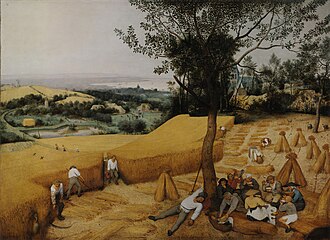 The Harvesters - Pieter Bruegel the Elder (1565)
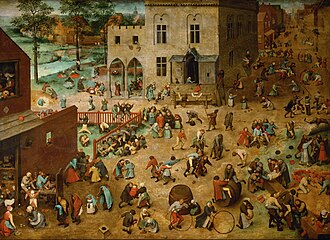 Children's Games - Pieter Bruegel the Elder (1560)
Paintings by related artists
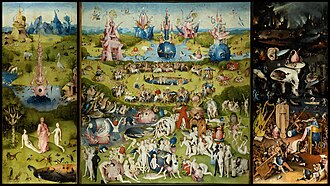 The Garden of Earthly Delights - Hieronymus Bosch
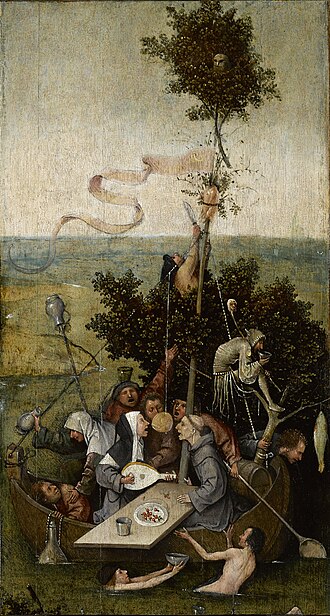 Ship of Fools - Hieronymus Bosch (1500s)
 The Ambassadors - Hans Holbein the Younger (1533)
 The Body of the Dead Christ in the Tomb - Hans Holbein the Younger (1520s)