Patroclus
Jacques-Louis David · 1780
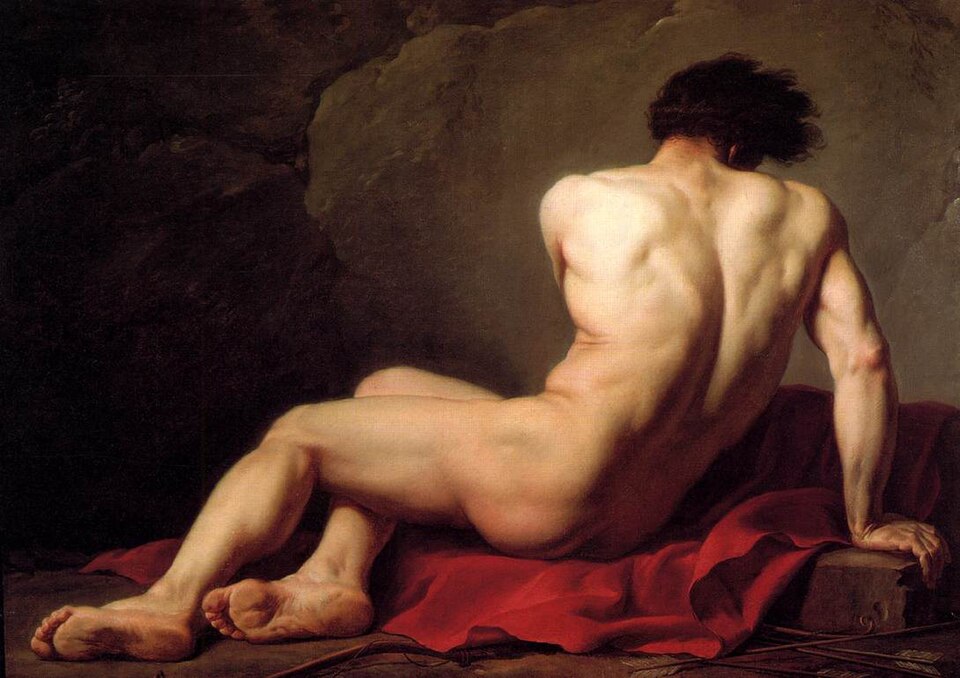
A naked man seen from behind, sitting in shadow, his body carved by light. Young David painted him in Rome, named him after a Homeric hero, and won the admiration of his fellow students.
The story behind the painting
In 1778 Jacques-Louis David won the Prix de Rome with his canvas Antiochus and Stratonice, which allowed him to spend several years in Rome. His teacher Joseph-Marie Vien, newly named director of the French Academy in Rome, travelled with him. Around 1780, in Rome, David painted this large oil on canvas, about 122 by 170 cm, known as Male Academy or Patroclus. It follows an earlier study called Hector of 1778, now in the Musée Fabre in Montpellier, and belongs to the same run of Trojan subjects that occupied him in those years.
What to look for
The painting shows a nude man seen from behind, in tones the sources call Caravaggesque: strong light carving a body out of darkness. The pose comes from the Dying Gaul, a marble copy of a lost Hellenistic bronze kept in the Capitoline Museums, which David could see in Rome. He turned the figure around and showed it from the back, so the eye travels over shoulders, spine and muscles rather than a face. Nothing in the neutral setting points to Troy, and no object links the man to the Greek warrior.
Meaning and intent
It is essentially an academic nude, the kind of figure study young painters made to master anatomy, and only the title gives it a mythological character. Patroclus was the companion of Achilles, and his death and its consequences were a theme dear to David. Episodes from the Iliad were frequent subjects of the Prix de Rome, and Trojan themes were common in French Neoclassical painting. The same year David also painted a large Funeral of Patroclus, now in the National Gallery of Ireland, and another male nude showing the body of Hector.
Legacy
David remembered this figure with pride. In his own words, recorded in the Delafontaine notes, he made it under the impulse of an entirely new inspiration, a large figure seen from the back that brought him great honour among his comrades at the Rome academy. The canvas was given by Bon-Thomas Henry in 1835 and is kept in the Musée Thomas-Henry in Cherbourg-en-Cotentin, France. It offers a rare look at the young David, still a student, already reaching for the sculptural power of his later Neoclassical works.
Did you know?
- Painted by David around 1780 in Rome, after his 1778 Prix de Rome.
- The pose is taken from the ancient Dying Gaul, turned to the back.
- Only the title links the nude to Patroclus.
- Given by Bon-Thomas Henry in 1835; in the Musée Thomas-Henry, Cherbourg.
About the artist
Jacques-Louis David (1748-1825)
nude · sitting · nudity · arrow · bow
More by Jacques-Louis David
 The Death of Socrates - Jacques-Louis David (1787)
 The Oath of the Horatii - Jacques-Louis David (1784)
 The Death of Marat - Jacques-Louis David (1793)
 The Coronation of Gabo Napoleon - Jacques-Louis David (1807)
 The Intervention of the Sabine Women - Jacques-Louis David (1799)
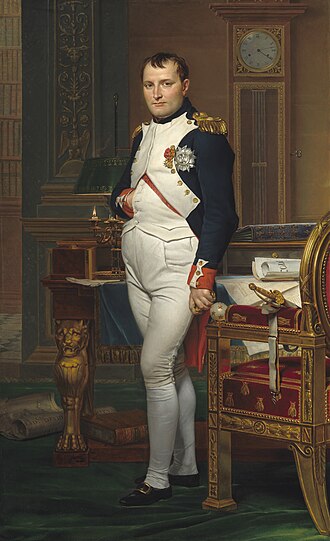 The Emperor Napoleon in His Study at the Tuileries - Jacques-Louis David (1812)
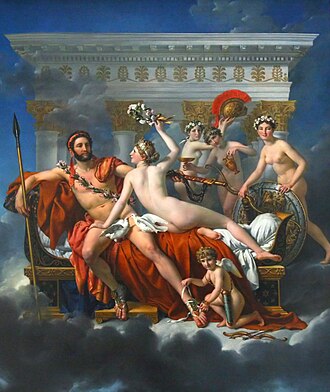 Mars Being Disarmed by Venus - Jacques-Louis David (1824)
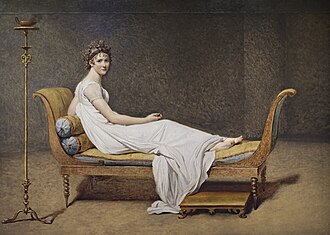 Portrait of Madame Récamier - Jacques-Louis David (1800)
Paintings by related artists
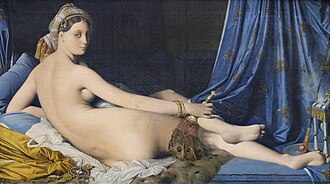 Grande Odalisque - Jean-Auguste-Dominique Ingres (1814)
 The Source - Jean-Auguste-Dominique Ingres (1856)
 The Third of May 1808 - Francisco Goya (1814)
 La Maja nue - Francisco Goya (1800)