Oedipus and the Sphinx
Jean-Auguste-Dominique Ingres · 1808
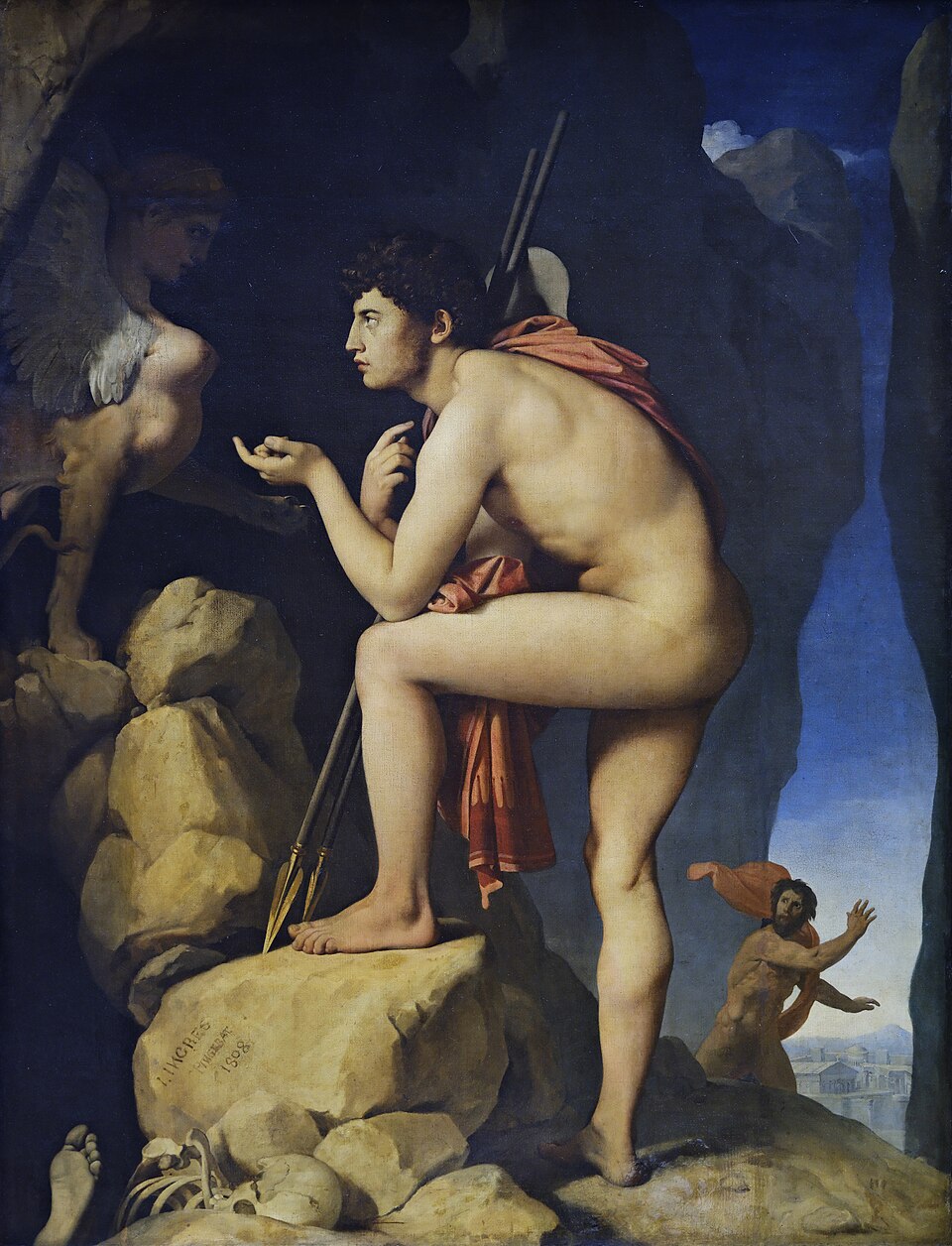
A young nude hero leans towards the Sphinx in the shadows and answers her riddle, while bones lie at his feet and a man flees behind him. Ingres began it as a student exercise in 1808 and finished it almost twenty years later.
The story behind the painting
Ingres won the Grand Prix de Rome in 1801 but only reached Rome in 1806. Working in a studio at the Villa Medici, he had to send works to Paris at regular intervals so his progress could be judged. As his envoi of 1808 he sent a life-size Figure of Oedipus together with The Valpinçon Bather, hoping to show his mastery of the male and the female nude. The academicians were moderately critical: they disliked the treatment of light in both paintings and found the figures not idealised enough. Ingres kept the Oedipus in his studio for years.
What to look for
The painting shows Oedipus explaining the riddle of the Sphinx. It is oil on canvas, 189 by 144 cm. Notice the contrast Ingres built between the brightly lit landscape in the distance and the shadows that wrap around the Sphinx. In the lower left corner lie human remains, the victims of those who failed the riddle. On the right a man runs away, and his attitude and expression reveal Ingres's study of Poussin. The canvas is signed and dated 1808 at lower left, even though much of what we see was painted later.
Meaning and intent
Around 1825 Ingres decided to turn what was essentially a figure study into a fuller narrative scene. He enlarged the canvas, adding 20 cm to the left, 31 cm to the top and 31 cm to the right. In the new space he set the bright distance against the dark rocks, changed the pose of the Sphinx, and added the bones and the fleeing man. A small oil sketch of about 1826, in which he tested the new composition, is in the National Gallery in London and once belonged to Edgar Degas, who bought it in 1897 or earlier.
Legacy
In November 1827 Ingres showed the finished work at the Salon, with two portraits, and they were well received. He sold the painting in 1829, and it entered the Louvre in 1878, where it remains. The subject stayed with him: in 1864 he painted a third version, smaller than the first, which reverses the composition and changes many details. That late version is in the Walters Art Museum in Baltimore. The student piece judged too little idealised thus became one of his lasting images.
Did you know?
- Begun in Rome as Ingres's student envoi of 1808.
- Enlarged and completed around 1825-1827, shown at the Salon of 1827.
- In the Louvre since 1878.
- A reversed third version of 1864 is in Baltimore.
About the artist
Jean-Auguste-Dominique Ingres (1780-1867)
man · Department of Paintings of the Louvre · mythological painting · nude · nudity · Neoclassicism · corpse · spear
More by Jean-Auguste-Dominique Ingres
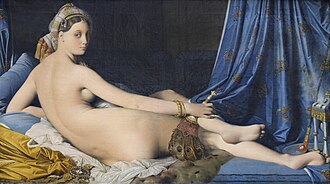 Grande Odalisque - Jean-Auguste-Dominique Ingres (1814)
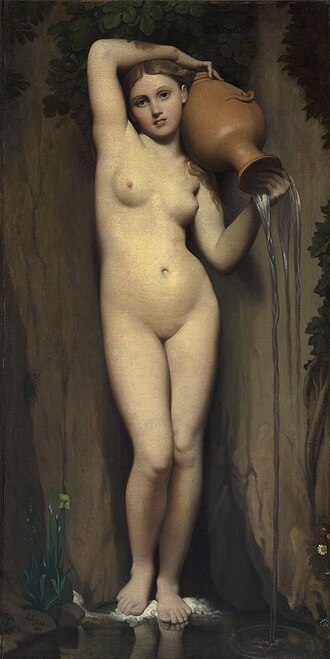 The Source - Jean-Auguste-Dominique Ingres (1856)
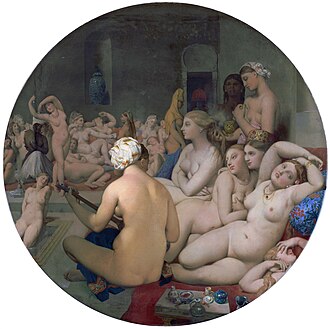 The Turkish Bath - Jean-Auguste-Dominique Ingres (1862)
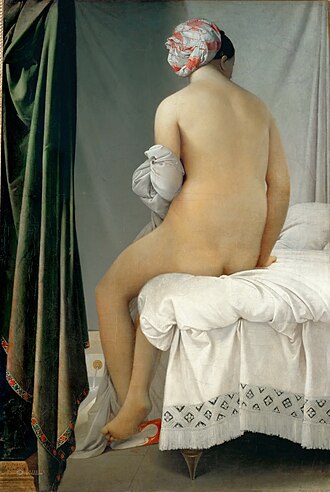 The Valpinçon Bather - Jean-Auguste-Dominique Ingres (1808)
 Napoleon I on his Imperial Throne - Jean-Auguste-Dominique Ingres (1806)
 Madame Moitessier - Jean-Auguste-Dominique Ingres (1856)
 Portrait of Monsieur Bertin - Jean-Auguste-Dominique Ingres (1832)
 Vénus Anadyomène - Jean-Auguste-Dominique Ingres (1808)
Paintings by related artists
 The Death of Socrates - Jacques-Louis David (1787)
 The Oath of the Horatii - Jacques-Louis David (1784)
 The Third of May 1808 - Francisco Goya (1814)
.jpg) La Maja nue - Francisco Goya (1800)
La Maja nue - Francisco Goya (1800)