La Dormeuse de Naples
Jean-Auguste-Dominique Ingres · 1809
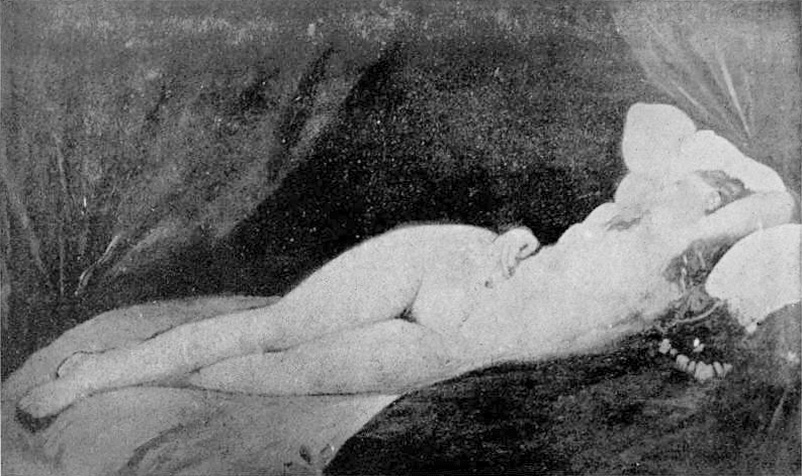
A life-size woman sleeps on a day-bed, one arm folded under her head. Ingres finished her in Rome in 1809, a king bought her, and in 1815 she vanished from a looted palace in Naples. No one has seen the painting since.
The story behind the painting
Ingres first conceived the picture in 1807, while he was a pensionnaire at the French Academy in Rome, as part of the work he owed the Academy. Its first name was simply Donna nuda che dorme, sleeping nude woman. He completed it on 28 October 1809, and it was exhibited as number 58 in the Capitoline Museums. Later that same year it was bought by Joachim Murat, king of Naples, who moved it into the smaller apartments of his royal palace. The young painter's nude had found a royal home.
What to look for
The painting itself cannot be looked at today, so what we know comes from Ingres's own memory. In 1832 he wrote to Caroline Murat and added a quick sketch made from recollection. He described a nude woman, life-size, stretched out on a day-bed. Her head rests on her left arm, which in turn lies on a cushion, and her right arm is folded behind her head. Beyond that letter, the work survives only through preparatory studies, Ingres's drawing from memory and an old photograph of a study for it. Imagine the pose, and the quiet of sleep it was meant to hold.
Meaning and intent
Like other works from his neoclassical years, such as Jupiter and Thetis, the picture joined classical sculpture with Renaissance painting. Like most reclining female nudes in Western art, its posture goes back to the Sleeping Ariadne sculpture in the Vatican Museums. Ingres also looked to Giorgione's Sleeping Venus, which he knew from engravings, and to Titian's Venus of Urbino, which he studied in the Uffizi and copied in 1822. The closest model for the pose, according to the source, was Titian's Pardo Venus. The sleeping woman was Ingres's answer to that long tradition.
Legacy
Queen Caroline commissioned La Grande Odalisque in 1814 as a companion piece, on a canvas of the same size, so the two nudes were meant to hang together. Then Murat fell from power, the royal palace in Naples was pillaged, and in 1815 the Dormeuse disappeared. In 1832 Ingres sent a courier to Caroline Murat hoping to find it in time for the Salon of 1833, without success. He reused the pose in Odalisque with Slave (1839) and Jupiter and Antiope (1851). Theories about where it might be inspired Adrien Goetz's 2004 novel La Dormeuse de Naples.
Did you know?
- Completed in Rome on 28 October 1809.
- Bought the same year by Joachim Murat, king of Naples.
- Lost since the Naples royal palace was pillaged in 1815.
- La Grande Odalisque was commissioned as its pendant.
About the artist
Jean-Auguste-Dominique Ingres (1780-1867)
woman · nude · nudity · Neoclassicism · bed · 1795-1820 in Western fashion · lying · drapery
More by Jean-Auguste-Dominique Ingres
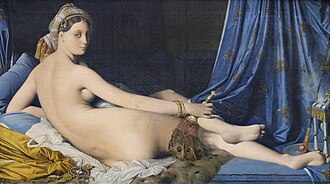 Grande Odalisque - Jean-Auguste-Dominique Ingres (1814)
 The Source - Jean-Auguste-Dominique Ingres (1856)
 The Turkish Bath - Jean-Auguste-Dominique Ingres (1862)
 The Valpinçon Bather - Jean-Auguste-Dominique Ingres (1808)
 Napoleon I on his Imperial Throne - Jean-Auguste-Dominique Ingres (1806)
 Madame Moitessier - Jean-Auguste-Dominique Ingres (1856)
 Portrait of Monsieur Bertin - Jean-Auguste-Dominique Ingres (1832)
 Vénus Anadyomène - Jean-Auguste-Dominique Ingres (1808)
Paintings by related artists
 The Death of Socrates - Jacques-Louis David (1787)
 The Oath of the Horatii - Jacques-Louis David (1784)
 The Third of May 1808 - Francisco Goya (1814)
 La Maja nue - Francisco Goya (1800)