Jesus among the doctors
Jean-Auguste-Dominique Ingres · 1862
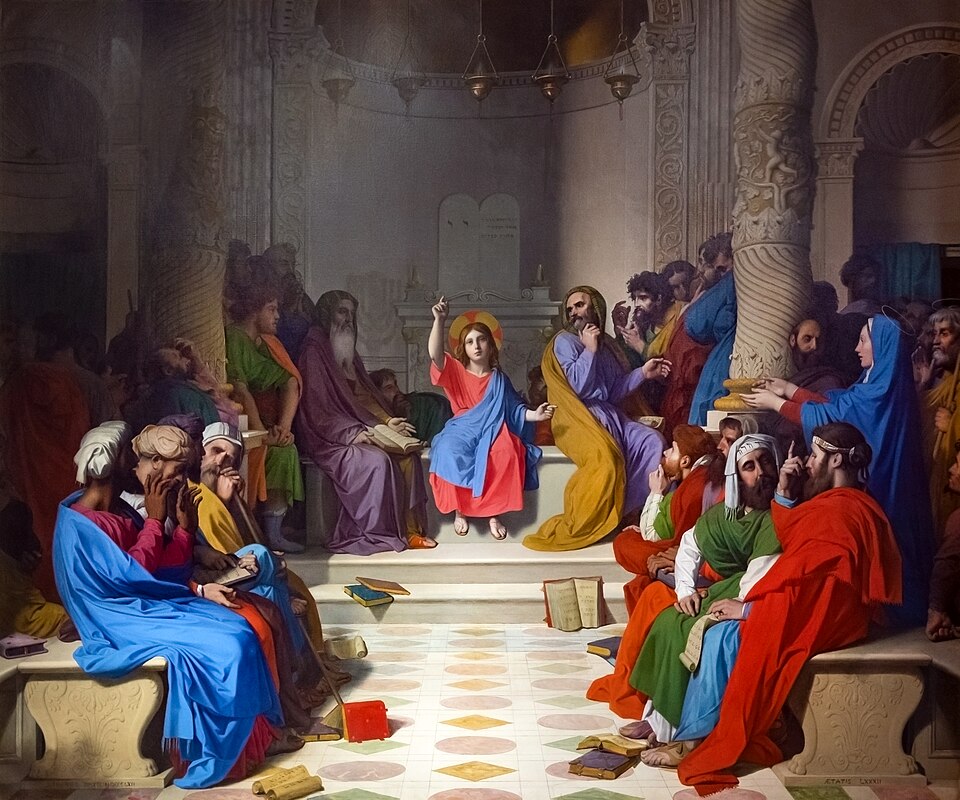
A mother rushes in with open arms after three days of searching for her son. Ingres began this picture for a grieving queen in 1845 and finished it almost twenty years later, long after her throne had fallen.
The story behind the painting
King Louis-Philippe and Queen Marie-Amélie commissioned this painting for the chapel of the Château de Bizy in the Eure, in homage to their son Ferdinand-Philippe, Duke of Orléans, who died in 1842. At the queen's request Ingres chose the episode of Jesus among the doctors. He began in 1845, but the revolution of 1848 brought down the July Monarchy and the picture was never delivered. Ingres finished it almost twenty years later, in 1862, a few years before his death. It became part of his bequest to the museum of his native town, Montauban, where it is kept with oil studies and many drawings.
What to look for
The scene takes place in the Temple of Jerusalem, made to look like a church. In the apse are two tablets in Hebrew, one with the name of God and one with a line from Exodus, framed by twisted columns that recall a Raphael design of the Temple. Jesus sits at the centre, at the vanishing point, talking with the attentive doctors. On the left Mary and Joseph burst in, marked by their haloes, and Mary stretches out her arms. The faces and drapery have a hieratic stillness. The background and the left side are in shadow, while the right is lit, especially Mary.
Meaning and intent
In Luke's Gospel the twelve-year-old Jesus stays behind in Jerusalem after Passover, and his parents find him after three days in the Temple, listening to and questioning the doctors. Ingres took his model from Raphael's School of Athens, the artist he admired all his life. He placed symbolic weight on the Virgin coming to find her child, in reference to Queen Marie-Amélie, who chose the subject and had just lost her eldest son. The story of a mother searching for a lost son becomes a quiet portrait of a real mother's grief.
Legacy
When Ingres took the picture up again in 1862, he put people close to him into it: the doctor in green on the right is modelled on the poet and critic Théophile Gautier, the one in violet on the publisher Magimel, and Saint Joseph is said to be inspired by the painter Alexandre Desgoffe. Gautier praised the finished work. Preparatory drawings, such as one at the Musée Bonnat-Helleu in Bayonne, reveal that women posed for some of the doctors. As so often, Ingres began from the nude, studying anatomy first and then building the clothing around the body.
Did you know?
- Commissioned by Louis-Philippe and Marie-Amélie for the chapel at Bizy.
- Begun in 1845, finished in 1862.
- Never delivered because of the 1848 revolution.
- Kept at the Musée Ingres-Bourdelle in Montauban.
About the artist
Jean-Auguste-Dominique Ingres (1780-1867)
religious art · Musée Ingres Bourdelle
More by Jean-Auguste-Dominique Ingres
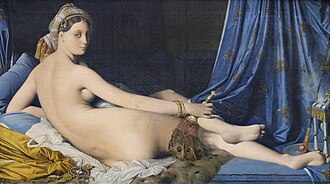 Grande Odalisque - Jean-Auguste-Dominique Ingres (1814)
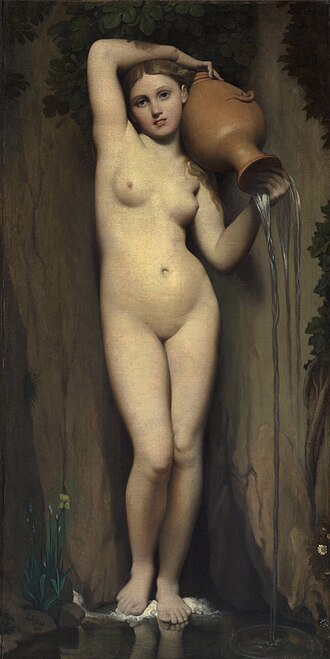 The Source - Jean-Auguste-Dominique Ingres (1856)
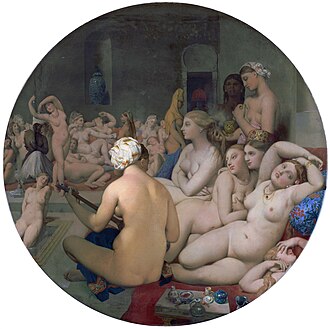 The Turkish Bath - Jean-Auguste-Dominique Ingres (1862)
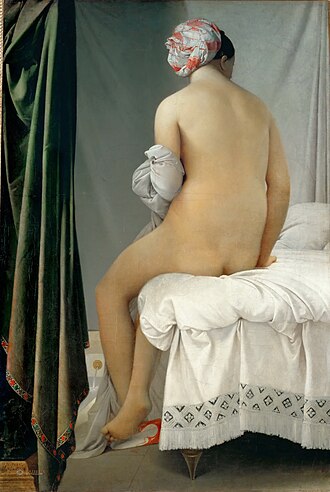 The Valpinçon Bather - Jean-Auguste-Dominique Ingres (1808)
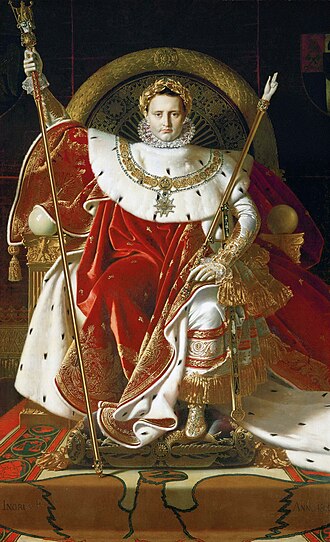 Napoleon I on his Imperial Throne - Jean-Auguste-Dominique Ingres (1806)
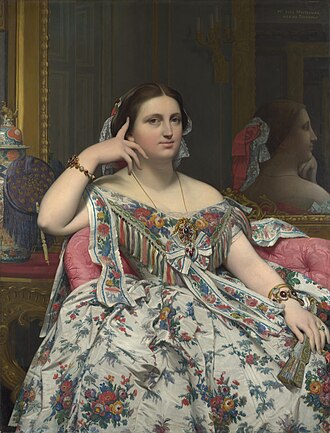 Madame Moitessier - Jean-Auguste-Dominique Ingres (1856)
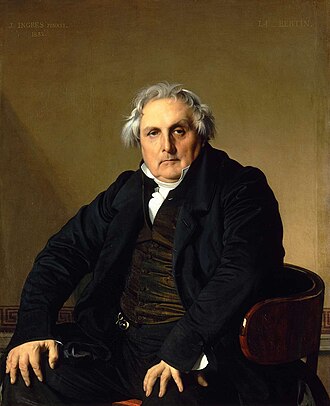 Portrait of Monsieur Bertin - Jean-Auguste-Dominique Ingres (1832)
 Vénus Anadyomène - Jean-Auguste-Dominique Ingres (1808)
Paintings by related artists
 The Death of Socrates - Jacques-Louis David (1787)
 The Oath of the Horatii - Jacques-Louis David (1784)
 The Third of May 1808 - Francisco Goya (1814)
 La Maja nue - Francisco Goya (1800)