Grainstack in Sunlight
Claude Monet · 1890s
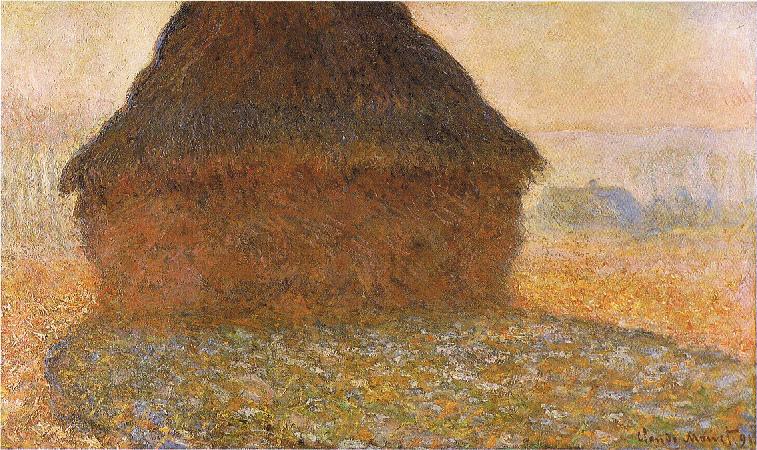
A single grainstack glows in the sun. When the young Kandinsky saw it in Moscow, he could not at first tell what it showed, and that shock helped push him toward abstract painting.
The story behind the painting
Grainstack in Sunlight was painted by Claude Monet in 1891, according to the French Wikipedia article, and belongs to his Grainstacks series; Wikidata gives only the 1890s. On 4 May 1891 Paul Durand-Ruel opened a Paris exhibition of fifteen Grainstacks, an event eagerly awaited by collectors. Pissarro wrote to his son Lucien that everyone wanted Monets, above all grainstacks at sunset. Critics were enthusiastic. But Monet could not show every canvas he had begun: Ernest Hoschedé died on 23 April, and Alice and her children, who had lived with Monet for years, were shaken.
What to look for
The canvas, about 60 by 100 cm, is wide and low, giving space to a field and the single stack under strong light. The sources say little about its details, so the best guide is the title itself: look at how the sunlight is carried by colour rather than by outline. That is exactly what struck Kandinsky. He wrote that he felt, confusingly, that the object was missing from the picture, while the unsuspected power of the palette appeared to him beyond all his dreams.
Meaning and intent
In his book Reminiscences, first published in 1913, Vassily Kandinsky, by then leader of the Blue Rider, defended his move toward abstraction. He described seeing this painting at the Moscow exhibition as an event that marked him deeply: suddenly, for the first time, he saw a picture. He was unable at the time to draw conclusions, but he understood that painting had gained fabulous force and brilliance, and that, unconsciously, the object as an indispensable element of the picture had been discredited.
Legacy
Grainstack in Sunlight was only delivered to Durand-Ruel in July 1891, and he acquired it. In 1896 it was among the works sent to the Exhibition of French Art organised by the Red Cross in Moscow, where Kandinsky saw it before leaving for Germany. It was later shown in Germany and Britain and passed through several private collections before the Kunsthaus Zürich acquired it in 1969. A painting of a pile of grain thus became a turning point in the story of modern art.
Did you know?
- Painted by Monet in 1891 (Wikidata: 1890s), part of the Grainstacks series.
- Shown in Moscow in 1896 at a Red Cross exhibition of French art.
- Kandinsky described it as a revelation in his 1913 book.
- In the Kunsthaus Zürich since 1969.
About the artist
Claude Monet (1840-1926)
More by Claude Monet
 Impression, Sunrise - Claude Monet (1872)
 Water Lilies - Claude Monet (1906)
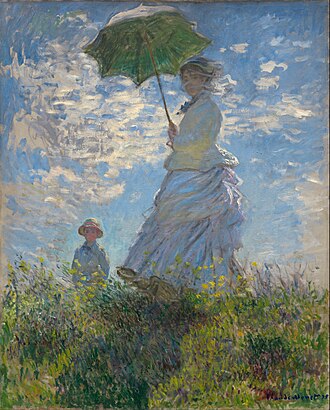 Woman with a Parasol - Claude Monet (1875)
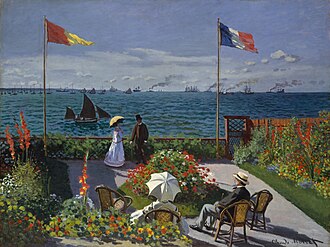 Garden at Sainte-Adresse - Claude Monet (1867)
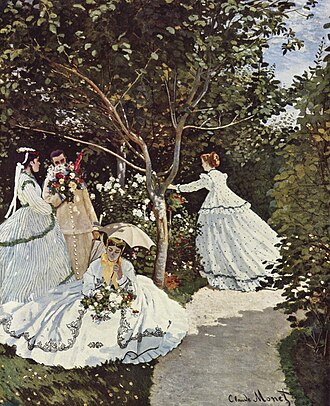 Women in the Garden - Claude Monet (1866)
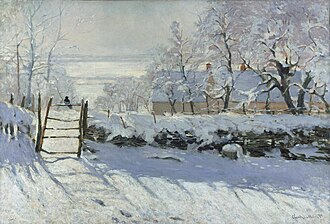 The Magpie - Claude Monet (1868)
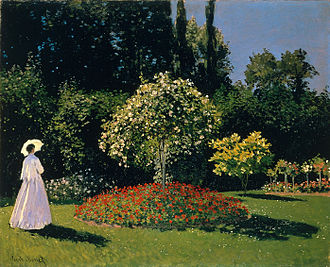 Woman in the Garden - Claude Monet (1867)
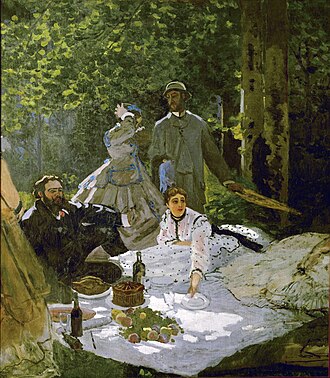 Luncheon on the Grass - Claude Monet (1866)
Paintings by related artists
 The Fighting Temeraire - J. M. W. Turner (1839)
 Rain, Steam and Speed - The Great Western Railway - J. M. W. Turner (1844)
 L'Origine du monde - Gustave Courbet (1866)
 A Burial at Ornans - Gustave Courbet (2020)
 Luncheon on the Grass - Édouard Manet (1863)
 Olympia - Édouard Manet (1863)
 Dance at Le Moulin de la Galette - Pierre-Auguste Renoir (1876)
 Luncheon of the Boating Party - Pierre-Auguste Renoir (1881)
 The Cradle - Berthe Morisot (1872)
 Summer's Day - Berthe Morisot (1879)
 L'Absinthe - Edgar Degas (1875)
 The Bellelli Family - Edgar Degas (1858)