Fräulein Heck
Lovis Corinth · 1897
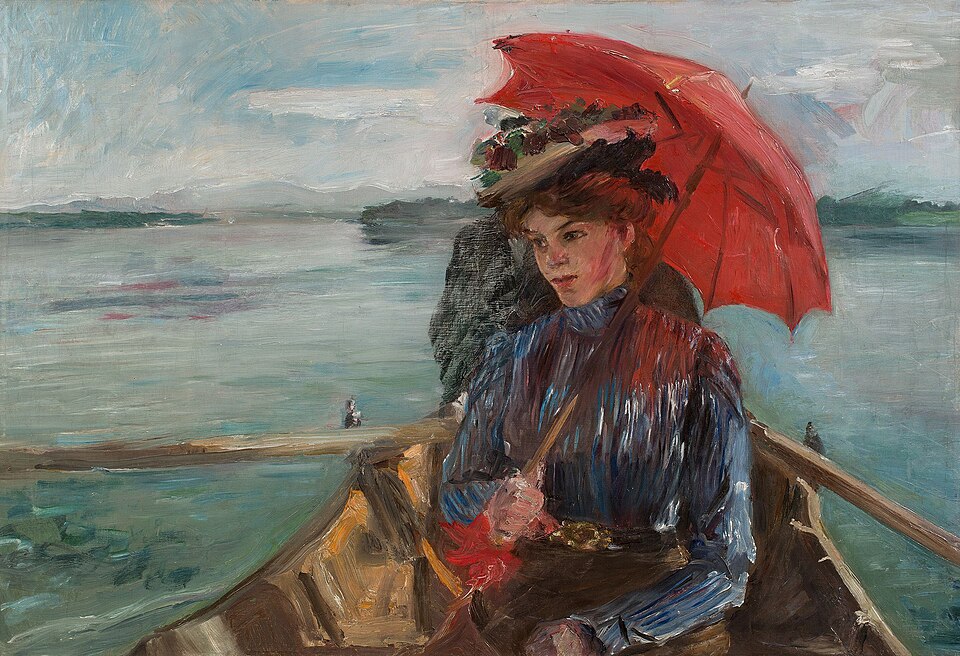
A young woman sits in a rowing boat on a Bavarian lake under a red parasol, her eyes lowered, lost in thought. Lovis Corinth painted Berta Heck in 1897 and kept her face sharp while the water and sky dissolve into broad strokes.
The story behind the painting
According to the catalogue of Corinth's paintings by his wife Charlotte Berend-Corinth, the picture was painted in 1897 in a boat on Lake Starnberg in Bavaria. Corinth was living in Munich then and spent much time in the surrounding countryside. His close circle included the Munich writer Max Halbe, through whom he met Halbe's wife Luise and her sister Berta Heck, the sitter here. In his picture Breakfast in Max Halbe's Garden, Corinth portrayed all three together with the poet Karl Rössler. The oil on canvas is horizontal, 84 by 57 cm, and is not signed.
What to look for
The young woman sits in the foreground of a small rowing boat, turned slightly right, holding an open red parasol above her head that fills much of the upper right. She wears a long-sleeved dress in dark blues and violets, painted with vertical strokes, and a hat decorated with flowers or ornaments. Behind her a partly visible figure, probably a man in dark clothes, turned away, holds the oars that reach into the water on both sides. The oars and the horizon divide the background into three similar horizontal bands of lake, distant shore and pale cloudy sky.
Meaning and intent
Horst Uhr compared the picture with French Impressionist works, especially Manet's Boating of 1874, though he noted it cannot be said whether Corinth knew them. Unlike the psychologically neutral approach of Manet and Monet, Uhr wrote, Corinth was not willing to sacrifice his model's features to the dissolving effects of light. The strokes are broad on the lake and quick on the blouse and hat but more careful in the face, making her the structural and psychological centre. Her slightly averted gaze seems lost in her innermost thoughts, perhaps born of a trust between painter and model.
Legacy
The painting first belonged to Max Halbe, the sitter's brother-in-law, then passed to a collector in Cologne and changed owners several times, appearing at auction at Villa Grisebach at least twice. It was shown in 1913 at the Paul Cassirer special exhibition of Corinth's work at the Berlin Secession, and in 1926 at the memorial exhibition in the Nationalgalerie, where it was wrongly titled Frau Max Halbe in a Boat. In 1976 it was shown at the Wallraf-Richartz-Museum in Cologne. The trust Uhr describes continued the next year, when Corinth painted Luise Halbe in several portraits.
Did you know?
- Painted in 1897 in a boat on Lake Starnberg.
- The sitter is Berta Heck, sister of Luise Halbe.
- Once wrongly titled Frau Max Halbe in a Boat in 1926.
- Now in private hands after several changes of owner.
About the artist
Lovis Corinth (1858-1925)
More by Lovis Corinth
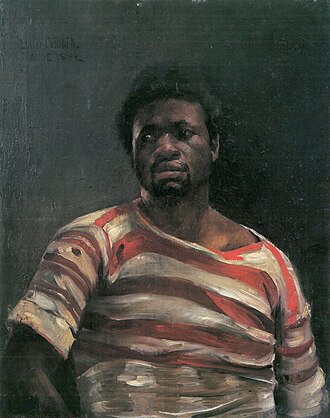 Black Othello - Lovis Corinth (1884)
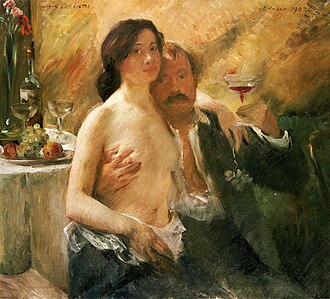 Self portrait with his wife Charlotte Berend-Corinth and a sekt glass - Lovis Corinth (1902)
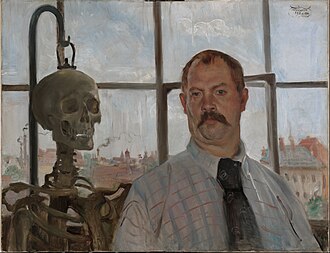 Self-portrait with Skeleton - Lovis Corinth (1896)
 Innocentia - Lovis Corinth (1890)
 Susanna in the Bath - Lovis Corinth (1890)
 The Red Christ - Lovis Corinth (1922)
 Reading Woman - Lovis Corinth (1911)
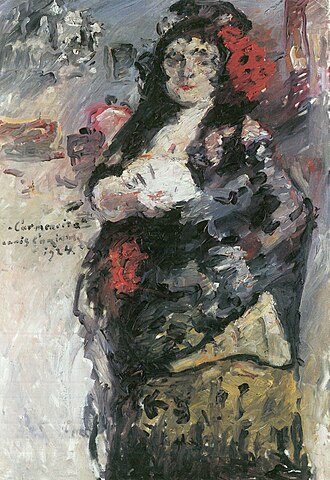 Carmencita - Lovis Corinth (1924)