Blick auf Arles
Vincent van Gogh · 1889
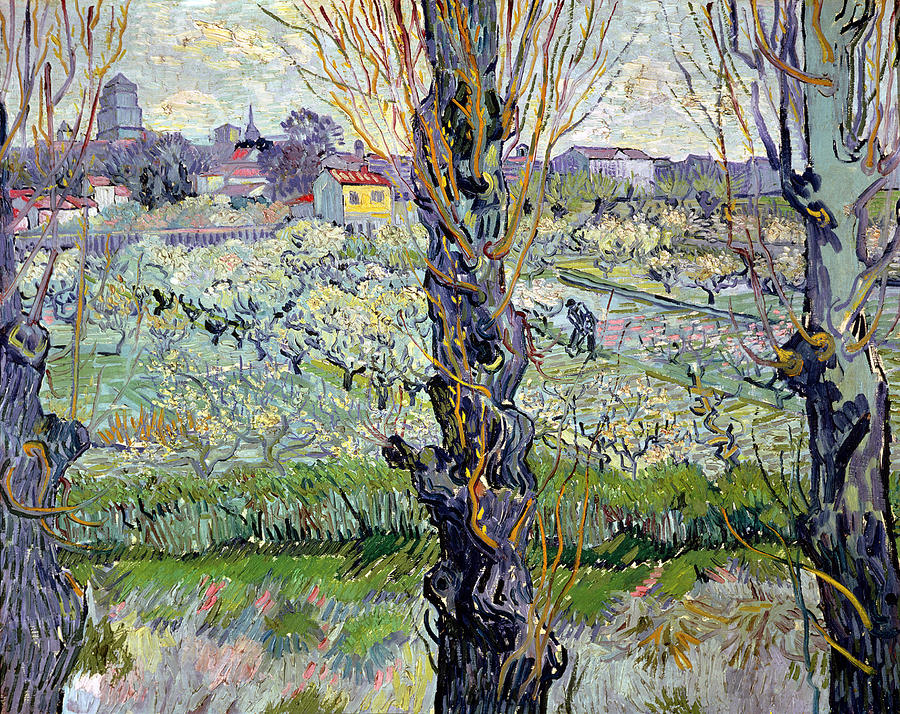
Blossoming orchards in the foreground, the old towers of Arles on the horizon, and a modern army barracks sitting right beside them: Van Gogh's spring view holds a whole town's past and present in one frame.
The story behind the painting
Vincent van Gogh painted View of Arles, Flowering Orchards in the spring of 1889, while he was living in Arles in the south of France. It is one of several works in his Flowering Orchards series, the group of paintings in which he returned again and again to fruit trees in blossom around the town. The available sources say little about the exact day or the mood in which this canvas was made, so it is best not to invent one. What they do record is the place: a vantage point across a canal lined with poplars, looking toward the historic centre of Arles. The canvas is fairly large for him, about 72 by 92 centimetres, a sign that he considered the subject worth a full-scale effort rather than a quick sketch.
What to look for
Let your gaze travel in layers. In front lie the flowering orchards that give the painting its name. Then comes the canal and the line of poplars along its bank, standing like a screen between the trees and the town. Beyond them rises Arles itself. On the left you can find the towers of Saint-Trophime and of the College St Charles, landmarks of the old historic centre. On the right, by contrast, stands a recent building, the Caserne Calvin, the barracks that housed the Zouave regiment. Wikidata also lists human figures among the painting's subjects, so look for people in the scene as you explore it. The pleasure is in the contrast: soft blossom against stone towers, and centuries-old churches against a brand-new military block.
Meaning and intent
The sources do not record Van Gogh explaining this painting, but they do highlight the contrast built into it: the historic towers to the left, the modern barracks to the right. That pairing gives the view a quiet tension between old Arles and the town as it was changing. The barracks also had a personal side. Van Gogh knew several of the Zouave officers stationed there. He painted one of them in his native uniform, and his portrait of Lieutenant Milliet is known as The Lover. So the building on the right was not anonymous scenery for him; it housed men he had met and painted. Seen this way, the canvas joins the renewal of spring blossom with a portrait of a real community, sacred, ordinary and military side by side.
Legacy
Van Gogh clearly valued this canvas. He included it in his selection of works to be shown at the Les XX exhibition in Brussels in 1890, one of the rare occasions when he chose paintings to present to the public himself. Today it belongs to the Bavarian State Painting Collections in Germany. The landscape it records has partly vanished: poplar trees still stand along the canal, but the orchards and the Caserne Calvin are gone. That gives the painting an added role as a record of a lost view of Arles. For visitors it offers a gentler side of Van Gogh's southern period, in which the fragile beauty of blossom season is set within a recognisable, lived-in town.
Schon gewusst?
- It is part of Van Gogh's Flowering Orchards series, painted in Arles.
- The towers of Saint-Trophime and the College St Charles appear on the left, the Caserne Calvin barracks on the right.
- Van Gogh chose it for the Les XX exhibition in Brussels in 1890.
- The poplars along the canal still stand, but the orchards and barracks are gone.
Über den Künstler
Vincent van Gogh (1853-1890)
Landschaftsmalerei · Mensch · Arles · Bayerische Staatsgemäldesammlungen
Mehr von Vincent van Gogh
 Die Sternennacht - Vincent van Gogh (1889)
.jpg) Caféterrasse am Abend - Vincent van Gogh (1888)
Caféterrasse am Abend - Vincent van Gogh (1888) Sonnenblumen - Vincent van Gogh (1888)
 Mandelblüte - Vincent van Gogh (1890)
 Weizenfeld mit Raben - Vincent van Gogh (1890)
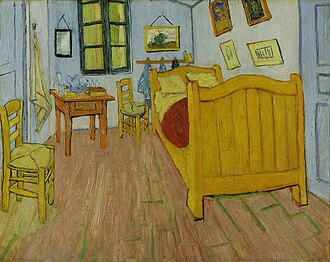 Das Schlafzimmer - Vincent van Gogh (1888)
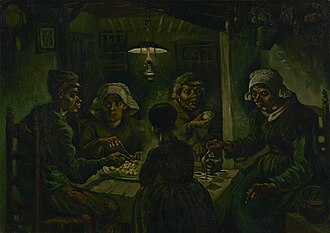 Die Kartoffelesser - Vincent van Gogh (1885)
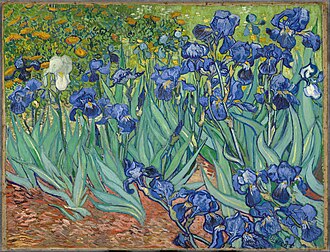 Schwertlilien - Vincent van Gogh (1889)
Werke verwandter Künstler
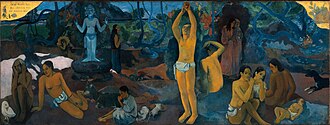 Woher kommen wir? Wer sind wir? Wohin gehen wir? - Paul Gauguin (1897-1898)
%201889.jpg) Der gelbe Christus - Paul Gauguin (1889)
Der gelbe Christus - Paul Gauguin (1889) Das Frühstück im Grünen - Édouard Manet (1863)
 Olympia - Édouard Manet (1863)