Blick auf Rouelles, Le Havre
Claude Monet · 1858
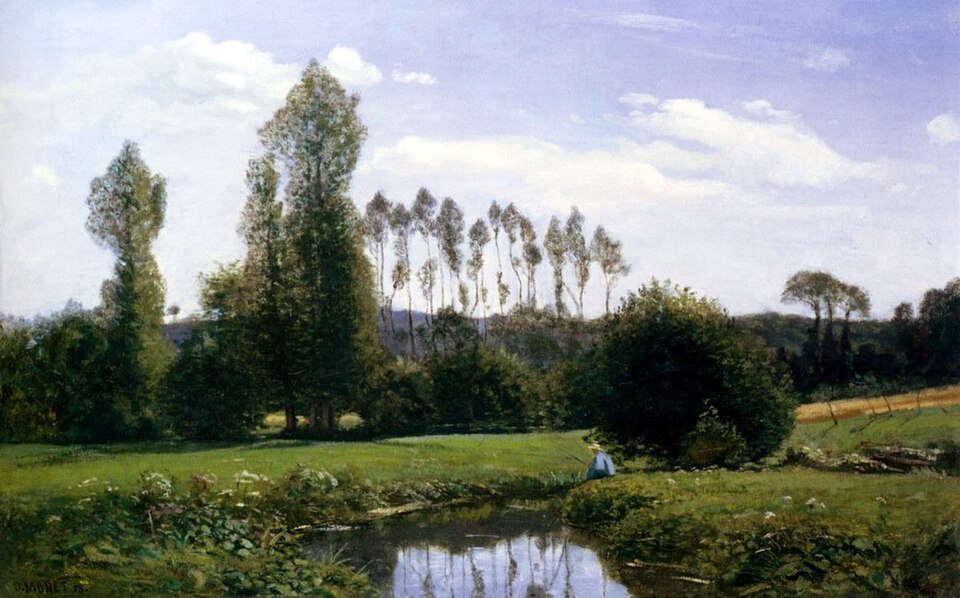
A quiet stream, a summer field, a seventeen-year-old who had just learned to look at nature. This is the earliest known painting by Claude Monet, signed with a name he would soon drop.
The story behind the painting
As a teenager in Le Havre, Oscar-Claude Monet was known for caricatures, which he showed at Gravier's, a local framing shop. Above them hung seascapes by Eugene Boudin, which Monet found disgusting; he disliked the man without having met him and avoided an introduction. One day he walked into the shop while Boudin was there. Boudin praised the caricatures and urged him to paint landscapes. In early summer 1858, probably a few months later, the two went painting in the Montgeon forest at Rouelles, north-east of Le Havre. Monet watched Boudin work and painted this view following his instructions.
What to look for
The picture shows the land around a small stream, either the Rouelles or the Lezarde, in the Rouelles district of Le Havre in Normandy. Wikidata gives its size as 46 by 65 cm. Look at the signature: it reads O. Monet, because the young painter had not yet dropped Oscar from his name, which he did in his early twenties. The source notes the painting is too sophisticated and refined to have been his very first attempt, so it is the earliest known work rather than the first he ever made.
Meaning and intent
Wikipedia says it was on this expedition that Monet first gained an appreciation for nature. The painting is the record of a turn: a boy who mocked faces with a pencil, sitting in a forest beside a man fifteen years older, learning to paint what he saw in front of him. Boudin became his first painting teacher when Monet was seventeen and a half. The scene was not chosen for any story or symbol, only for the stream, the trees and the light of a Norman summer.
Legacy
In August 1858 Monet sent the painting to an exhibition in Le Havre and it was accepted. Two of Boudin's paintings, both called Landscape (vallee de Rouelles), hung in the same show. When it was exhibited in Rouen, a local critic wrote scathingly that Monet's picture had the same qualities as Boudin's, and Monet took that as a compliment. In 2019 it was shown in Claude Monet: The Truth of Nature at the Denver Art Museum, next to Boudin's painting of the same scene. Wikidata lists it at the Marunuma Art Park in Japan.
Schon gewusst?
- The earliest known painting by Claude Monet, from 1858.
- Signed O. Monet, for Oscar-Claude Monet.
- Painted under the guidance of Eugene Boudin.
- Shown in Denver in 2019 beside Boudin's view of the same scene.
Über den Künstler
Claude Monet (1840-1926)
Mehr von Claude Monet
 Impression, Sonnenaufgang - Claude Monet (1872)
 Seerosen - Claude Monet (1906)
 Die Frau mit dem Sonnenschirm - Claude Monet (1875)
 Garten in Sainte-Adresse - Claude Monet (1867)
 Frauen im Garten - Claude Monet (1866)
 Die Elster - Claude Monet (1868)
 Frau im Garten - Claude Monet (1867)
 Das Frühstück im Grünen - Claude Monet (1866)
Werke verwandter Künstler
 Die letzte Fahrt der Temeraire - J. M. W. Turner (1839)
 Rain, Steam and Speed - The Great Western Railway - J. M. W. Turner (1844)
 Der Ursprung der Welt - Gustave Courbet (1866)
 Ein Begräbnis in Ornans - Gustave Courbet (2020)
 Das Frühstück im Grünen - Édouard Manet (1863)
 Olympia - Édouard Manet (1863)
 Tanz im Moulin de la Galette - Pierre-Auguste Renoir (1876)
 Das Frühstück der Ruderer - Pierre-Auguste Renoir (1881)
 Wiege - Berthe Morisot (1872)
 Sommertag - Berthe Morisot (1879)
 Der Absinth - Edgar Degas (1875)
 Die Bellelli Familie - Edgar Degas (1858)