Baumwurzeln und Baumstämme
Vincent van Gogh · 1890
.jpg)
Roots, trunks and earth twist into a blaze of blue, green and ochre so dense you can barely say what you are seeing: this may be the last picture Van Gogh ever painted.
The story behind the painting
In May 1890 Vincent van Gogh left the asylum at Saint-Rémy and moved to Auvers-sur-Oise, a small town just north of Paris. He spent the last months of his life there, painting at an extraordinary pace. Tree Roots dates from July 1890, and some consider it his final painting before his death later that month. It belongs to a group of late landscapes on double-square canvases, long horizontal formats twice as wide as they are tall; this one measures 50 by 100 centimetres. In 2020 Wouter van der Veen, scientific director of the Institut Van Gogh, identified the probable spot where it was painted from an old postcard: a bank on the rue Daubigny, about 150 metres from the Auberge Ravoux, where Van Gogh was staying. He confirmed this in 2021 with a photograph from around 1907.
What to look for
Let your eye travel slowly across the long, wide canvas. At first you think you recognise tree roots and trunks, gripping a sloping bank, but the scholar Jan Hulsker noted how hard it is to grasp the subject as a whole. Forms are cut off by the edges, crowded together and seen so close that they lose their usual scale. What remains is the act of painting itself: energetic brushstrokes, interlocking shapes and bright colours that the sources describe as perhaps too cheerful for sombre thoughts. Rather than a view with a horizon and sky, you face a wall of growth, almost a pattern. Spend a moment with the upper part, and with the way roots and trunks bend and knot, and notice how the painting keeps slipping between landscape and pure surface.
Meaning and intent
What did Van Gogh mean by it? Honestly, we do not know. In 1882 in The Hague he had drawn a study of tree roots and told his brother Theo that he wanted to express something of life's struggle. Whether he returned to that thought in 1890 is uncertain: his letters give no hint, and the bright colours may argue against it. Scholars Van der Veen and Knapp argue that here, as in Undergrowth with Two Figures, the painting itself matters more than the subject, an approach that anticipates abstract art and German Expressionism. In 2023 the photographer Raymond Martinez proposed that a hidden self-portrait, a profile with one eye closed, might appear in the upper part; this idea has not been scientifically validated by Van Gogh scholars.
Legacy
Tree Roots is held by the Van Gogh Museum in Amsterdam, and its own history has had a dramatic chapter. On 14 April 1991 it was stolen from the museum together with nineteen other paintings, and it was successfully recovered. Its reputation has only grown since. Hulsker called it the most original of Van Gogh's double-square canvases, and many viewers are drawn to it as a possible final statement, painted within walking distance of the inn where he died. More than a farewell, though, it shows an artist still experimenting, pushing his subject toward the edge of abstraction. Standing before it, you can feel the restless energy of those last weeks in Auvers translated directly into paint.
Schon gewusst?
- It is painted on a double-square canvas, 50 × 100 cm.
- It was stolen in 1991 with 19 other paintings and later recovered.
- Its likely location, on the rue Daubigny, is about 150 metres from Van Gogh's last lodgings.
Über den Künstler
Vincent van Gogh (1853-1890)
Landschaftsmalerei · Post-Impressionismus · Van Gogh Museum
Mehr von Vincent van Gogh
 Die Sternennacht - Vincent van Gogh (1889)
.jpg) Caféterrasse am Abend - Vincent van Gogh (1888)
Caféterrasse am Abend - Vincent van Gogh (1888) Sonnenblumen - Vincent van Gogh (1888)
 Mandelblüte - Vincent van Gogh (1890)
 Weizenfeld mit Raben - Vincent van Gogh (1890)
 Das Schlafzimmer - Vincent van Gogh (1888)
 Die Kartoffelesser - Vincent van Gogh (1885)
 Schwertlilien - Vincent van Gogh (1889)
Werke verwandter Künstler
 Woher kommen wir? Wer sind wir? Wohin gehen wir? - Paul Gauguin (1897-1898)
%201889.jpg) Der gelbe Christus - Paul Gauguin (1889)
Der gelbe Christus - Paul Gauguin (1889)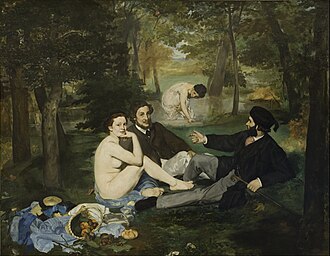 Das Frühstück im Grünen - Édouard Manet (1863)
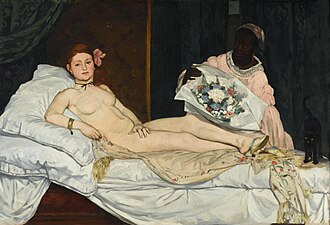 Olympia - Édouard Manet (1863)