Die Steinigung des heiligen Stephanus
Rembrandt van Rijn · 1624
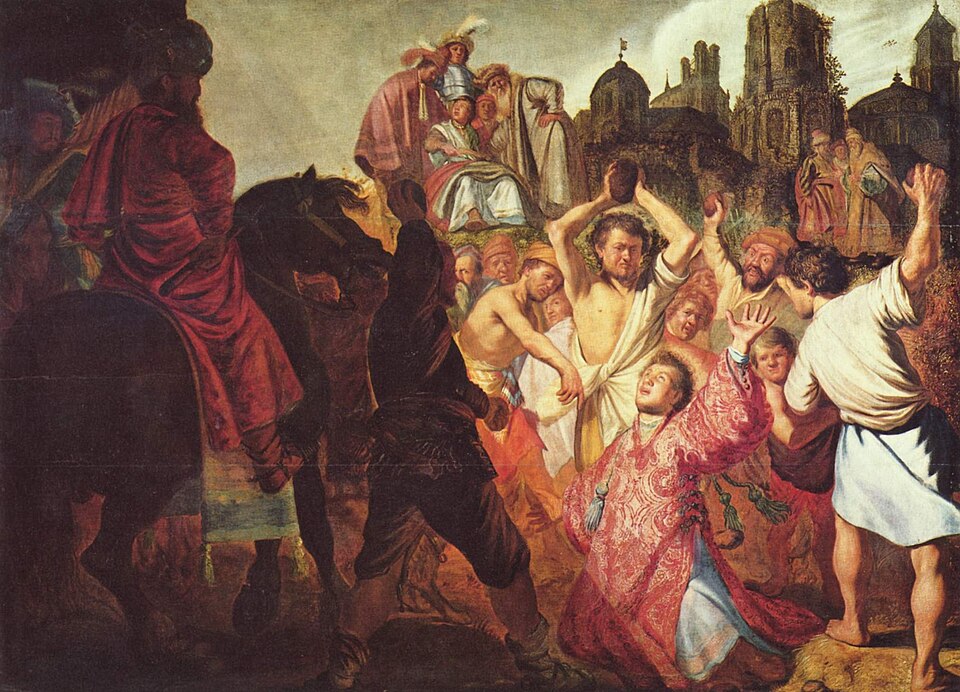
A crowd of men raise stones above a kneeling figure bathed in light, while a young face behind him looks on in alarm. That face may belong to the painter himself, a nineteen-year-old named Rembrandt.
The story behind the painting
This is the first signed painting by Rembrandt, made when he was only nineteen. Wikipedia dates it to 1625, while Wikidata gives 1624, so the year depends on which source you follow. Painted in oil on a wood panel, it belongs to his earliest work, at a moment when the young Dutch artist was absorbing the example of Caravaggio and Adam Elsheimer. The subject comes from the Acts of the Apostles, chapter 7: Stephen, a young deacon of the Christian community in Jerusalem, was condemned to death by stoning. Rembrandt chose the final moment, when Stephen is attacked outside the city and speaks his last words to Christ.
What to look for
The panel is split into two zones by a diagonal, a play of light and dark known as chiaroscuro. On the left, a man on horseback sits in shadow. On the right, Stephen and his persecutors stand in the light, and the brightness around the saint signals that the heavens are open to him. Count the crowd: there are around twenty figures pressing in. In the background, look for Saul of Tarsus, seated and holding the coats of the men throwing stones. Then find the face just behind Stephen. It appears to be a self-portrait. Observers have also noted some inaccuracies in the drawing, a reminder that this is the work of a very young painter.
Meaning and intent
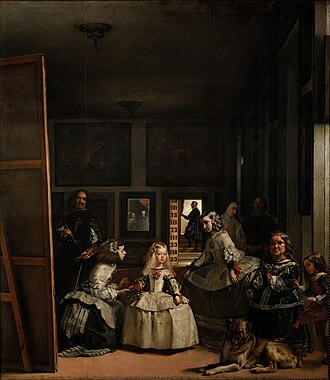
The painting tells of faith meeting violence, and Rembrandt keeps the focus on Stephen's last prayer rather than on wounds. The divided light carries the meaning: darkness on one side, and on the other an opening heaven shining around the dying deacon. The most intriguing interpretation concerns the painter's own presence. Art historian John Durham suggests that Rembrandt presents himself as an alarmed participant, someone who may be having second thoughts about what is happening. Writers compare this device of placing oneself in a larger scene to what Diego Velázquez later did in Las Meninas. Some even argue that as many as seven variations of Rembrandt's self-portrait appear among the figures.
Legacy
As the first signed work by Rembrandt, this panel marks the start of a career and shows a young artist already working with dramatic light and with his own face as a subject. It measures about 89.5 by 123.6 centimetres and is now exhibited at the Musée des Beaux-Arts de Lyon in France. The subject stayed with him: the source notes that Rembrandt also made an etching of Saint Stephen. Visitors to Lyon can stand before the panel and search, as scholars do, for the painter hidden in the crowd, wondering whether he is witness, participant or both.
Schon gewusst?
- Considered Rembrandt's first signed painting, made at age 19.
- Dated 1625 by Wikipedia and 1624 by Wikidata.
- Oil on wood panel, about 89.5 × 123.6 cm.
- Exhibited at the Musée des Beaux-Arts de Lyon.
Über den Künstler
Rembrandt van Rijn (1606-1669)
religiöse Kunst · Mann · Niederländisches Goldenes Zeitalter der Malerei · Stephanus
Mehr von Rembrandt van Rijn
 Die Nachtwache - Rembrandt van Rijn (1642)
 Selbstbildnis - Rembrandt van Rijn (1659)
 Die Anatomie des Dr. Tulp - Rembrandt van Rijn (1632)
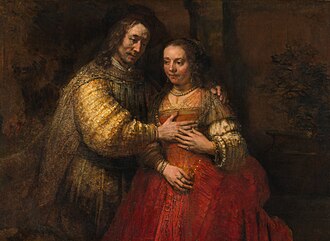 Die Judenbraut - Rembrandt van Rijn (1660s)
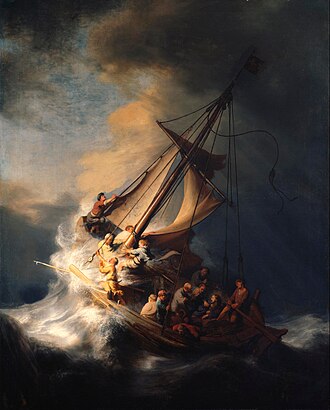 Der Sturm auf dem See Genesareth - Rembrandt van Rijn (1633)
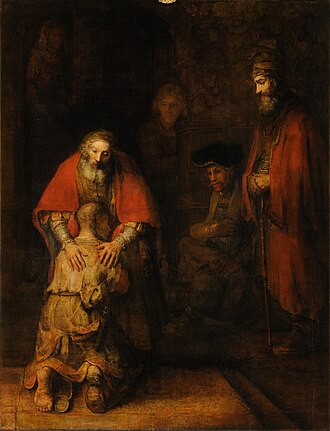 Die Rückkehr des verlorenen Sohnes - Rembrandt van Rijn (1668)
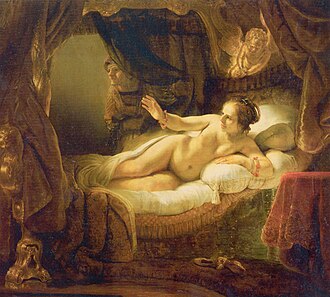 Danaë - Rembrandt van Rijn (1636)
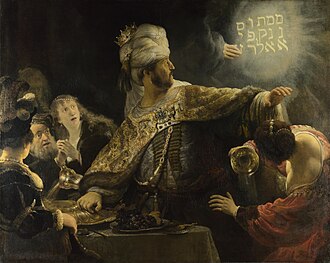 Das Gastmahl des Belsazar - Rembrandt van Rijn (1636)
Werke verwandter Künstler
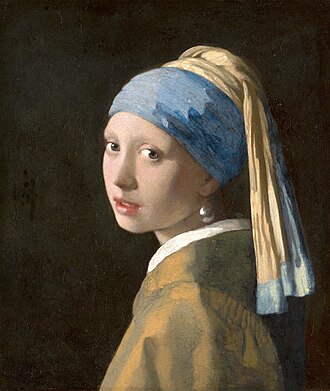 Das Mädchen mit dem Perlenohrgehänge - Johannes Vermeer (1665)
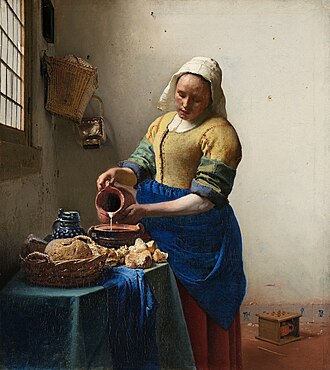 Dienstmagd mit Milchkrug - Johannes Vermeer (c. 1658)
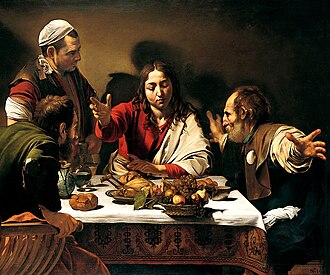 Das Abendmahl in Emmaus - Caravaggio (1601)
 Die Berufung des Hl. Matthäus - Caravaggio (1609)
 Las Meninas - Diego Velázquez (1656)
 Die Übergabe von Breda - Diego Velázquez (1635)