Waschplatz von Pontoise
Camille Pissarro · 1872
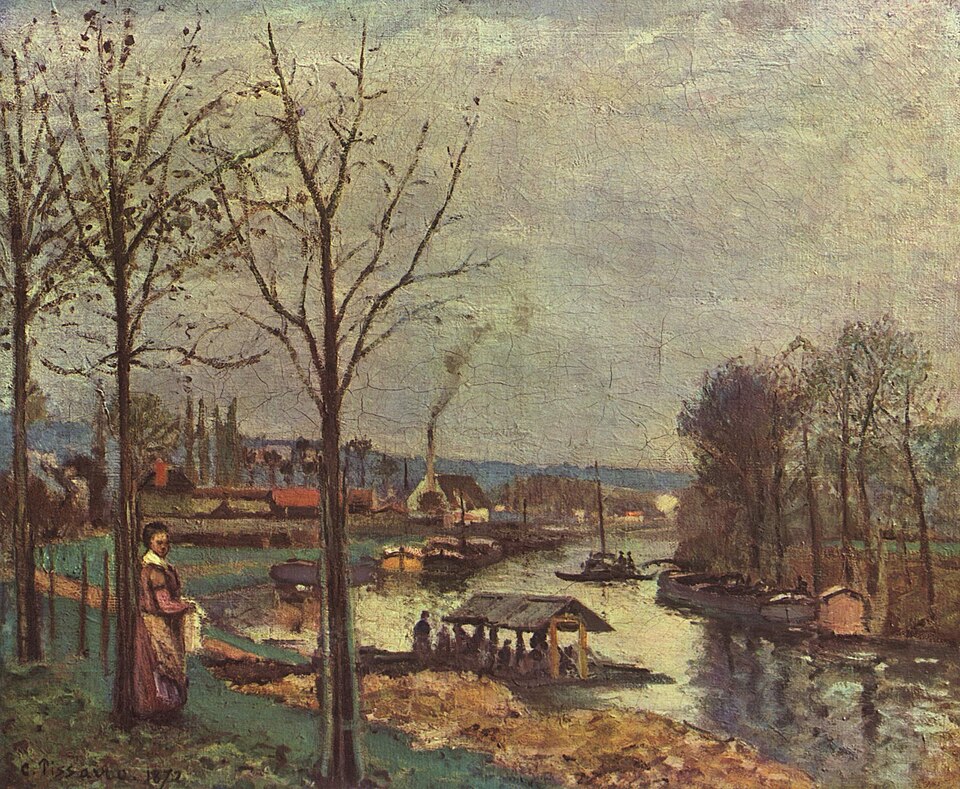
A washerwoman leans against a tree and looks straight at us, while behind her barges line the Seine and a factory chimney smokes. Pissarro painted Port-Marly in 1872 not as a place of pleasure but as a place of work.
The story behind the painting
Pissarro painted this oil on canvas, 46.5 by 56 cm, at Port-Marly in 1872. The river nearby had already drawn Camille Corot, who stayed at Port-Marly in August 1872 and painted canvases there, including The Bend of the Seine at Port-Marly, and who summed up his subtle approach to light as never losing the first impression that moved us. In 1867 Louis Auguste Delahaye had been allowed to build the paper mill that Pissarro shows; it burned down one night in August 1904. Pissarro had already painted this same site in 1869.
What to look for
On the left bank a washerwoman stands against a tree and looks at the viewer, leading us into the activities of the river. Barges fitted out as wash-houses and other barges line the Seine, and beyond them rises the paper mill of Port-Marly with its smoking chimney. The dark colours match a cloudy winter day. The barges along the towpath and the floating boat form a diagonal, set against the verticals of the chimney, the masts and the tree trunks. Compare it with Corot's late view of the same river to see how far the young Impressionists had moved.
Meaning and intent
Far from the pleasures of the well-off middle class, Pissarro shows the beginning of industry in the suburb between Bougival and Port-Marly, and human labour. The painting reflects his interest in social reality: traditional handwork and industrial machinery face each other on the same stretch of water. Alfred Sisley painted nearby sites too, including sand dredgers at Port-Marly, but in one of those canvases he shows the paper mill with no chimney, only smoke from an opening in the gable. Pissarro keeps the chimney at the centre.
Legacy
The painting was shown at the fourth Impressionist exhibition in 1879, listed as belonging to Gustave Caillebotte. Caillebotte bequeathed it to the French state in 1894, and through Leonce Benedite it entered the Musee du Luxembourg; it is now in the Musee d'Orsay. Since the 1990s a life-size reproduction has stood at the spot where it was painted, at the end of the towpath, on a trail of the Pays des Impressionnistes. Vegetation now blocks much of the view, and a rowing school stands where the mill once was.
Schon gewusst?
- Painted at Port-Marly in 1872.
- Shown at the fourth Impressionist exhibition in 1879.
- Bequeathed to the state by Gustave Caillebotte in 1894.
- A life-size copy stands where it was painted.
Über den Künstler
Camille Pissarro (1830-1903)
Frau · Landschaftsmalerei · Musée d’Orsay · Landschaft · Haus · Laubbaum
Mehr von Camille Pissarro
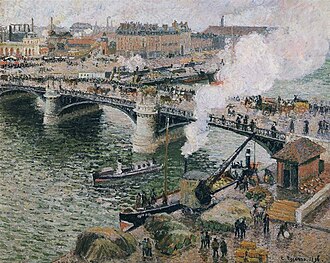 Pont Boieldieu in Rouen, Rainy Weather - Camille Pissarro (1896)
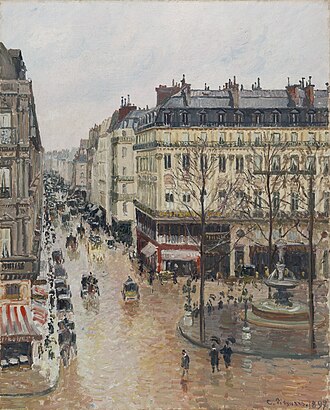 Rue Saint-Honoré, dans l'après-midi. Effet de pluie - Camille Pissarro (1897)
.jpg) Boulevard Montmartre, Mardi Gras - Camille Pissarro (1897)
Boulevard Montmartre, Mardi Gras - Camille Pissarro (1897)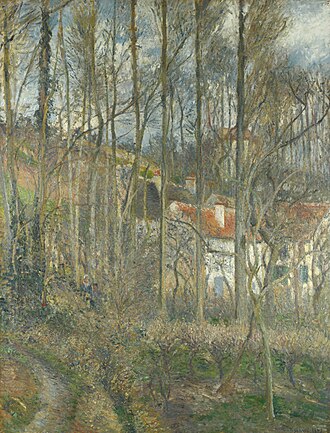 Côte des Bœufs à L'Hermitage, Pontoise - Camille Pissarro (1877)
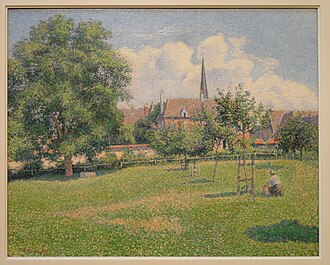 Das Haus der tauben Frau - Camille Pissarro (1886)
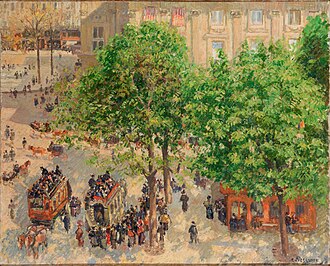 Place du Theatre-Francais in Spring - Camille Pissarro (1898)
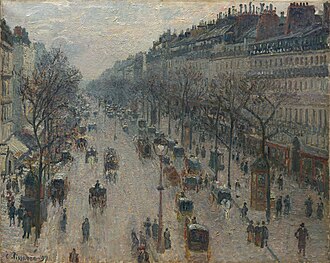 Boulevard Montmartre an einem Wintermorgen - Camille Pissarro (1897)
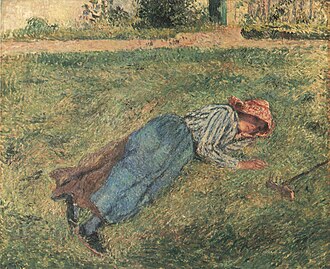 Im Gras liegendes Mädchen - Camille Pissarro (1882)
Werke verwandter Künstler
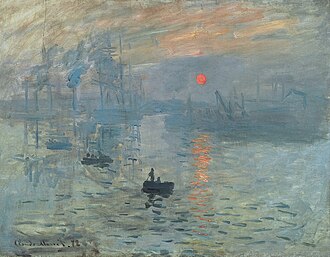 Impression, Sonnenaufgang - Claude Monet (1872)
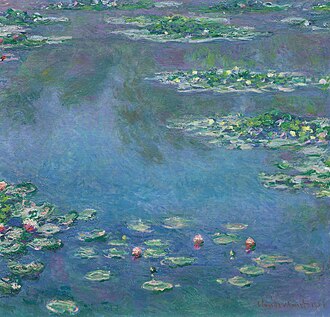 Seerosen - Claude Monet (1906)
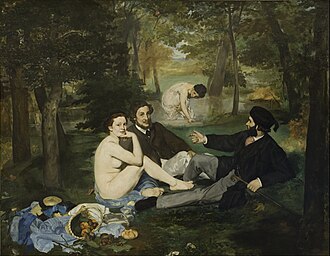 Das Frühstück im Grünen - Édouard Manet (1863)
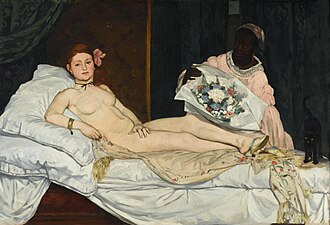 Olympia - Édouard Manet (1863)
 Tanz im Moulin de la Galette - Pierre-Auguste Renoir (1876)
 Das Frühstück der Ruderer - Pierre-Auguste Renoir (1881)
 Der Absinth - Edgar Degas (1875)
 Die Bellelli Familie - Edgar Degas (1858)
 Straße in Paris an einem regnerischen Tag - Gustave Caillebotte (1877)
 Die Parkettschleifer - Gustave Caillebotte (1875)
 Strandspaziergang - Joaquín Sorolla (1909)
 Sad Inheritance - Joaquín Sorolla (1898)