Die Ebene von Auvers
Vincent van Gogh · 1890
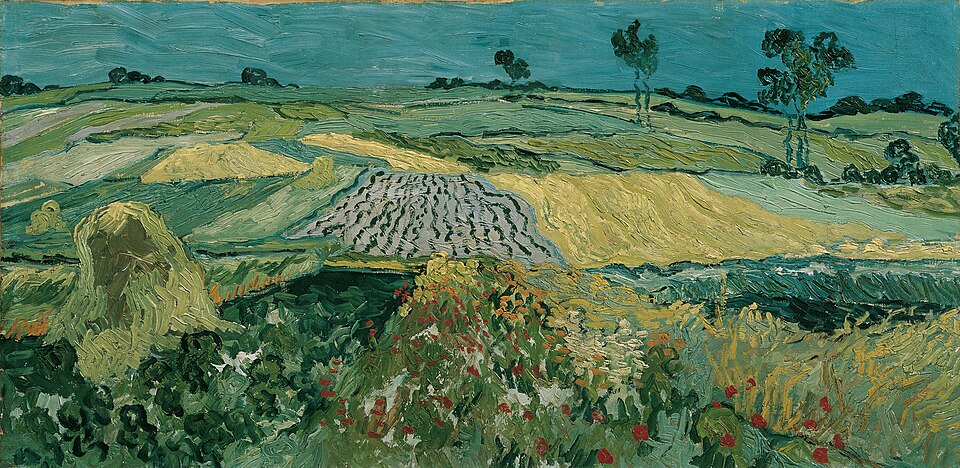
A wide band of fields in yellow, green and blue rolls up to a high horizon under a quiet blue-green sky. Van Gogh painted it in Auvers in the summer of 1890, only weeks before his death.
The story behind the painting
Van Gogh lived in Auvers-sur-Oise from 20 May 1890 until his death on 29 July that year. He came after months in the asylum at Saint-Rémy-de-Provence and a short stay with his brother in Paris, choosing Auvers because Dr Paul Gachet lived there. He lodged at the Auberge Ravoux, visited the doctor often and became his friend. In those 70 days he made about 80 paintings and many drawings, above all landscapes of the summer fields. He first mentioned The Plain of Auvers in a letter to Theo on 24 June 1890, noting only its unusual size: 50 centimetres high and a metre wide.
What to look for
The canvas, 50 by 101 cm, is about twice as wide as it is high. The view rises from flat ground in front over a hill to a high horizon. There are few landmarks: a haystack at front left, some slender trees in the middle distance on the right, a few sketched bushes. Most of the surface is fields, a complex patchwork of trapezoid shapes in graded yellows, greens and blues. Furrows are stressed in places, and in the foreground you can pick out stalks of grain and red poppies. The brushwork changes between dabs, long strokes and horseshoe-shaped marks. The sky is almost a single blue-green, suggesting the mood after rain or on a dull day. The picture is neither signed nor dated.
Meaning and intent
Van Gogh described its colours as tender green, yellow and blue-green, and in a letter of 2 July 1890 compared it to the landscapes of Georges Michel, known for dark, cloudy skies. Compared with his Plain of La Crau near Arles of 1888, which has a similar haystack and high horizon, the Auvers view has no working people and turns to cooler colours. The long format came from Pierre Puvis de Chavannes, whose frieze-like Inter artes et naturam Van Gogh had admired at the Salon du Champ-de-Mars. He used this double-square format in 14 pictures, 13 of them about 50 by 100 cm, and thought of pairing this one first with Undergrowth with a Walking Couple and later with the portrait of Marguerite Gachet at the Piano.
Legacy
The Plain of Auvers belongs to Van Gogh's last group of landscapes, made in the final weeks of his life. Fields had been a recurring motif since his years in Provence, and here they become almost the whole picture, with no figures to distract from the land and the weather. In a letter he sketched it alongside a peasant woman and the undergrowth motif, showing how carefully he planned these pictures as a set. Today the painting is in the collection of the Österreichische Galerie Belvedere in Vienna.
Schon gewusst?
- Painted in Auvers-sur-Oise in the summer of 1890.
- First mentioned in a letter to Theo on 24 June 1890.
- One of 14 double-square pictures from Auvers.
- In the Belvedere, Vienna.
Über den Künstler
Vincent van Gogh (1853-1890)
Landschaftsmalerei · Österreichische Galerie Belvedere
Mehr von Vincent van Gogh
 Die Sternennacht - Vincent van Gogh (1889)
 Caféterrasse am Abend - Vincent van Gogh (1888)
 Sonnenblumen - Vincent van Gogh (1888)
 Mandelblüte - Vincent van Gogh (1890)
 Weizenfeld mit Raben - Vincent van Gogh (1890)
 Das Schlafzimmer - Vincent van Gogh (1888)
 Die Kartoffelesser - Vincent van Gogh (1885)
 Schwertlilien - Vincent van Gogh (1889)
Werke verwandter Künstler
 Die großen Badenden - Paul Cézanne (1900s)
 Der Knabe mit der roten Weste - Paul Cézanne
 Woher kommen wir? Wer sind wir? Wohin gehen wir? - Paul Gauguin (1897-1898)
 Der gelbe Christus - Paul Gauguin (1889)
 Die Aufrichtung des Kreuzes - Peter Paul Rubens (1609)
 Der Raub der Töchter des Leukippos - Peter Paul Rubens (1618)
 Strandspaziergang - Joaquín Sorolla (1909)
 Sad Inheritance - Joaquín Sorolla (1898)
 Tanz im Moulin de la Galette - Pierre-Auguste Renoir (1876)
 Das Frühstück der Ruderer - Pierre-Auguste Renoir (1881)
 Das Promenoir des »Moulin Rouge« - Henri de Toulouse-Lautrec (1892)
 Die Toilette - Henri de Toulouse-Lautrec (1896)