Der Kuss
Edvard Munch · 1897
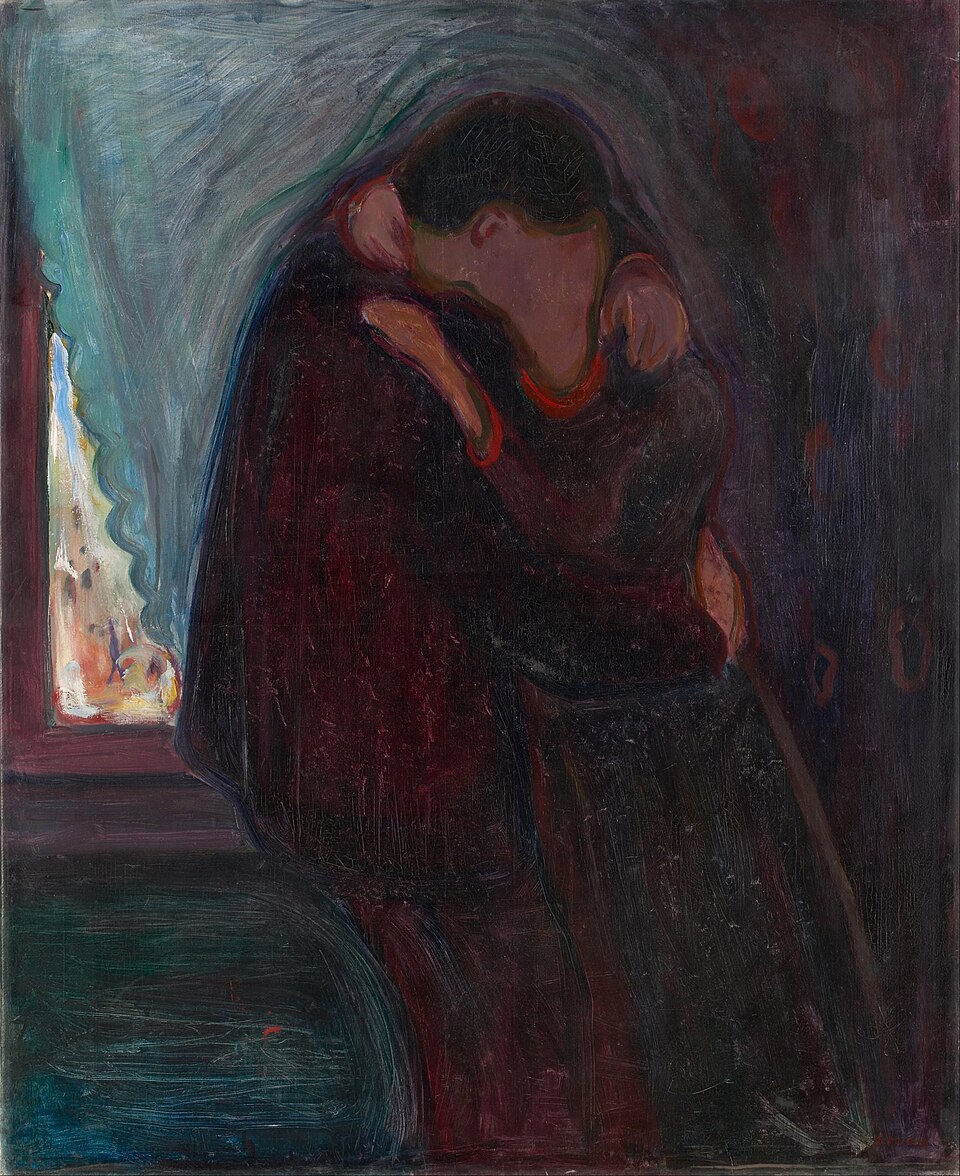
In a dark room, beside a curtained window with only a sliver of daylight, a couple holds each other so close that their two faces melt into one shape. Munch returned to this kiss again and again; this is his 1897 painting of it.
The story behind the painting
Edvard Munch first tried the motif of a kissing couple in 1888 and 1889, in paintings and in woodcuts, and he completed this oil on canvas in 1897. It belongs to his Frieze of Life, a cycle he worked on for more than thirty years, tracing attraction, courtship, realisation and disappointment in what he called the battle between men and women that is called love. Munch's life was marked by illness and death in his family, a strict religious father, disappointed love and melancholy, and he never married. The critic Ulrich Bischoff notes that the room resembles Munch's own, as seen in Night in Saint-Cloud, and so finds an autobiographical element here.
What to look for
The canvas is 81 by 99 cm. Almost everything is darkness; a curtain covers the window, and only a narrow strip of daylight slips past it. Against it stand the lovers, their faces a single featureless form. Roberta Smith describes Munch's long, somewhat slurpy strokes as more stained than painted, and you can see how thin the paint lies. In versions of this motif the lively world outside contrasts with the timeless room where the couple stand frozen. Munch painted another, more complex kiss in the same period; this one is the simpler of the two.
Meaning and intent
The fused faces express belonging and togetherness. Yet the Museum of Modern Art reads the darkness as a sign of Munch's ambivalence about romance, and the historian Reinhold Heller finds it virtually impossible to separate the two figures, a union that also threatens loss of individuality and identity, close to death. Contemporaries were sharp: the writer Stanisław Przybyszewski said the merged faces looked like a gigantic ear, deaf in the ecstasy of the blood, and August Strindberg wrote of two beings fusing, the smaller, like a carp, ready to devour the larger.
Legacy
The Kiss was exhibited in 1903 in Munch's show Love's Awakening, hung with a version of his Madonna. In later versions of the motif Munch went further, merging not only the faces but the bodies too. The 1897 canvas now belongs to the Munch Museum in Oslo. It is a picture of tenderness that refuses to be simple, holding together the warmth of an embrace and the fear of disappearing inside it, the emotional honesty that, as Roberta Smith writes, made his work shocking and thrilling at once.
Schon gewusst?
- Painted in 1897, oil on canvas, 81 by 99 cm.
- Part of Munch's Frieze of Life.
- Exhibited in 1903 in the show Love's Awakening.
- In the Munch Museum, Oslo.
Über den Künstler
Edvard Munch (1863-1944)
Porträt · Munch-Museum Oslo · Kuss
Mehr von Edvard Munch
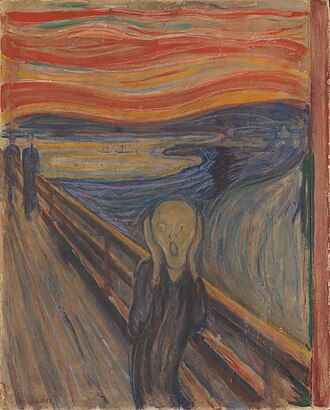 Der Schrei - Edvard Munch (1893)
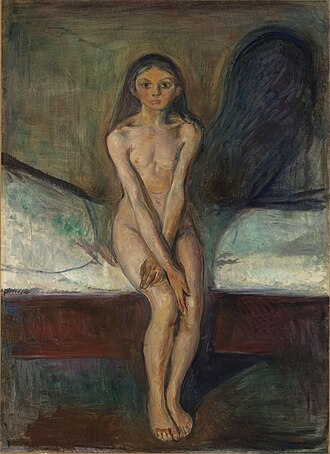 Pubertät - Edvard Munch (1895)
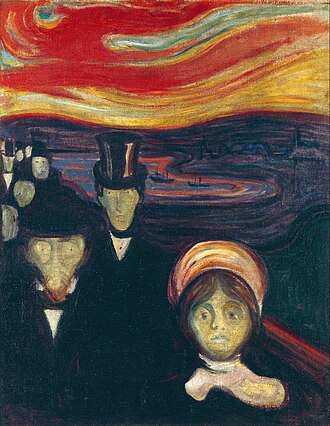 Angst - Edvard Munch (1894)
.jpg) Inger am Strand - Edvard Munch (1889)
Inger am Strand - Edvard Munch (1889).jpg) Abend auf der Karl Johans gate - Edvard Munch (1892)
Abend auf der Karl Johans gate - Edvard Munch (1892)%2C%20NG.M.01111.jpg) Nacht in Saint-Cloud - Edvard Munch (1890)
Nacht in Saint-Cloud - Edvard Munch (1890) Selbstbildnis mit Zigarette - Edvard Munch (1895)
%2C%20Kunsthalle%20Bremen.jpg) Das Kind und der Tod - Edvard Munch (1899)
Das Kind und der Tod - Edvard Munch (1899)