Das Ewig-Weibliche
Paul Cézanne · 1877
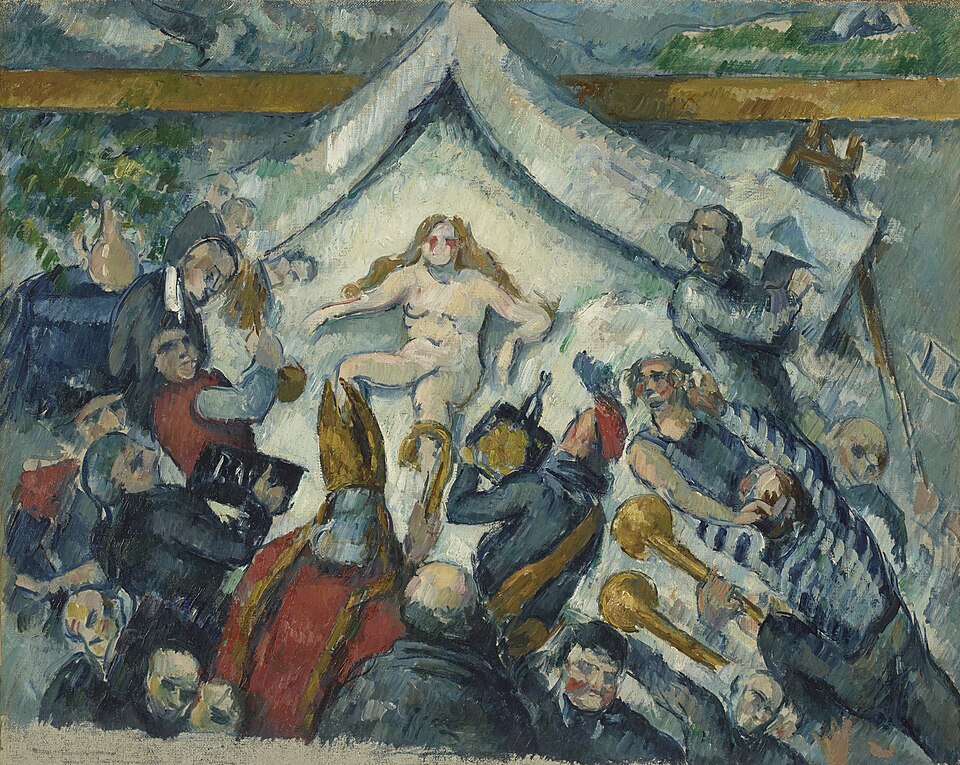
A crowd of men, bishop, banker, painter and musician, presses toward one naked woman on a canopied bed. Cézanne's small, strange canvas of 1877 is half homage, half confession, and it is where his famous parallel brushstrokes first began.
The story behind the painting
The Eternal Feminine is an oil on canvas of 1877, only about 43 by 53 cm. It shows men from many walks of life gathered around a single female figure, among them writers, lawyers and a painter who may be Delacroix or Cézanne himself. Curators Christopher Riopelle and Françoise Cachin have suggested it reinterprets Delacroix's The Death of Sardanapalus of 1827, and a preparatory drawing shows Cézanne first arranged the scene in the same structure. Cézanne admired Delacroix to a degree historians call almost humiliating. Changes in his own life, including his relationship with the model Hortense Fiquet from around 1870, may also lie behind his anxious images of women.
What to look for
A naked, golden-haired woman lies on a bed in the centre. Her face is blank, her eyes seem blinded, and her open pose suggests vulnerability. Above her, a canopy and drapes form a triangle, and with the clouds letting light spill onto her they create a diamond-shaped, full-body halo, a mandorla. The men split into two groups, as in Courbet's The Painter's Studio: on the right the art world, a painter, a conductor and entertainers; on the left a social world of financier, soldier, bishop and banker. In the foreground a man who seems to stand for Cézanne watches, his hat floating off into the air.
Meaning and intent
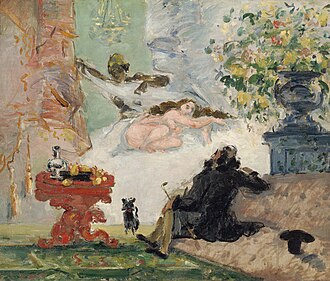
The work is deliberately ambiguous. The woman has been compared to the Virgin Mary, a saint or Venus, to the temptress of Saint Anthony, and to Liberty in Delacroix's Liberty Leading the People. Some scholars read a comment on the political and symbolic role of women, perhaps drawn from popular prints. Against Sardanapalus, Cézanne inverts the roles: the woman takes the tyrant's place and the men become the victims, so she rules by holding their attention. As in Modern Olympia, she can be seen as a femme fatale drawing men from their work; one reading sees Cézanne himself looking at her yet overcoming temptation.
Legacy
The painting is often seen as closing the Romantic and Baroque manner of Cézanne's early career. Its structure and rhythm come from parallel brushstrokes converging on the central nude, which unify the picture and impose order. It was one of the first paintings where he used these consecutive strokes, soon common in his work, and the technique went on to inspire younger artists such as Paul Signac and Gauguin. Ambroise Vollard bought it when it was shown in the Cézanne exhibition of November 1899, and since 1987 it has belonged to the J. Paul Getty Museum in Los Angeles.
Schon gewusst?
- Painted in 1877, about 43 x 53 cm.
- Possibly a reinterpretation of Delacroix's The Death of Sardanapalus.
- One of the first works with Cézanne's parallel brushstrokes.
- In the J. Paul Getty Museum since 1987.
Über den Künstler
Paul Cézanne (1839-1906)
Akt · Allegorie · J. Paul Getty Museum
Mehr von Paul Cézanne
 Die großen Badenden - Paul Cézanne (1900s)
 Der Knabe mit der roten Weste - Paul Cézanne
 The Basket of Apples - Paul Cézanne (1893)
 Stillleben mit Vorhang, Krug und Obstschale - Paul Cézanne (1890s)
 Haus in der Provence - Paul Cézanne (1880s)
 Olympia - Paul Cézanne (1873)
 Frau mit Kaffeekanne - Paul Cézanne (1895)
 Schädelpyramide - Paul Cézanne (1899)
Werke verwandter Künstler
 Die Sternennacht - Vincent van Gogh (1889)
 Caféterrasse am Abend - Vincent van Gogh (1888)
 Woher kommen wir? Wer sind wir? Wohin gehen wir? - Paul Gauguin (1897-1898)
 Der gelbe Christus - Paul Gauguin (1889)
 Strandspaziergang - Joaquín Sorolla (1909)
 Sad Inheritance - Joaquín Sorolla (1898)
 Tanz im Moulin de la Galette - Pierre-Auguste Renoir (1876)
 Das Frühstück der Ruderer - Pierre-Auguste Renoir (1881)
 Das Promenoir des »Moulin Rouge« - Henri de Toulouse-Lautrec (1892)
 Die Toilette - Henri de Toulouse-Lautrec (1896)