Lasset die Kinder zu mir kommen
Rembrandt van Rijn · 1620s
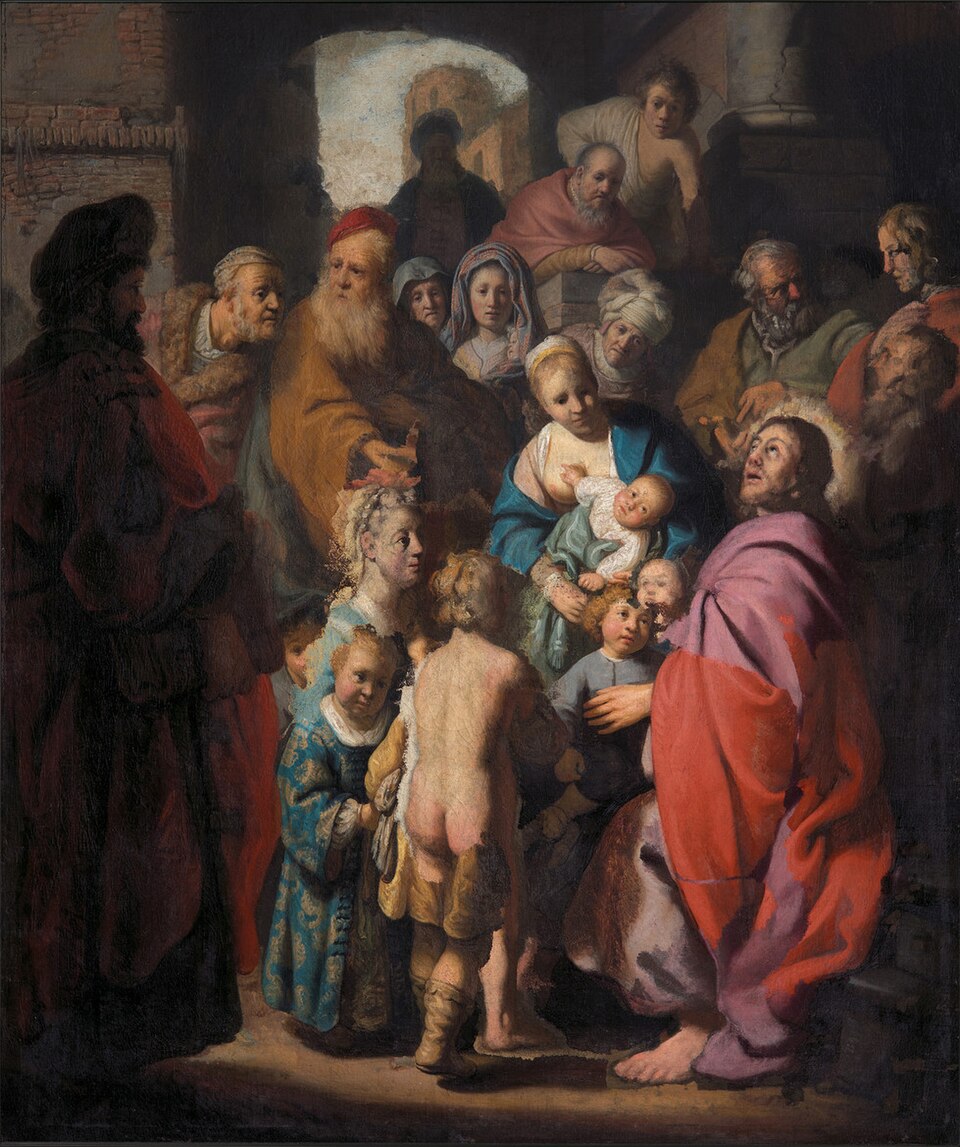
Sold at auction in 2014 as an anonymous Netherlandish picture, this crowded scene of Jesus and the children turned out to be an early Rembrandt, recognised by a young face in the background: the painter himself.
The story behind the painting
The painting shows the teaching of Jesus about little children, and it is dated to Rembrandt's years in Leiden, around 1627. It came to public attention when it appeared at the Lempertz auction house in Cologne on 17 May 2014, catalogued only as Netherlandish School, mid-17th century. The Amsterdam art dealer Jan Six is credited with recognising it as an early Rembrandt, after identifying the young man in white at the upper right as a self-portrait of the artist. The attribution and the Leiden dating followed, and several specialists, including Christopher Brown of the Ashmolean, authenticated it. Wikipedia dates it around 1627, and Wikidata places it in the 1620s.
What to look for
Search the upper right for the young man in white, the face that gave the painter away. The man under the archway at the back and the woman looking out between two other figures were modelled on Rembrandt's father and mother. When the work was sold it was covered with extensive later overpainting, removed in restoration. That overpainting had hidden a naked child in the foreground and had replaced the turban of a man at centre left with a Dutch soft cap. The crowd includes people in non-European dress. The picture was not completely finished when it was overpainted, and Christiaan Vogelaar suggested that some of the finishing may be by Claes Corneliszoon Moeyaert.
Meaning and intent
The subject is welcome: Jesus receiving the children whom others would turn away. The art historian Andrew Graham-Dixon links that subject, and the figures in non-European clothing among the crowd, with the refugees who came to Leiden in 1626 fleeing the Thirty Years' War. Read this way, the young Rembrandt filled a gospel scene with the faces of his own town, his own parents and himself, and with strangers who had just arrived there. The restoration made the reading clearer, bringing back the turban and the child that a later hand had painted out.
Legacy
Once restored, the painting was shown in the exhibition Young Rembrandt at Museum De Lakenhal in Leiden, opening on 2 November 2019, and then at the Ashmolean Museum in Oxford from 27 February to 7 June 2020. In 2026 Sotheby's announced that it would offer the painting at auction on 1 July of that year. In little more than a decade, a canvas listed as the work of an unknown mid-century hand had become a documented piece of Rembrandt's beginnings, with his parents and his own young face hidden in the crowd.
Schon gewusst?
- Dated to Rembrandt's Leiden period, around 1627.
- Appeared at auction in Cologne in 2014 as an anonymous Netherlandish work.
- Restoration removed overpainting that hid a naked child and a turban.
- Shown in Young Rembrandt, Leiden and Oxford, 2019-2020.
Über den Künstler
Rembrandt van Rijn (1606-1669)
religiöse Kunst · Jesus Christus · Kind · Rembrandt van Rijn · portrait historié
Mehr von Rembrandt van Rijn
 Die Nachtwache - Rembrandt van Rijn (1642)
 Selbstbildnis - Rembrandt van Rijn (1659)
 Die Anatomie des Dr. Tulp - Rembrandt van Rijn (1632)
 Die Judenbraut - Rembrandt van Rijn (1660s)
 Der Sturm auf dem See Genesareth - Rembrandt van Rijn (1633)
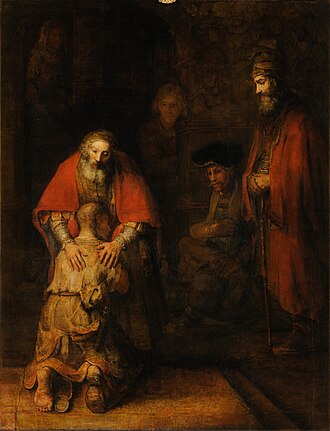 Die Rückkehr des verlorenen Sohnes - Rembrandt van Rijn (1668)
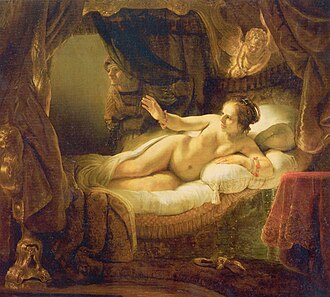 Danaë - Rembrandt van Rijn (1636)
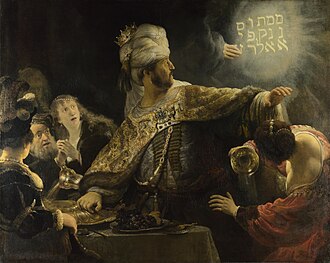 Das Gastmahl des Belsazar - Rembrandt van Rijn (1636)
Werke verwandter Künstler
 Das Mädchen mit dem Perlenohrgehänge - Johannes Vermeer (1665)
 Dienstmagd mit Milchkrug - Johannes Vermeer (c. 1658)
 Fest des hl.Nikolaus - Jan Steen (1660s)
 Mädchen mit Austern. - Jan Steen (1658)
 Ein Schütze einen Berkemeyer haltend, bekannt als „Der fröhliche Trinker" - Frans Hals (1620s)
 Der lachende Kavalier - Frans Hals (1624)
 Die Mühle von Wijk - Jacob van Ruisdael (1670)
 Judenfriedhof - Jacob van Ruisdael (1650s)
 Hof eines Hauses in Delft - Pieter de Hooch (1658)
 A Woman Peeling Apples - Pieter de Hooch (1663)