Rosen
Vincent van Gogh · 1890
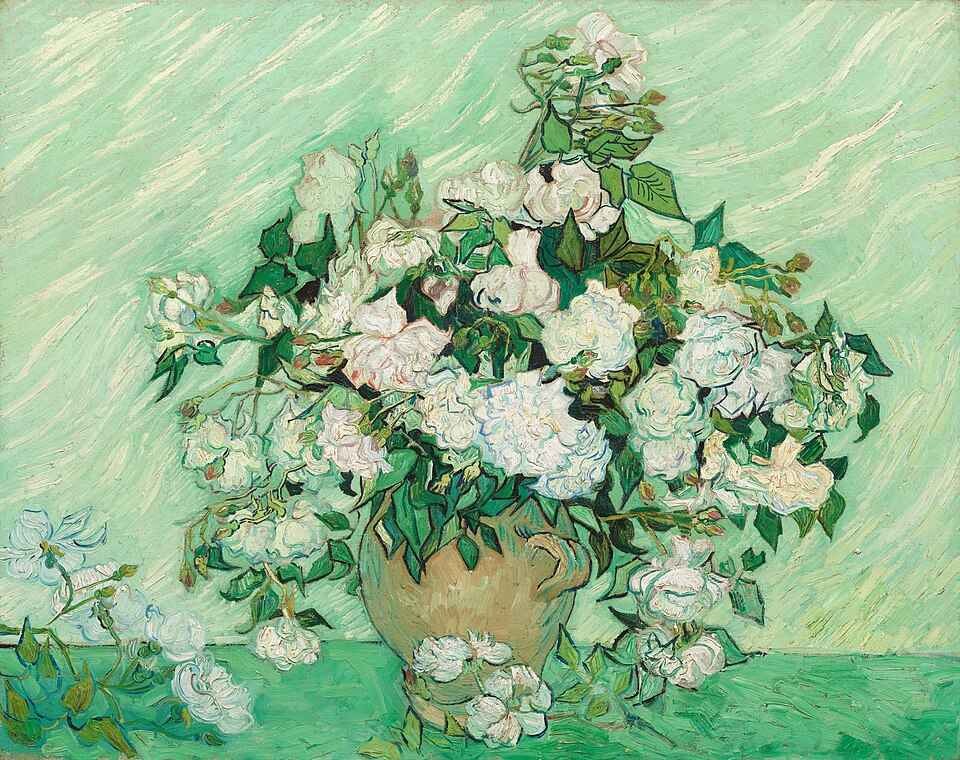
A vase overflowing with roses against a green as fresh as new spring leaves. Van Gogh painted it in his last days at Saint-Rémy, full of hope for what came next.
The story behind the painting
Van Gogh painted this still life in Saint-Rémy in 1890, shortly before leaving the Saint-Paul de Mausole asylum for the quiet town of Auvers-sur-Oise outside Paris. To his mother he wrote that for one's health it is very necessary to work in the garden and see the flowers growing. To his sister Wil he wrote that in his last days at Saint-Rémy he worked like a madman, painting great bouquets of violet irises and great bouquets of roses. When he left on 16 May, the thickly painted rose canvases stayed behind to dry, and reached him in Auvers by 24 June.
What to look for
The vase and its roses fill almost the whole picture, an overabundance Van Gogh also used in still lifes with carnations and anemones. Undulating ribbons of paint, laid in diagonal strokes, make the canvas move and echo the furled shapes of the flowers and leaves. The background is a fresh green, the delicate colour of new spring leaves. Imagine the roses as they once were: they were originally pink, and the colour has faded, so the strong contrast with the green is softer today than he intended.
Meaning and intent
The National Gallery of Art notes that Van Gogh had no known special association with roses, but that he saw all blossoming plants as celebrations of birth and renewal. Pink against green was his own pairing for spring, and he once wrote of pinks marrying the greens, a wedding of two complementary colours. He had learned such contrasts from Delacroix, Chevreul, Seurat and Monticelli. What colour is in a picture, he told Theo, enthusiasm is in life. This canvas carries the optimism he felt about his future.
Legacy
The painting belonged to the Paris collector Paul Gallimard by 1905 and to the Bernheim-Jeune family from at least 1917, who lent it to an exhibition in Zurich that year. In 1929 it went through Alex Reid and Lefèvre in London to W. Averell Harriman, and it was shown at the Marie Harriman Gallery in 1930 and in Buffalo the same year. In 1991 the Harrimans gave it to the National Gallery of Art in Washington, D.C. It is described as one of Van Gogh's largest and most beautiful still lifes; another Saint-Rémy rose painting is at the Metropolitan Museum of Art.
Schon gewusst?
- Painted in Saint-Rémy in 1890, just before the move to Auvers.
- The roses were originally pink; the colour has faded.
- Left behind to dry, it reached Auvers by 24 June 1890.
- Given to the National Gallery of Art, Washington, in 1991.
Über den Künstler
Vincent van Gogh (1853-1890)
National Gallery of Art · Baum · Blüte · Vase · Rose · Blumenmalerei · Blumenstrauß
Mehr von Vincent van Gogh
 Die Sternennacht - Vincent van Gogh (1889)
 Caféterrasse am Abend - Vincent van Gogh (1888)
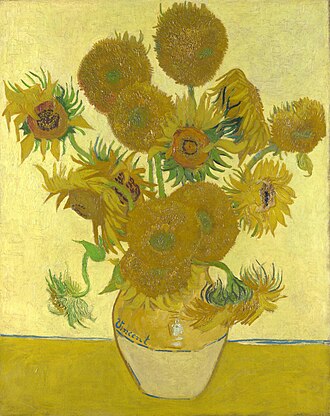 Sonnenblumen - Vincent van Gogh (1888)
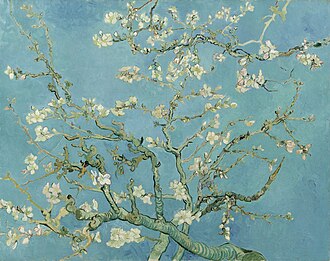 Mandelblüte - Vincent van Gogh (1890)
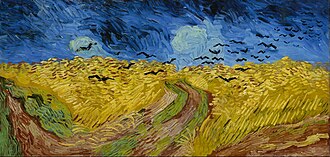 Weizenfeld mit Raben - Vincent van Gogh (1890)
 Das Schlafzimmer - Vincent van Gogh (1888)
 Die Kartoffelesser - Vincent van Gogh (1885)
 Schwertlilien - Vincent van Gogh (1889)
Werke verwandter Künstler
 Die großen Badenden - Paul Cézanne (1900s)
 Der Knabe mit der roten Weste - Paul Cézanne
 Woher kommen wir? Wer sind wir? Wohin gehen wir? - Paul Gauguin (1897-1898)
 Der gelbe Christus - Paul Gauguin (1889)
 Die Aufrichtung des Kreuzes - Peter Paul Rubens (1609)
 Der Raub der Töchter des Leukippos - Peter Paul Rubens (1618)
 Strandspaziergang - Joaquín Sorolla (1909)
 Sad Inheritance - Joaquín Sorolla (1898)
 Tanz im Moulin de la Galette - Pierre-Auguste Renoir (1876)
 Das Frühstück der Ruderer - Pierre-Auguste Renoir (1881)
 Das Promenoir des »Moulin Rouge« - Henri de Toulouse-Lautrec (1892)
 Die Toilette - Henri de Toulouse-Lautrec (1896)