Saint Germain l'Auxerrois
Claude Monet · 1867
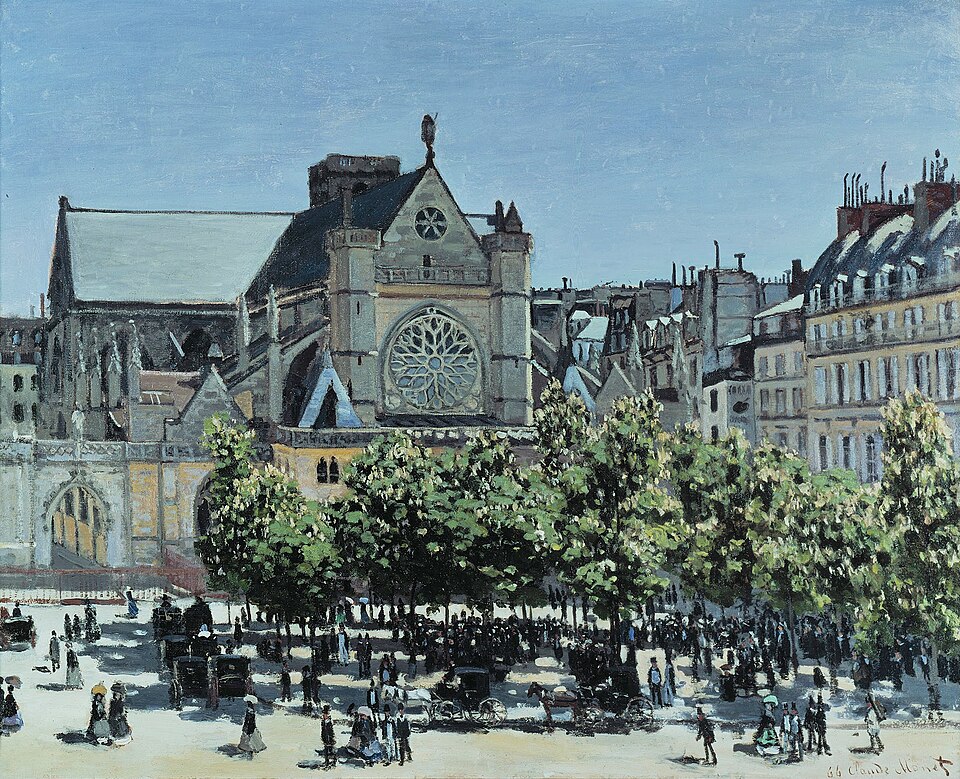
A Gothic church, fresh spring trees and tiny passers-by, seen from a balcony of the Louvre. Monet, aged 26 and poor, asked permission to paint there, and the Salon turned him down.
The story behind the painting
In spring 1867 Monet was 26, living in Paris with Camille, who was pregnant with their first son, and earning little from his art. With his friend Renoir he looked for views of Paris to paint outdoors. On 27 April 1867 he wrote to the superintendent of fine arts, Count de Nieuwerkerke, asking to make a view of Saint-Germain-l'Auxerrois. Granted access to the balcony on the east facade of the Louvre, he painted three works there: The Garden of the Princess, Quai du Louvre and this one.
What to look for
The quarter was new. Buildings blocking the view were demolished in 1853 for the place du Louvre, and the town hall of the 1st arrondissement was built as a match to the church, with a belfry between them that critics disliked. Monet left the belfry out, keeping only its southern base, and showed a building on the rue de l'Arbre-Sec behind the church instead. To balance the off-centre church he cut the right-hand building in half and drew the eye to the rose window, almost at the centre, painted in fine detail, with light and shadow and lines of perspective from upper floors, trees and figures.
Meaning and intent
The picture shows Monet's eye applied to the modern city, choosing what to keep and what to drop to make a harmonious view of a freshly cleaned church and square. Critics and fellow artists such as Daumier were harsh, especially about the figures, judged too small, but Émile Zola liked Monet's style applied to the urban world. It is a city view built with care, not a quick sketch. The rose window holds it together.
Legacy
Monet submitted it with the other two views to the Salon of 1869, without success. Durand-Ruel acquired it and showed it in London in 1872; it later belonged to the Hoschedé and Faure collections. Shown at Cassirer in Berlin with sixteen other Monets from the Faure collection, it was bought in 1906 by the Berlin Nationalgalerie with funds from two bankers. The canvas is dated 1866 by Monet, although it was painted in 1867.
Schon gewusst?
- Painted in spring 1867 from a balcony of the Louvre.
- Monet asked permission by letter on 27 April 1867.
- Rejected for the Salon of 1869.
- In the Berlin Nationalgalerie since 1906.
Über den Künstler
Claude Monet (1840-1926)
Stadtlandschaft · Alte Nationalgalerie
Mehr von Claude Monet
 Impression, Sonnenaufgang - Claude Monet (1872)
 Seerosen - Claude Monet (1906)
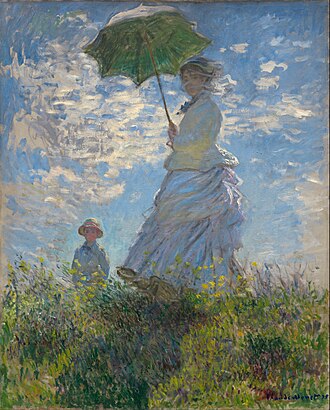 Die Frau mit dem Sonnenschirm - Claude Monet (1875)
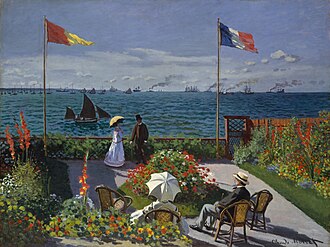 Garten in Sainte-Adresse - Claude Monet (1867)
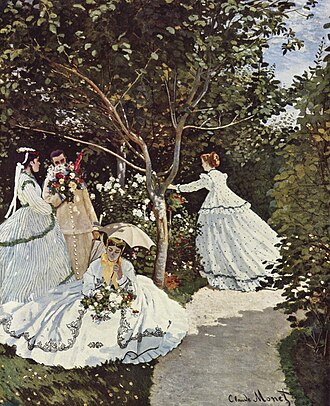 Frauen im Garten - Claude Monet (1866)
 Die Elster - Claude Monet (1868)
 Frau im Garten - Claude Monet (1867)
 Das Frühstück im Grünen - Claude Monet (1866)
Werke verwandter Künstler
 Die letzte Fahrt der Temeraire - J. M. W. Turner (1839)
 Rain, Steam and Speed - The Great Western Railway - J. M. W. Turner (1844)
 Der Ursprung der Welt - Gustave Courbet (1866)
 Ein Begräbnis in Ornans - Gustave Courbet (2020)
 Das Frühstück im Grünen - Édouard Manet (1863)
 Olympia - Édouard Manet (1863)
 Tanz im Moulin de la Galette - Pierre-Auguste Renoir (1876)
 Das Frühstück der Ruderer - Pierre-Auguste Renoir (1881)
 Wiege - Berthe Morisot (1872)
 Sommertag - Berthe Morisot (1879)
 Der Absinth - Edgar Degas (1875)
 Die Bellelli Familie - Edgar Degas (1858)