Snow Effect in Vétheuil
Claude Monet · 1870s
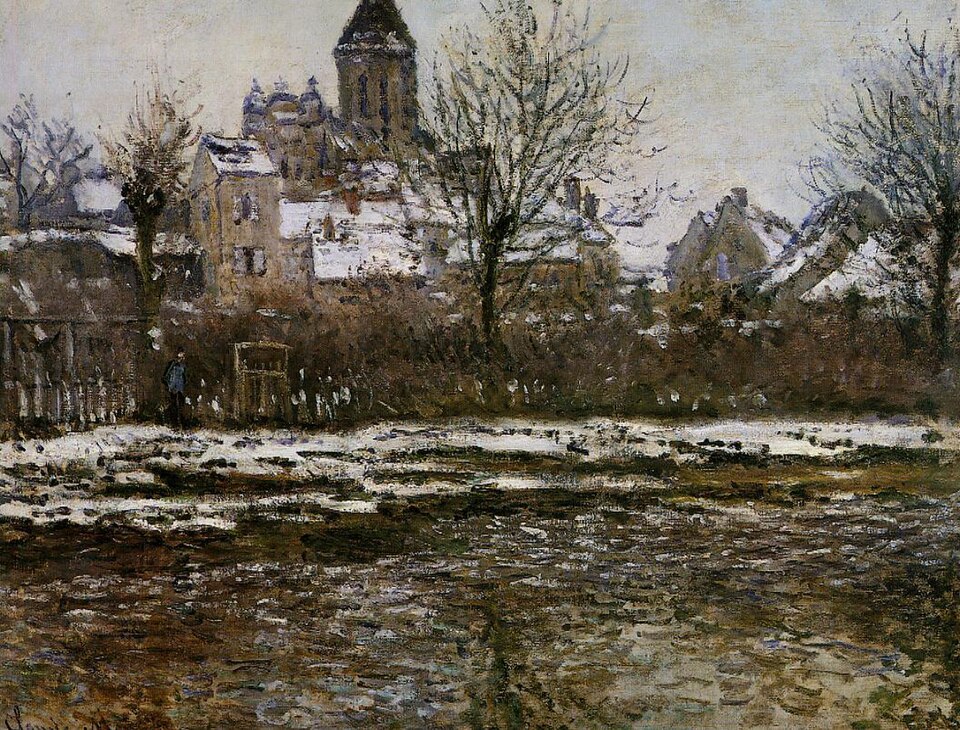
A snowy village seen from the Seine, its church rising above the flat banks. Monet painted it in the winter of 1878 to 1879, a hard time of debt and illness, from his studio boat.
The story behind the painting
Early in 1878 Monet was living in Paris with Camille, pregnant with their second child, and their son Jean. Camille was very ill, fame had not come, sales were modest and debts were piling up. Manet and Caillebotte helped him, but creditors pressed. Struggling to find subjects in the capital, Monet moved to Vétheuil that summer, sharing a house with the Hoschedé family, who were also in financial trouble. He painted about twenty canvases of the area in the fine season, and the following winter the village appeared in about half a dozen snow landscapes, including this one, painted from the Seine on his studio boat.
What to look for
The composition plays the horizontal lines of the riverbanks against the vertical of the church. The brushstrokes are lively, suggesting forms rather than describing detail. Look closely at the whites: they are subtly mixed with pinks, blues and greens, a sensitive way of handling light on snow. Monet set up on the water, so the village is seen across the river, the long line of the banks below and the church tower rising above the roofs. It is one of about half a dozen snow views of Vétheuil from that winter.
Meaning and intent
The scene itself is still, a village in winter, yet it is painted with a sense of movement, and the French Wikipedia account sees this as the source of the picture's originality. Painted in a period of hardship, it shows Monet looking hard at light rather than at his troubles, turning a cold, quiet place into something alive. The two families sharing one house, the debts and Camille's illness stay outside the frame; what remains is snow, water and light.
Legacy
Caillebotte bought the painting in January 1879, and it appeared in the catalogue of the fourth Impressionist exhibition that year. It was bequeathed to the French state in 1894 and moved to the Musée d'Orsay when that museum opened in 1986. It has travelled to about twenty exhibitions in Europe, the United States, Korea, Taiwan and Japan. Its first owner was a friend who had helped Monet through those difficult months.
Schon gewusst?
- Painted in the winter of 1878-1879 in Vétheuil.
- Painted from Monet's studio boat on the Seine.
- Bought by Caillebotte in January 1879.
- In the Musée d'Orsay since 1986.
Über den Künstler
Claude Monet (1840-1926)
Landschaftsmalerei · Musée d’Orsay · Baum · Landschaft · Seine · Schnee · Dorf
Mehr von Claude Monet
 Impression, Sonnenaufgang - Claude Monet (1872)
 Seerosen - Claude Monet (1906)
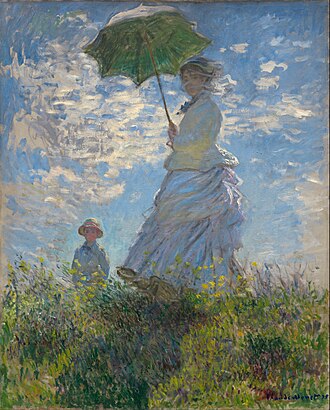 Die Frau mit dem Sonnenschirm - Claude Monet (1875)
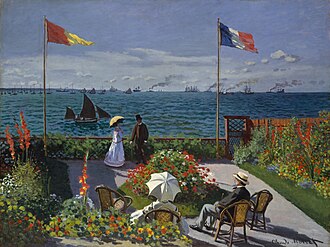 Garten in Sainte-Adresse - Claude Monet (1867)
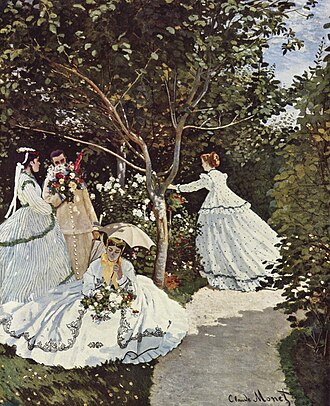 Frauen im Garten - Claude Monet (1866)
 Die Elster - Claude Monet (1868)
 Frau im Garten - Claude Monet (1867)
 Das Frühstück im Grünen - Claude Monet (1866)
Werke verwandter Künstler
 Die letzte Fahrt der Temeraire - J. M. W. Turner (1839)
 Rain, Steam and Speed - The Great Western Railway - J. M. W. Turner (1844)
 Der Ursprung der Welt - Gustave Courbet (1866)
 Ein Begräbnis in Ornans - Gustave Courbet (2020)
 Das Frühstück im Grünen - Édouard Manet (1863)
 Olympia - Édouard Manet (1863)
 Tanz im Moulin de la Galette - Pierre-Auguste Renoir (1876)
 Das Frühstück der Ruderer - Pierre-Auguste Renoir (1881)
 Wiege - Berthe Morisot (1872)
 Sommertag - Berthe Morisot (1879)
 Der Absinth - Edgar Degas (1875)
 Die Bellelli Familie - Edgar Degas (1858)