Rauchende Frauen
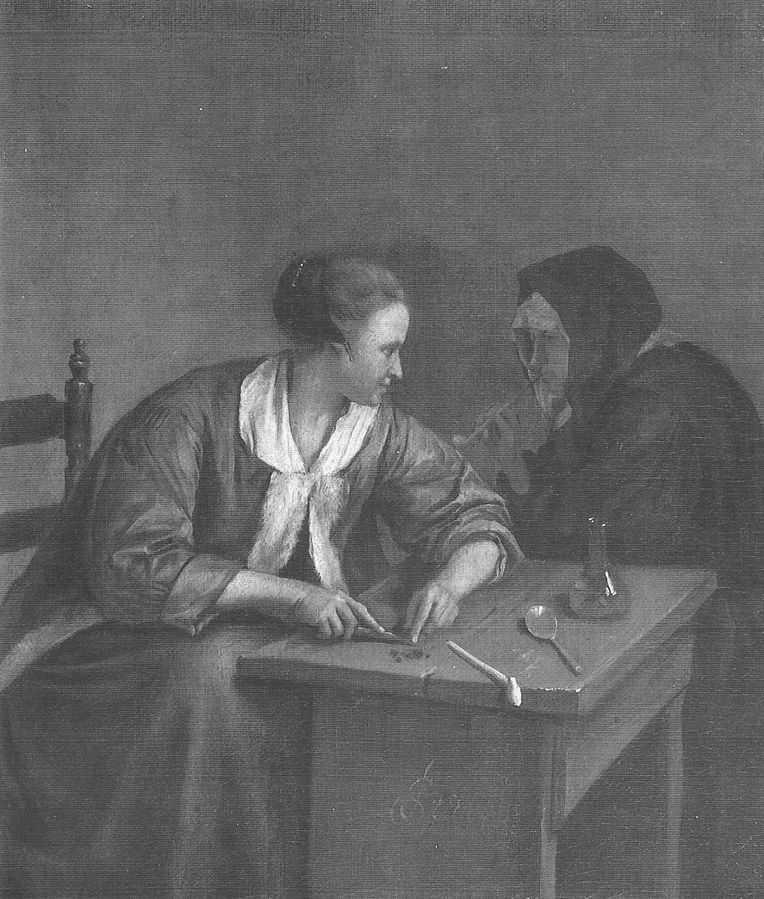
A young woman cuts tobacco at a plain wooden table while an old woman beside her puffs on a clay pipe. Jan Steen made a small joke of it, and a quiet warning about how fast life goes up in smoke.
The story behind the painting
Jan Steen was the son of a brewer and for a time ran a brewery in Delft himself, so he knew the habits of his contemporaries, especially life in taverns. His work is full of merry or drunken company. Smoking Women probably dates from his Haarlem years, between 1661 and 1670. Related pictures from the same period include A Man Blowing Smoke at a Drunken Woman in the National Gallery, London, and The Wine is a Mocker in Pasadena. The painting is small, 28.5 by 23.5 cm, oil on canvas later transferred to oak.
What to look for
In a dim interior two women sit at a simple table of plain boards. On the left, in bright light, a young woman in a reddish silk jacket with a white collar and fur trim leans forward, holding a piece of tobacco with her left hand and cutting it with a knife. Chopped tobacco and a clay pipe lie ready, beside a glass bottle and a pewter spoon, perhaps a hint of drink. In the shadow behind sits a much older woman wrapped in dark cloth, pipe to her mouth. The young one looks at her with what Helmut Börsch-Supan called a glance of agreement. It is signed J Steen.
Meaning and intent
Tobacco was a popular pleasure in Europe from the early 17th century, and like drinking, smoking was seen as a vice that clouded the head. Coarse scenes of smokers and drinkers entertained wealthy citizens and warned them at the same time. Steen sharpens the warning by showing women, from whom his contemporaries expected more restraint. The picture can also stand for the sense of smell, a theme of Dutch painting. The fleeting smoke recalls vanitas still lifes, and the contrast of the young and the old woman makes the shortness of life visible.
Legacy
Cornelis Hofstede de Groot suggested this is the Steen auctioned in Amsterdam in 1740 and in Leiden in 1761. It is recorded at Sanssouci in Potsdam in 1890, and from 1932 it hung in the Grunewald hunting lodge. After 1945 it was stolen and taken to Britain, where it was in the Nora Bibi collection in Southport by 1951. When the London dealer Duits offered it in 1964, it was bought back for the Berlin palaces. It returned to Grunewald until the early 2000s and is now shown at Oranienburg Palace.
Schon gewusst?
- Probably painted in Haarlem between 1661 and 1670.
- Only 28.5 by 23.5 cm.
- Stolen after 1945 and bought back in 1964.
- Now shown at Oranienburg Palace.
Über den Künstler
Jan Steen (1626-1679)
Stiftung Preußische Schlösser und Gärten Berlin-Brandenburg
Mehr von Jan Steen
 Fest des hl.Nikolaus - Jan Steen (1660s)
 Mädchen mit Austern. - Jan Steen (1658)
 Der Bürgermeister von Delft und seine Tochter - Jan Steen (1655)
 Die verkehrte Welt - Jan Steen (1663)
 'As the Old Sing, So Pipe the Young' - Jan Steen (1665)
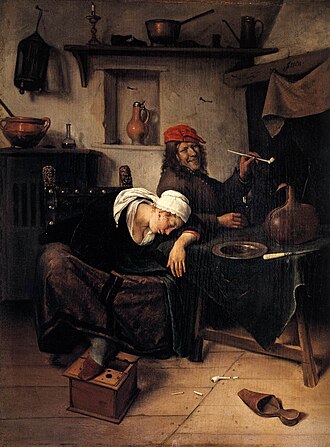 Idlers - Jan Steen (1660s)
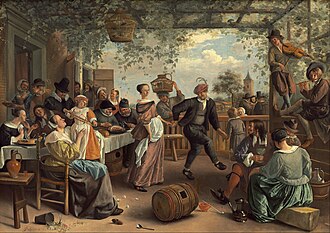 The Dancing Couple - Jan Steen (1663)
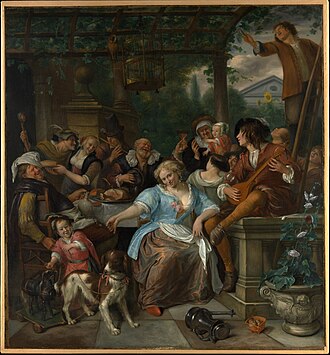 Fröhliche Gesellschaft auf einer Terrasse - Jan Steen (1670)
Werke verwandter Künstler
 Die Nachtwache - Rembrandt van Rijn (1642)
 Selbstbildnis - Rembrandt van Rijn (1659)
 Das Mädchen mit dem Perlenohrgehänge - Johannes Vermeer (1665)
 Dienstmagd mit Milchkrug - Johannes Vermeer (c. 1658)
 Ein Schütze einen Berkemeyer haltend, bekannt als „Der fröhliche Trinker" - Frans Hals (1620s)
 Der lachende Kavalier - Frans Hals (1624)
 Die Mühle von Wijk - Jacob van Ruisdael (1670)
 Judenfriedhof - Jacob van Ruisdael (1650s)
 Hof eines Hauses in Delft - Pieter de Hooch (1658)
 A Woman Peeling Apples - Pieter de Hooch (1663)