Simeons Lobgesang
Rembrandt van Rijn · 1631
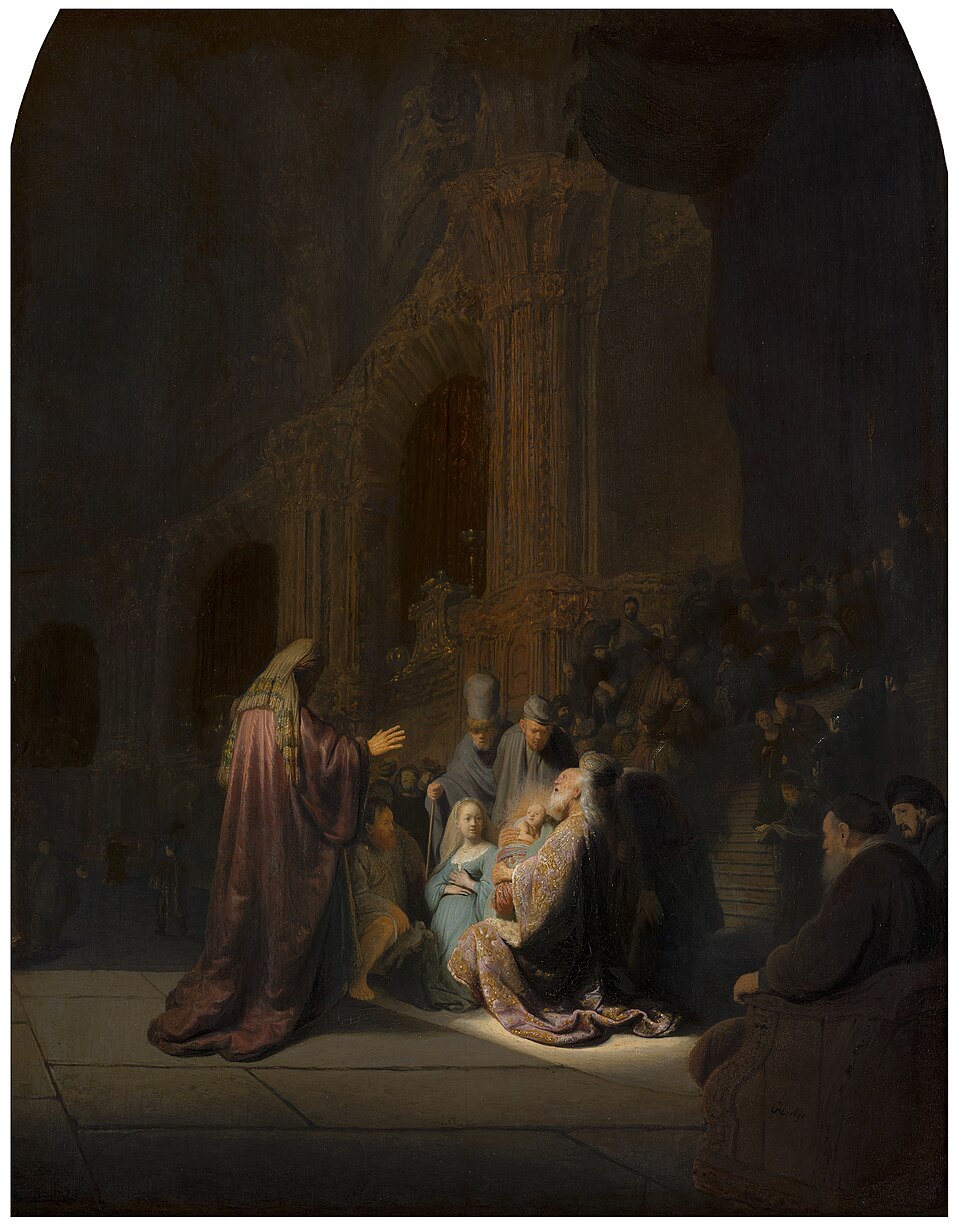
In a vast, shadowy temple an old man holds a newborn, and the light on his face seems to come from the child. Rembrandt painted it in Leiden in 1631, and the panel has travelled through palaces, a revolution and the Louvre since.
The story behind the painting
Rembrandt painted this oil on panel in 1631, while he was still living in Leiden. It shows an episode from the Gospel of Luke. Mary and Joseph have gone up to the temple in Jerusalem to present Jesus, their firstborn, as Jewish law required. Simeon, a just and devout old man, comes into the temple, takes the child in his arms and blesses God. It was not the only time Rembrandt turned to the scene: he had painted Simeon and Anna in the Temple in 1627 to 1628, and much later an unfinished Simeon in the Temple around 1669.
What to look for
The panel measures only 60.9 by 47.9 cm, yet the temple feels immense. It is drawn as a great Gothic interior, deep and mysterious, perhaps inspired by the Pieterskerk in Leiden. The composition favours diagonals, and the figures are elongated, typical of Rembrandt's style at that time. Find Simeon with the child: the light that falls on the old man seems to come from the baby himself. Around this bright pool, the vast building fades into darkness, so the small group feels like the only lit place in the world.
Meaning and intent
The story is about recognition. An old man who has waited his whole life holds a baby and knows him, and Rembrandt shows that moment through light. By making the child the source of brightness, he lets the picture say who this infant is without any words. The towering, dim architecture makes the people small and the moment quiet and intimate. Simeon's prayer of praise, which gives the work its name, becomes a scene of light found in darkness.
Legacy
In 1632 the panel was probably in the collection of Frederick Henry of Orange-Nassau, though the inventory cannot tell it apart from Rembrandt's earlier version. It passed to his widow Amalia of Solms-Braunfels, then to their daughter Albertine Agnes. In 1733 Philip van Dijk bought it at the sale of Adriaan Bout's collection. Under William V its upper corners were sawn off and an arched top added, so it could hang as a pair with a work by Gerard Dou. France seized it in 1795 for the Louvre, and it returned in 1815. It entered the Mauritshuis in 1822, and in 1983 and 1989 its original shape was restored.
Schon gewusst?
- Oil on panel, 60.9 by 47.9 cm, painted in Leiden in 1631.
- Shows Simeon blessing the infant Jesus in the temple (Luke 2).
- Taken to the Louvre in 1795, returned in 1815.
- In the Mauritshuis, The Hague, since 1822.
Über den Künstler
Rembrandt van Rijn (1606-1669)
religiöse Kunst · Niederländisches Goldenes Zeitalter der Malerei · Mauritshuis
Mehr von Rembrandt van Rijn
 Die Nachtwache - Rembrandt van Rijn (1642)
 Selbstbildnis - Rembrandt van Rijn (1659)
 Die Anatomie des Dr. Tulp - Rembrandt van Rijn (1632)
 Die Judenbraut - Rembrandt van Rijn (1660s)
 Der Sturm auf dem See Genesareth - Rembrandt van Rijn (1633)
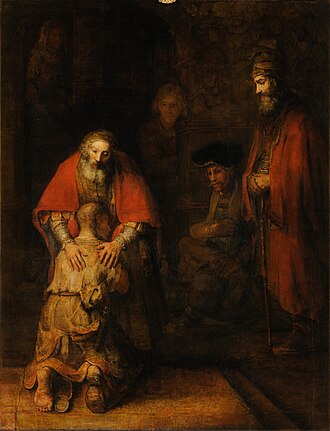 Die Rückkehr des verlorenen Sohnes - Rembrandt van Rijn (1668)
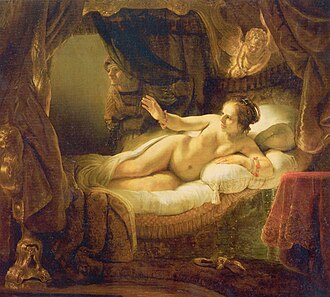 Danaë - Rembrandt van Rijn (1636)
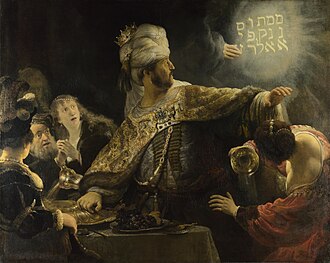 Das Gastmahl des Belsazar - Rembrandt van Rijn (1636)
Werke verwandter Künstler
 Das Mädchen mit dem Perlenohrgehänge - Johannes Vermeer (1665)
 Dienstmagd mit Milchkrug - Johannes Vermeer (c. 1658)
 Fest des hl.Nikolaus - Jan Steen (1660s)
 Mädchen mit Austern. - Jan Steen (1658)
 Ein Schütze einen Berkemeyer haltend, bekannt als „Der fröhliche Trinker" - Frans Hals (1620s)
 Der lachende Kavalier - Frans Hals (1624)
 Die Mühle von Wijk - Jacob van Ruisdael (1670)
 Judenfriedhof - Jacob van Ruisdael (1650s)
 Hof eines Hauses in Delft - Pieter de Hooch (1658)
 A Woman Peeling Apples - Pieter de Hooch (1663)