Sigismunda mourning over the Heart of Guiscardo
William Hogarth · 1759
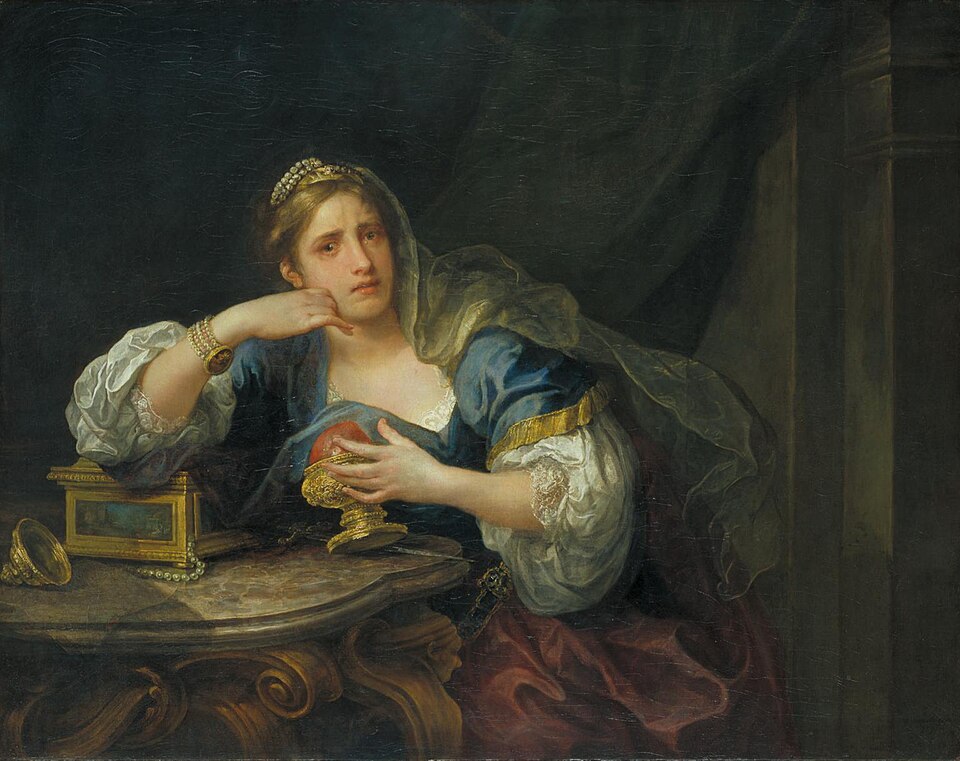
A princess in pearls and silk weeps over a golden cup holding her murdered husband's heart. Hogarth meant it to prove he could rival the old Italian masters. Instead it brought him some of the harshest ridicule of his life.
The story behind the painting
Sir Richard Grosvenor commissioned the painting in 1758, after seeing Hogarth's Piquet, or Virtue in Danger, in the studio and asking for a picture on the same terms. Hogarth chose a serious subject from Boccaccio's Decameron, the first tale of the fourth day. He is said to have wanted to equal the old Italian masters. He spent at least two hundred days on it, and when he presented it, Grosvenor declined, saying it would bring melancholy thoughts too often. In disgust, Hogarth released him from the bargain. The work was finished in 1759.
What to look for
Sigismunda sits at an ornate wooden table in a pearl tiara and flowing silk, probably modelled on Hogarth's wife Jane, clasping the golden goblet that holds Guiscardo's heart. In the carved table leg a turbaned, pug-nosed face emerges, reminiscent of Hogarth's own self-portrait. Look too for the pentimenti visible to the naked eye: a piece of paper painted over at the table's edge, her index finger once bent toward the heart and later straightened, a looped cord badly hidden at top right. Hogarth also repainted her fingers to remove the blood.
Meaning and intent
In the tale Sigismunda's father, Prince Tancred of Salerno, has the low-born Guiscardo killed for marrying her in secret and sends her his heart in a golden cup. She had vowed to die without a tear, but weeps, then poisons the cup and drinks. The story was popular in England through John Dryden's Fables of 1699 and James Thomson's stage version of 1745. Hogarth was looking for grief with dignity, the grand drama of history painting rather than the satire for which he was famous.
Legacy
Shown at Spring Gardens in 1761, it was attacked. Horace Walpole called Sigismunda a maudlin fallen virago, and John Wilkes dismissed it as not human. After ten days Hogarth replaced it with Chairing the Member. He never sold it, and a planned engraving was dropped by March 1761. After his widow Jane died in 1789 it passed to her cousin Mary Lewis, then to John Boydell, who showed it in his Shakespeare Gallery. J. H. Anderdon owned it by 1814 and left it to the Tate in 1879.
Schon gewusst?
- Commissioned in 1758 by Sir Richard Grosvenor, who then declined it.
- Based on a tale in Boccaccio's Decameron.
- Ridiculed at the 1761 exhibition and withdrawn after ten days.
- Bequeathed to the Tate in 1879.
Über den Künstler
William Hogarth (1697-1764)
National Gallery · mythologische Malerei · Tate
Mehr von William Hogarth
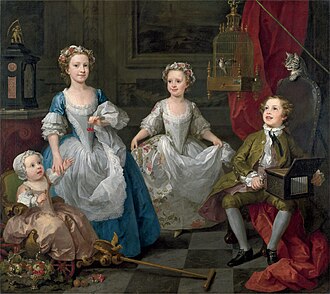 Porträt der Graham-Kinder - William Hogarth (1742)
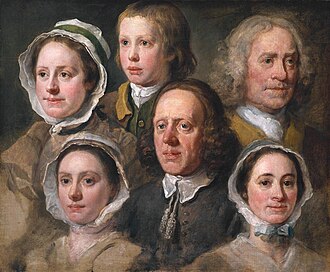 Hogarth's Servants - William Hogarth (1750s)
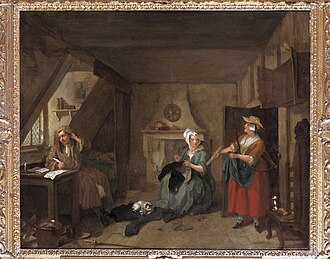 Der gepeinigte Poet - William Hogarth (1730s)
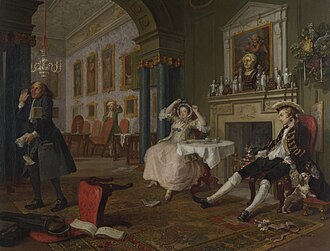 Gemäldezyklus »Mariage à la Mode«, Szene: Kurz nach der Hochzeit - William Hogarth (1743)
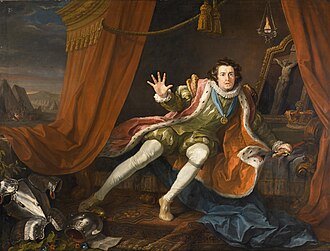 David Garrick as Richard III - William Hogarth (1745)
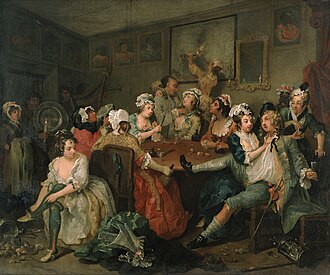 Gemäldefolge »Der Lebensweg eines Wüstlings«, Szene: Szene in einer Schenke - William Hogarth (1735)
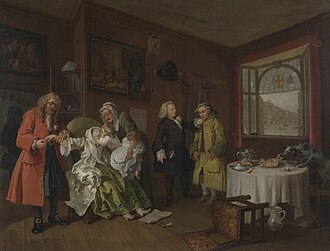 Gemäldezyklus «Mariage à la Mode», Szene (6): Selbstmord der Comtesse - William Hogarth (1743)
Der letzte Widerstand - William Hogarth (1759)