Der Afrikaner Scipio
Paul Cézanne · 1867
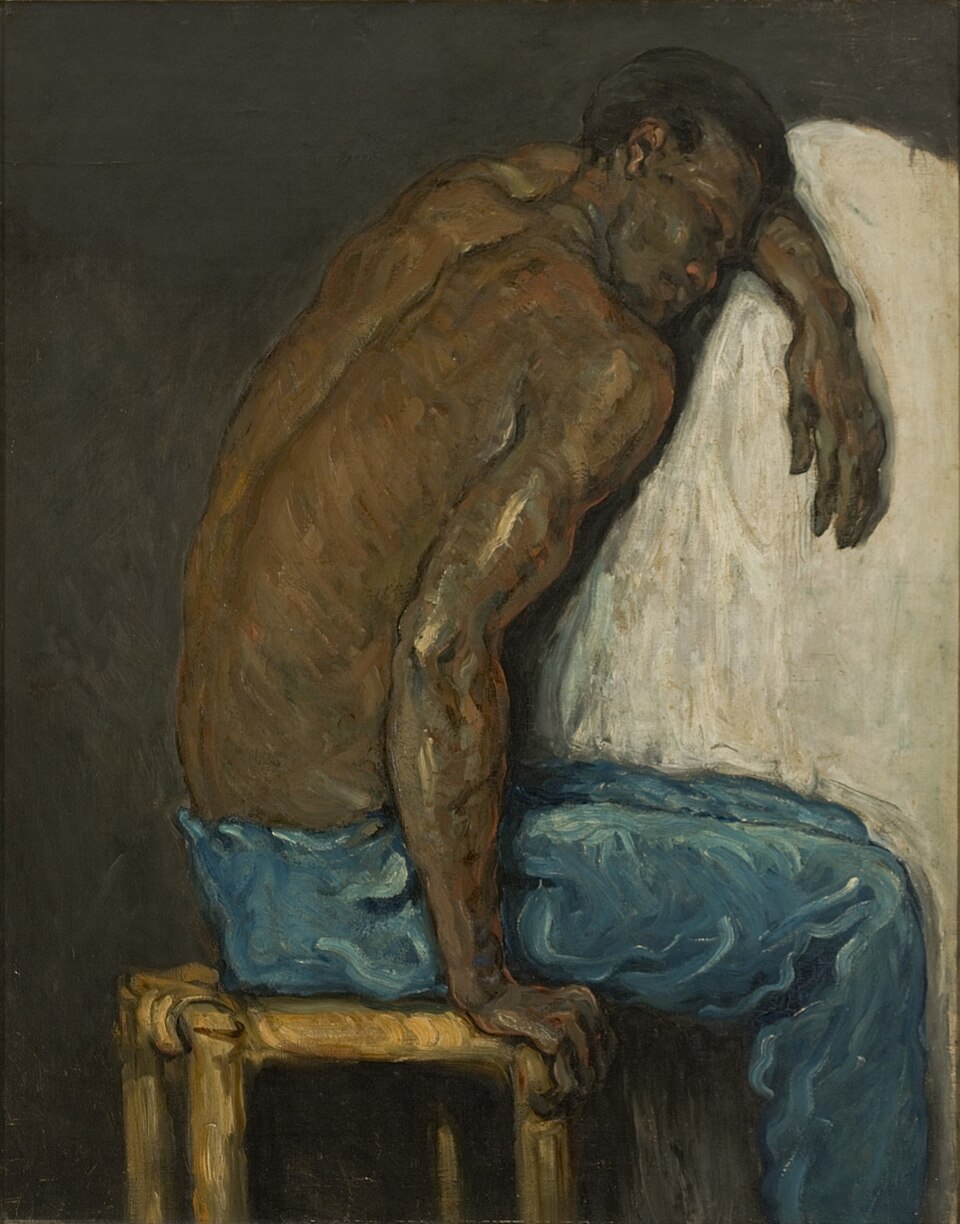
A model slumps forward in Cézanne's studio, his long muscular back built from broad strokes of colour. Monet kept this early canvas in his bedroom and called it a work of the greatest strength.
The story behind the painting
Scipion was a model at the Académie Suisse, where Cézanne studied after arriving in Paris in 1862. Little else is known about him. Scholars speculate that he also posed for a plaster by Philippe Solari, Sleeping Negro, exhibited at the Salon of 1868. The painting shows him in Cézanne's studio. It is usually dated 1867, because its thick brushwork, type of model and long strokes closely match The Abduction, one of the few Cézanne pictures that carries a date. Scholars count it among three important works he made that year in Paris or Aix, with The Abduction and Mary Magdalen.
What to look for
Scipion is shown with an elongated torso and a muscular back, accentuated by broad brushstrokes. Look at how Cézanne modulates the tone of the back with many different colours rather than one flat skin tone. The figure leans forward, and beside him lies a white mass. Scholars suspect Cézanne may first have painted another figure in that area and later covered it over. The canvas measures 107 by 86 cm, a large and heavy presence for a young painter's study of a studio model.
Meaning and intent
Scholars have offered various readings, often suggesting that Scipion is mourning the death of an unknown person. The source gives no firm answer, and the painting itself offers only the weight of the body and the bowed posture. What is clear is the force of the execution. Visitors to Monet's studio in Giverny were surprised by it, and the critic Louis Vauxcelles called it a striking masterpiece, worthy of Delacroix. Art historians consider it among the strongest works of Cézanne's early career.
Legacy
The painting belonged to Claude Monet, who owned thirteen other works by Cézanne. He kept this one in his bedroom with other favourites and called it a work of the greatest strength. Monet had acquired the canvas from Ambroise Vollard. It passed to his son Michel Monet, who sold it to the dealer Paul Rosenberg. In 1950 the São Paulo Museum of Art bought it from the Wildenstein Galleries, and it remains there today, a link between Cézanne's early studio years and the private collection of the painter who admired him.
Schon gewusst?
- Painted around 1867, from a model at the Académie Suisse in Paris.
- Owned by Claude Monet, who kept it in his bedroom.
- Critic Louis Vauxcelles called it worthy of Delacroix.
- In the São Paulo Museum of Art since 1950.
Über den Künstler
Paul Cézanne (1839-1906)
Porträt · Museu de Arte de São Paulo
Mehr von Paul Cézanne
 Die großen Badenden - Paul Cézanne (1900s)
 Der Knabe mit der roten Weste - Paul Cézanne
 The Basket of Apples - Paul Cézanne (1893)
 Stillleben mit Vorhang, Krug und Obstschale - Paul Cézanne (1890s)
 Haus in der Provence - Paul Cézanne (1880s)
 Olympia - Paul Cézanne (1873)
 Frau mit Kaffeekanne - Paul Cézanne (1895)
 Schädelpyramide - Paul Cézanne (1899)
Werke verwandter Künstler
 Die Sternennacht - Vincent van Gogh (1889)
 Caféterrasse am Abend - Vincent van Gogh (1888)
 Woher kommen wir? Wer sind wir? Wohin gehen wir? - Paul Gauguin (1897-1898)
 Der gelbe Christus - Paul Gauguin (1889)
 Strandspaziergang - Joaquín Sorolla (1909)
 Sad Inheritance - Joaquín Sorolla (1898)
 Tanz im Moulin de la Galette - Pierre-Auguste Renoir (1876)
 Das Frühstück der Ruderer - Pierre-Auguste Renoir (1881)
 Das Promenoir des »Moulin Rouge« - Henri de Toulouse-Lautrec (1892)
 Die Toilette - Henri de Toulouse-Lautrec (1896)