Portrait of Dirck van Os
Rembrandt van Rijn · 1658
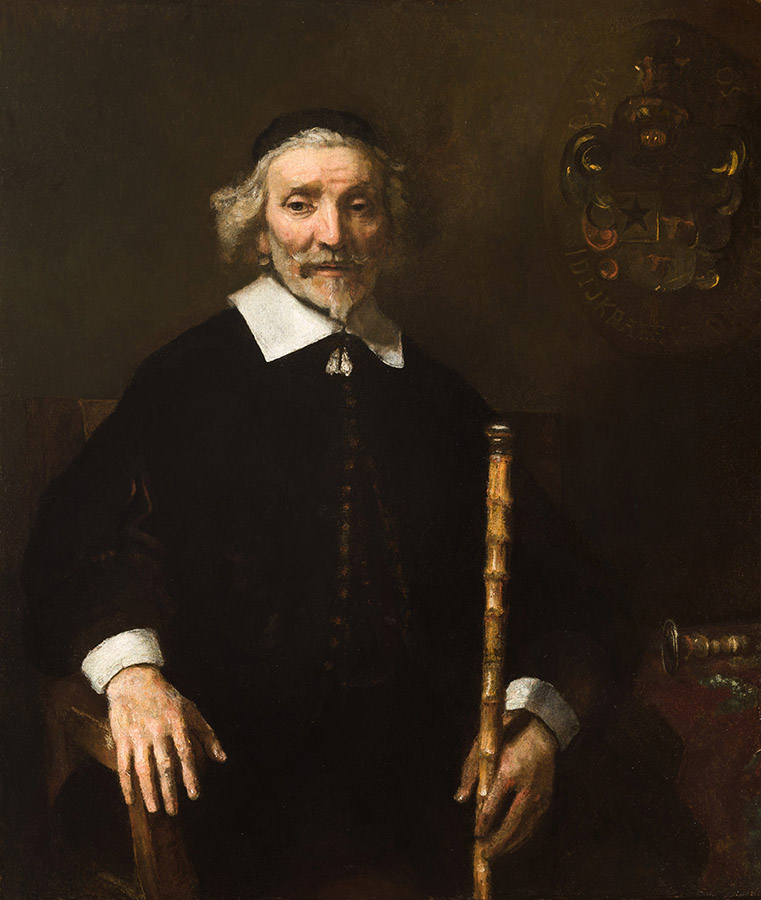
An old Amsterdam merchant's son sits with his cane, plain in black and white. For decades the painting was filed as the work of a pupil, until restorers stripped away later additions and found Rembrandt underneath.
The story behind the painting
The sitter is Dirck van Os III, who lived from 1590 to 1668 and was a prominent Dutch citizen. His father, also Dirck van Os, born in Antwerp in 1556 and died in Amsterdam in 1615, was a merchant, insurer, financier and shipowner, and one of the founders of the Compagnie van Verre, the Amsterdam Exchange Bank and the Dutch East India Company. Rembrandt painted the son late in his own career, around 1658, when Dirck was an elderly man in his late sixties.
What to look for
The canvas is about 101 by 86 cm. Van Os sits holding a cane in his left hand, wearing a black robe with white collar and cuffs and a cap. What you see today is plainer than what earlier owners saw. During restoration, conservators found that lace around the collar and a chain with a cross hanging from his neck were later additions, not Rembrandt's, and they removed them. Look at the restrained contrast of black and white and at the weight of age in the seated figure.
Meaning and intent
Removing the lace and the cross brought the portrait back to the sober image of a Protestant merchant family. The museum's new frame follows the same idea. Its associate curator of European art described it as a restrained style that matches the conservative Protestant sensibility of the age and the strong mercantile culture of the Netherlands, which profited from importing exotic woods through the Dutch East India Company. The sitter's own father helped found that company, so the frame quietly links the man to his family's fortune.
Legacy
In 1898 a New York dealer bought the portrait from a private collector in St. Petersburg, and in 1899 it went to the Boston businessman Frederick Sears. The Joslyn Art Museum in Omaha acquired it in 1942. Long thought a Rembrandt, it was later reclassified as School of Rembrandt. In 2012 it went to Amsterdam, where Ernst van de Wetering and Martin Bijl, former head of restoration at the Rijksmuseum, studied and treated it and concluded it was a true Rembrandt. It was unveiled in 2014, and a new, less ornate frame replaced its gilded Louis XIV frame in 2016.
Schon gewusst?
- Painted by Rembrandt around 1658.
- The sitter's father helped found the Dutch East India Company.
- Reattributed to Rembrandt during conservation in Amsterdam from 2012.
- In the Joslyn Art Museum, Omaha, since 1942.
Über den Künstler
Rembrandt van Rijn (1606-1669)
Mehr von Rembrandt van Rijn
 Die Nachtwache - Rembrandt van Rijn (1642)
 Selbstbildnis - Rembrandt van Rijn (1659)
 Die Anatomie des Dr. Tulp - Rembrandt van Rijn (1632)
 Die Judenbraut - Rembrandt van Rijn (1660s)
 Der Sturm auf dem See Genesareth - Rembrandt van Rijn (1633)
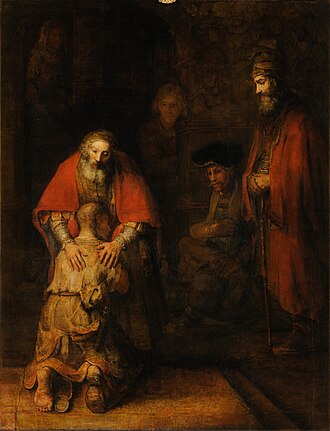 Die Rückkehr des verlorenen Sohnes - Rembrandt van Rijn (1668)
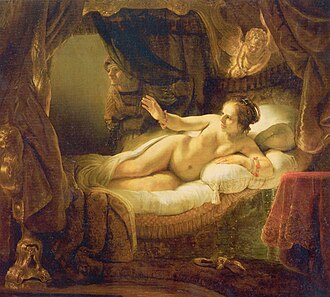 Danaë - Rembrandt van Rijn (1636)
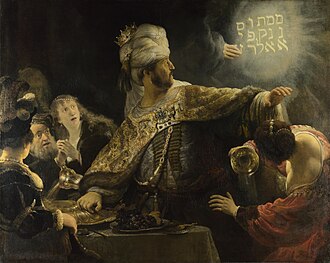 Das Gastmahl des Belsazar - Rembrandt van Rijn (1636)
Werke verwandter Künstler
 Das Mädchen mit dem Perlenohrgehänge - Johannes Vermeer (1665)
 Dienstmagd mit Milchkrug - Johannes Vermeer (c. 1658)
 Fest des hl.Nikolaus - Jan Steen (1660s)
 Mädchen mit Austern. - Jan Steen (1658)
 Ein Schütze einen Berkemeyer haltend, bekannt als „Der fröhliche Trinker" - Frans Hals (1620s)
 Der lachende Kavalier - Frans Hals (1624)
 Die Mühle von Wijk - Jacob van Ruisdael (1670)
 Judenfriedhof - Jacob van Ruisdael (1650s)
 Hof eines Hauses in Delft - Pieter de Hooch (1658)
 A Woman Peeling Apples - Pieter de Hooch (1663)