Portrait of a Woman Wearing a Gold Chain
Rembrandt van Rijn · 1634
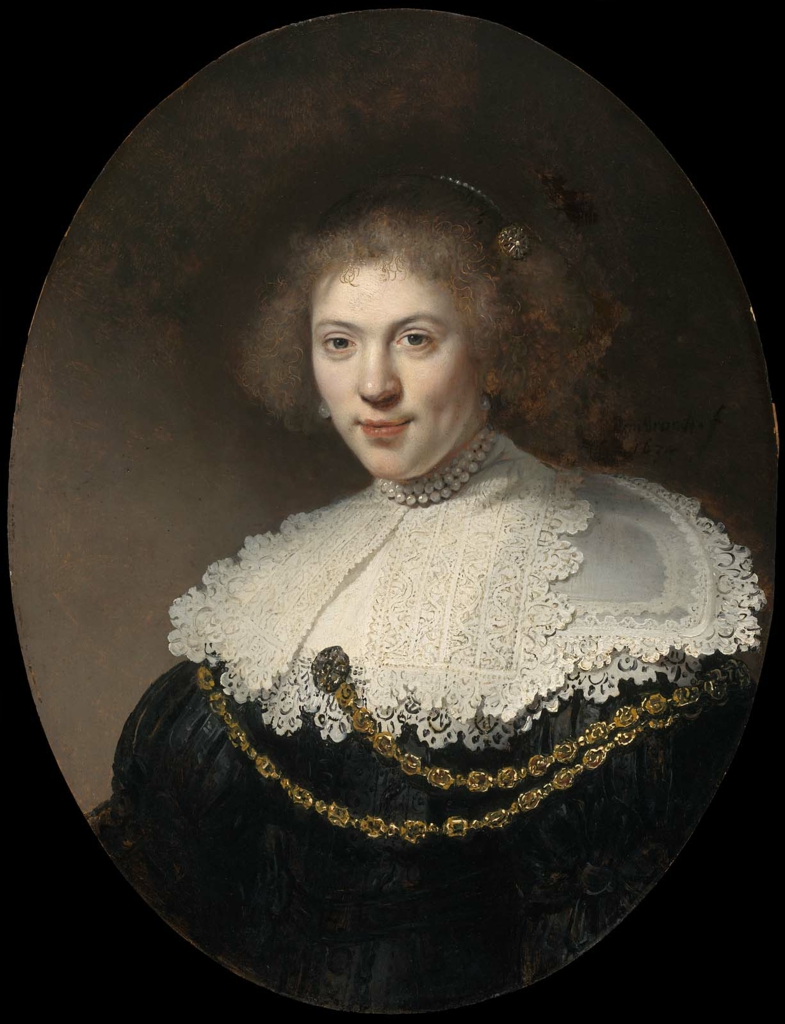
A young woman with a pale, delicate face smiles out of an oval frame, a long gold chain looped twice across her shoulders. Her name was once thought known; today it is a question.
The story behind the painting
Rembrandt's oval portrait on oak panel is dated 1634 and belongs to the Museum of Fine Arts, Boston. It has a pendant, a portrait of a man, and both have been attributed to Rembrandt since the 19th century, although the Rembrandt Research Project has raised doubts. Many oval portraits of women from 17th century Amsterdam survive; some were made as pairs and some stood alone. The sitter was once identified as Margaretha de Vlaming van Oudtshoorn, second wife of Nicolaes Tulp, but Hofstede de Groot already recorded that name only as a former identification.
What to look for
Hofstede de Groot saw a woman of about twenty-five, half-length and life size, without hands. She leans slightly left and looks straight out, with a pale, delicate complexion and an amiable expression. Her short, fair, curly hair holds a rosette on the left and a pearl comb behind it. A triple string of pearls circles her neck, a pearl hangs in each ear, and she wears a black gown with slashed sleeves. The long gold chain is wound twice across her bosom and shoulders and fastened with a rosette to her triple lace collar. Light falls fully from the left against a greenish-grey ground.
Meaning and intent
The source opens by calling her smiling, and that warmth is what sets the picture apart from more formal portraits. Her flat, layered lace collar follows a style worn in the 1630s and 1640s alongside the stiff millstone ruff, so even her dress places her in a precise moment of Amsterdam fashion. The pearls, chain and rosettes speak of wealth, yet the face stays gentle and open. Compare it with Rembrandt's Oval Portrait of a Woman from the same period to see how the two collar styles lived side by side.
Legacy
The panel passed through the collections of Baron de Seillière and the Princesse de Sagan in Paris; she sold it in 1891 to Cottier, a dealer in New York. It then belonged to Frederick Ames of Boston, and his widow gave it to the museum in 1893 in his name, together with its pendant. Hofstede de Groot catalogued it in 1914 as number 848, A Young Woman with a Triple Lace Collar. Its attribution remains debated, but the pair has stayed together in Boston for more than a century.
Schon gewusst?
- Oval oak panel, dated 1634.
- Formerly identified as Margaretha de Vlaming van Oudtshoorn.
- Given to the Museum of Fine Arts, Boston in 1893 with its pendant.
- The Rembrandt Research Project has raised doubts about the attribution.
Über den Künstler
Rembrandt van Rijn (1606-1669)
Frau · Porträt · Museum of Fine Arts Boston
Mehr von Rembrandt van Rijn
 Die Nachtwache - Rembrandt van Rijn (1642)
 Selbstbildnis - Rembrandt van Rijn (1659)
 Die Anatomie des Dr. Tulp - Rembrandt van Rijn (1632)
 Die Judenbraut - Rembrandt van Rijn (1660s)
 Der Sturm auf dem See Genesareth - Rembrandt van Rijn (1633)
 Die Rückkehr des verlorenen Sohnes - Rembrandt van Rijn (1668)
 Danaë - Rembrandt van Rijn (1636)
 Das Gastmahl des Belsazar - Rembrandt van Rijn (1636)
Werke verwandter Künstler
 Das Mädchen mit dem Perlenohrgehänge - Johannes Vermeer (1665)
 Dienstmagd mit Milchkrug - Johannes Vermeer (c. 1658)
 Fest des hl.Nikolaus - Jan Steen (1660s)
 Mädchen mit Austern. - Jan Steen (1658)
 Ein Schütze einen Berkemeyer haltend, bekannt als „Der fröhliche Trinker" - Frans Hals (1620s)
 Der lachende Kavalier - Frans Hals (1624)
 Die Mühle von Wijk - Jacob van Ruisdael (1670)
 Judenfriedhof - Jacob van Ruisdael (1650s)
 Hof eines Hauses in Delft - Pieter de Hooch (1658)
 A Woman Peeling Apples - Pieter de Hooch (1663)